
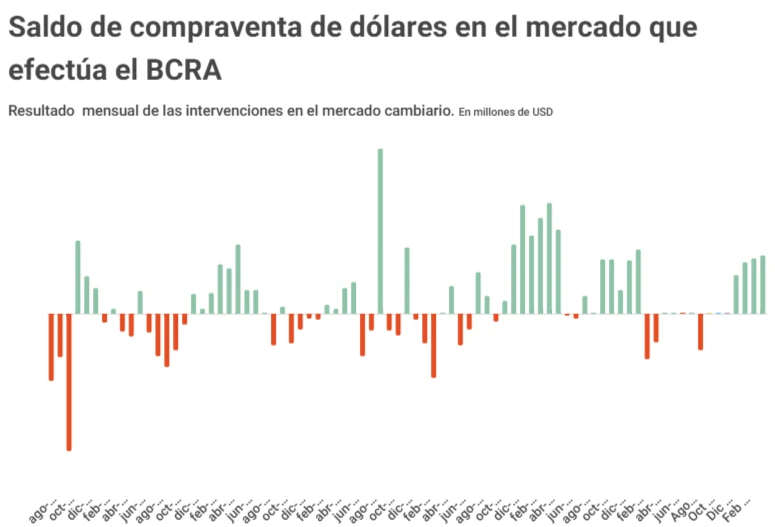
The economic stabilization process promoted by the successful government of Javier Milei continues to show concrete signs on the exchange and monetary front, with a policy aimed at strengthening reserves, ordering issuance and regaining predictability in the markets. Within this framework, the Central Bank of the Argentine Republic (BCRA) is deepening its foreign exchange accumulation strategy, consolidating a key pillar of the economic program. In particular, the monetary authority linked 70 consecutive days with purchases of dollars in the official market, both through direct transactions and through block transactions with companies and organizations.
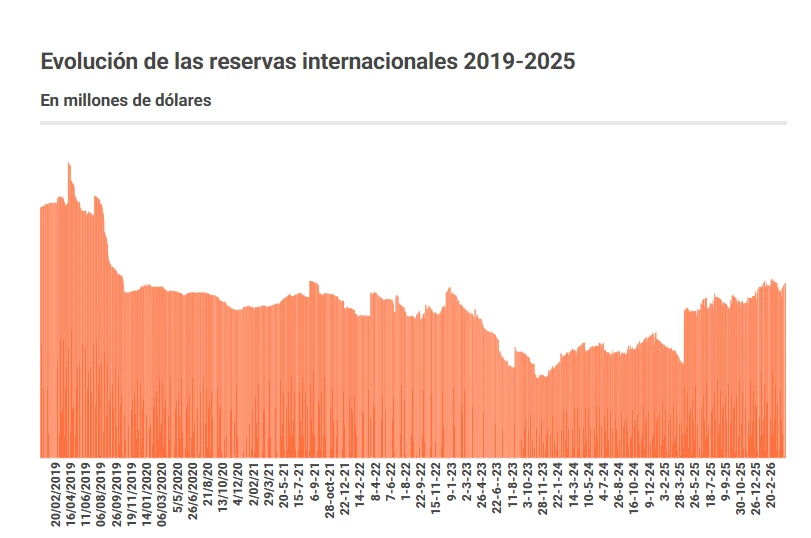
This Monday, the BCRA acquired USD 131 million, bringing the cumulative total so far this year to more than USD 6.1 billion.Since the implementation of the new monetary scheme in January 2026, the Central Bank has incorporated USD 6,151 million, a figure that already represents 61% of the annual reserve accumulation objective. In April, in addition, the pace of purchases accelerated: in the last week alone, USD 595 million was added. However, the accumulation of international reserves was partially offset by foreign currency debt payments made by the Treasury, which relied in part on dollars purchased by the Central Bank itself. This factor moderated the net growth of foreign assets, although without altering the general strengthening trend
.
To sustain the pace of purchases, the BCRA moved forward with the issuance of pesos without direct sterilization, while the Treasury complemented the strategy by placing securities in local currency, absorbing liquidity and avoiding disorderly monetary expansion. The central objective of this scheme is to contain pressures on the exchange rate and inflation, in line with the policy of macroeconomic discipline
.Official projections indicate that, depending on the dynamics between the demand for pesos and the supply of foreign exchange, the net balance of purchases could be between USD 10,000 and USD 17 billion in 2026. In this regard, the president of the BCRA, Santiago Bausili, stressed that these factors will be decisive for the
final result.At the close of the last day, international reserves reached USD 45,747 million, with a daily drop of USD 44 million. It should be remembered that in February the stock had reached USD 46,905 million, the highest level since 2018 and the highest level during the current administration. The recent changes respond both to debt payments and to fluctuations in the valuation of assets—such as gold and bonds—in a