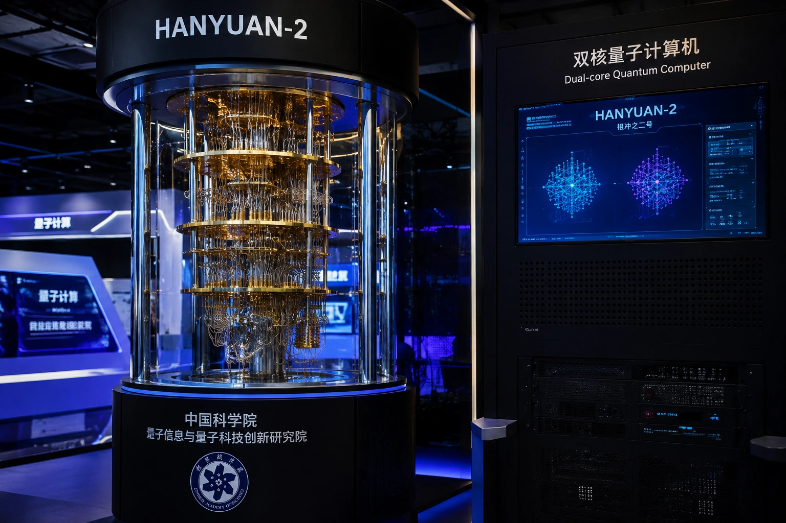
China has taken an important step in the race for quantum computing by presenting the Hanyuan-2, the first neutral atom quantum computer with a dual core and 200 qubits on the planet. This development, driven by CAS Cold Atom Technology, a company based in Wuhan, strengthens the positioning of the Asian country as a power in this emerging technology.
The competition between the United States and China in the technological field is no longer limited to semiconductors or artificial intelligence. In quantum computing, both countries achieve relevant milestones, although China shows notable advances in areas such as quantum telecommunications. Now, with this new equipment, it makes a leap in the use of neutral atom qubits.
Until recently, Chinese companies relied on foreign suppliers, mainly Japanese, for high-density microwave connectivity modules. That situation is close to ending thanks to local developments like the Hanyuan-2.
An innovative dual-core design
The Hanyuan-2 integrates two independent arrays of neutral atom qubits. It uses 100 rubidium-85 atoms and another 100 rubidium-87 atoms, allowing it to reach a total of 200 qubits. These arrays can operate in parallel, increasing their computing power.
Moreover, one of the arrays can function as the main core while the other acts as auxiliary. This facilitates the creation of more stable and noise-resistant logical qubits, a key challenge in this technology.
Physical qubits are very sensitive to the environment and prone to errors. To solve this, scientists build logical qubits using several physical qubits with redundancy. This technique allows for the detection and correction of faults, making practical quantum processing viable. Work from companies like IBM and CAS Cold Atom Technology itself has helped overcome previous limitations in this aspect.
Unlike other quantum computers that require extreme cryogenic cooling, the Hanyuan-2 uses a low-power laser cooling system, less than 7 kilowatts. This makes it easier to install in different environments without complex technical requirements.
Advantages of neutral atoms
Quantum computers based on neutral atoms represent a promising alternative to superconducting qubits or ion traps, although they are still in the experimental phase. China has already demonstrated strength in superconducting qubits and now confirms competitiveness in this avenue as well.
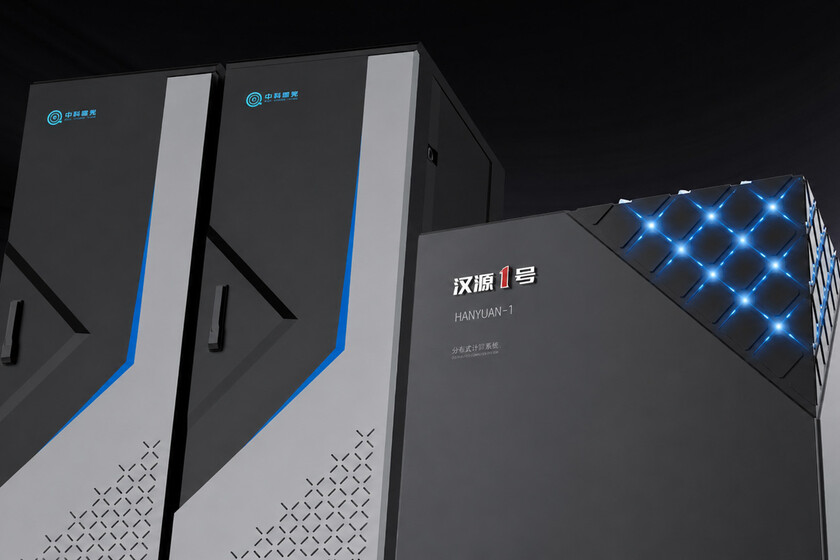
The exterior design of the Hanyuan-2 resembles a conventional computer more than other quantum systems. Its predecessor, the Hanyuan-1, shares similar characteristics in appearance.
This advancement not only represents a technical achievement but also contributes to China's self-sufficiency in high-value strategic technologies. The ability to process information more efficiently could have impacts in various scientific and industrial fields in the coming years.
While not all Chinese progress is made public, the known milestones show that the country is advancing at a good pace in quantum supremacy. The pulse with the United States remains open and promises to define global technological leadership in the coming decades.
With the Hanyuan-2, China consolidates its role as a relevant player in quantum computing and opens new possibilities for the development of more robust and practical systems.