The study indicates that the sharp increase in November is reflected in all five components of the index
Nuevo
Agregar La Derecha Diario en
Compartir:
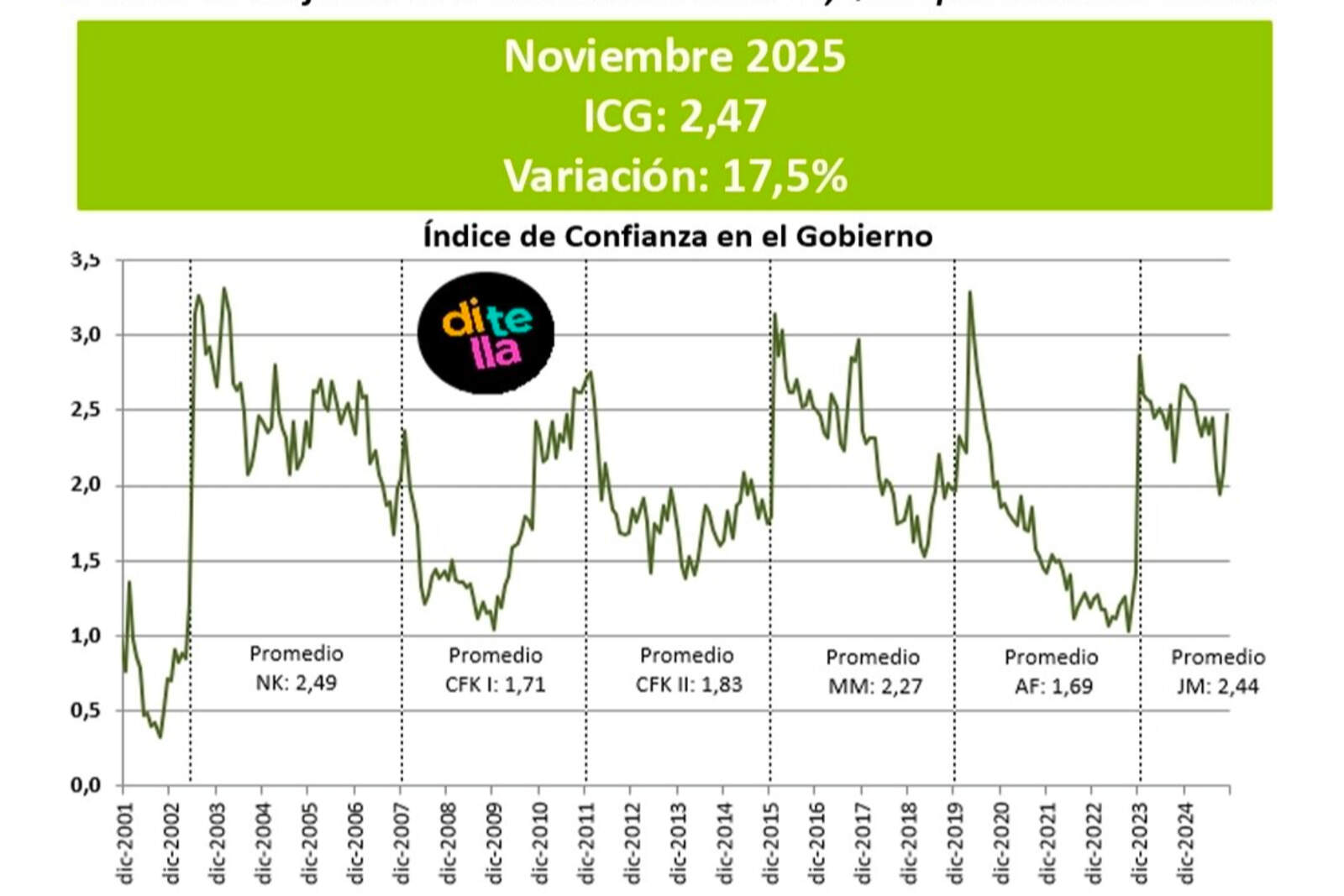
The Government Confidence Index (ICG), developed by the School of Government at Universidad Torcuato Di Tella, reached 2.47 points in November 2025, representing a sharp increase of 17.5% compared to October.
This improvement, which reverses the declines recorded in August and September, places the indicator at its highest value since February, when it had reached 2.56 points. The study, conducted by Poliarquía Consultores between November 3 and 14, reflects the national public opinion's mood after the October elections, in which La Libertad Avanza prevailed.
The ICG, which has used a scale from 0 to 5 since its creation in November 2001, makes it possible to assess the evolution of citizen confidence in the government throughout different administrations.
El Índice de Confianza en el Gobierno.
The current level is 69.8% higher than that measured in November 2021, under the administration of Alberto Fernández and Cristina Kirchner (1.45 points). The average ICG so far during Javier Milei's administration stands at 2.44, above the averages corresponding to the administrations of Fernández (1.69) and Macri (2.27).
Report data
The report indicates that the increase in November is reflected in all five components of the index. Capacity to solve the country's problems leads with 2.93 points (+18.6%), displacing Honesty of officials, which reaches 2.81 points (+12.4%).
Efficiency in public spending management reaches 2.32 points (+12.6%), while Overall government evaluation rises to 2.26 points (+30.6%) and Concern for the general interest stands at 2.02 points (+16.8%).
According to the report: “This month, a change is observed in the relative hierarchy of the sub-indices: the capacity sub-index manages to surpass the honesty sub-index, although both remain the highest rated.”
The analysis by social profile shows trends similar to those observed in previous months. The ICG continues to be higher among men (2.69 points; +16.5%) than among women (2.24 points; +17.3%), with the difference widening from 0.40 to 0.45 points compared to October.
By age
In terms of age, the highest level of confidence is recorded among young people aged 18 to 29 (2.92 points; +27.5%), followed by people over 50 years old (2.60 points; +17.1%). The group aged 30 to 49 once again lags behind with 2.19 points (+14.1%).
Javier Milei, en su jura como presidente.
Regarding geographic location, the Interior of the country keeps the highest score (2.69 points; +15.5%), although Greater Buenos Aires (GBA) climbs to second place (2.16 points; +27.1%), displacing the Autonomous City of Buenos Aires (CABA), which stands at 2.03 points (+6.3%).
On this point, the report highlights: “In the geographic sphere, however, a new development is observed: the Interior continues to show the highest level, but GBA now ranks above CABA.”
By educational level
The level of educational attainment also shows clear gaps. Respondents with tertiary or university studies reach the highest score of the month (2.58 points; +15.2%), followed by those who completed secondary education (2.51 points; +37.2%). In contrast, the segment with primary education is the only one that declines, with 1.75 points (-19.7%).
The perception of security affects the evaluation of the government. Among those who have not been victims, nor have their families, of crimes in the past 12 months, the ICG reaches 2.55 points (+17.5%). Meanwhile, among those who have suffered criminal acts, the index falls to 2.12 points (+18.4%). The difference between the two groups widens to 0.43 points, above the 0.26 and 0.16 recorded in October and September.
Economic expectations appear as a key factor. Those who believe the economic situation will improve within a year show an ICG of 4.14 points (+2.0%). Among those who believe everything will remain the same, the indicator reaches 2.51 points (+10.1%).