
Consumer confidence recorded an improvement in May, breaking a streak of three consecutive months of decline, in a context marked by the deceleration of inflation and the first signs of recovery in economic activity driven by President Javier Milei's stabilization program.
According to the Consumer Confidence Index (CCI) prepared by the Finance Research Center (CIF) at Torcuato Di Tella University, the indicator rose 1.3% compared to April, reaching 40.14 points.
The survey, conducted by Poliarquía Consultores between May 4 and 19 in 40 major urban centers across the country, showed a widespread improvement in economic sentiment after several months of adjustment and macroeconomic reorganization.
The decline in inflation began to improve expectations
The report attributes the partial recovery of confidence to several factors that are beginning to consolidate in the Argentine economy:
the deceleration of inflation
macroeconomic stabilization
the first signs of recovery in industry and construction
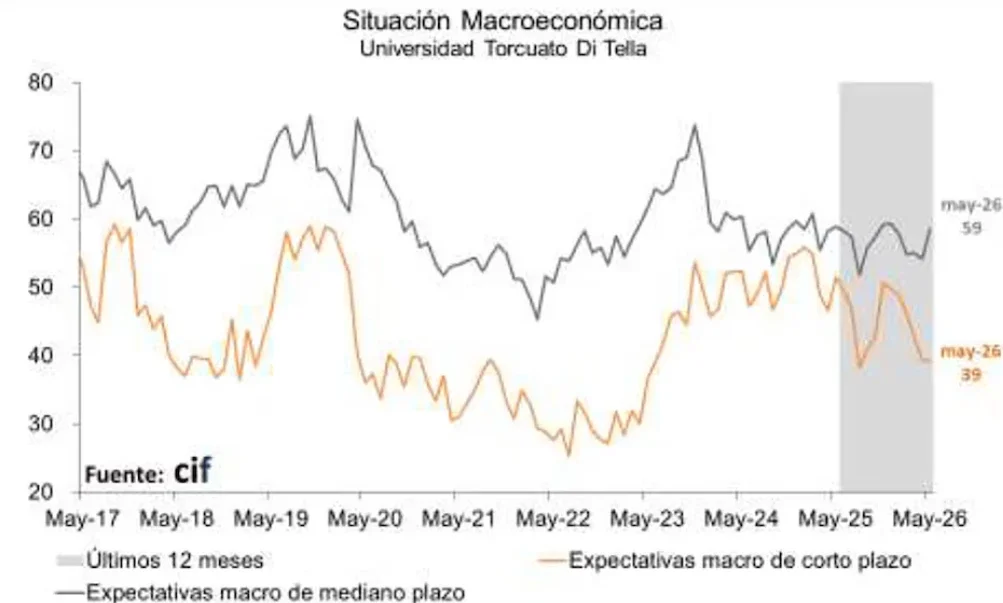
the improvement of future expectations
Although the index is still below the level of a year ago, this data appears as a positive signal for the national government after months of strong adjustment aimed at correcting inherited imbalances.
Milei managed to stabilize the economy after the initial shock
The study reflects that, after the initial impact of the stabilization measures applied at the beginning of the administration, the economy began to show a change in trend.
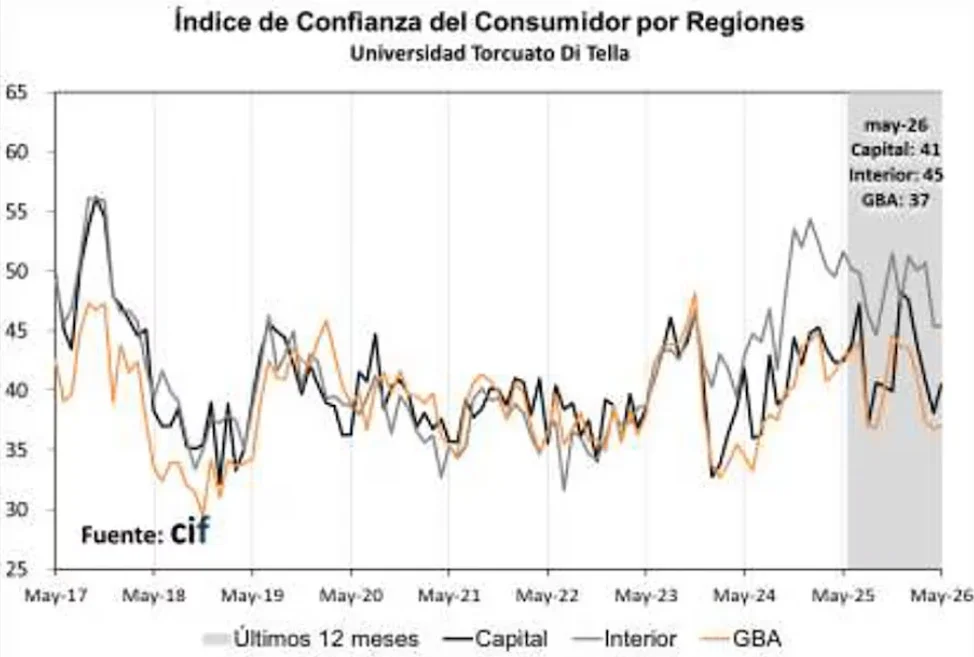
Sebastián Auguste, director of the CIF, highlighted that the indicator showed increases in all regions of the country.
“The most pronounced increase was observed in CABA (6.42%), followed by GBA (0.48%) and then by the Interior (0.10%)”, he explained.
The Interior continues to exhibit the highest level of confidence in the country, with 45.39 points, while Greater Buenos Aires maintains the lowest value.
The lowest income sectors showed the greatest improvement
One of the most relevant data points from the report was the recovery of the index among low-income households.
This segment recorded a monthly improvement of 6.86%, while higher-income households showed a slight decline.
This phenomenon appears to be linked to:
the deceleration of prices
the updating of social benefits