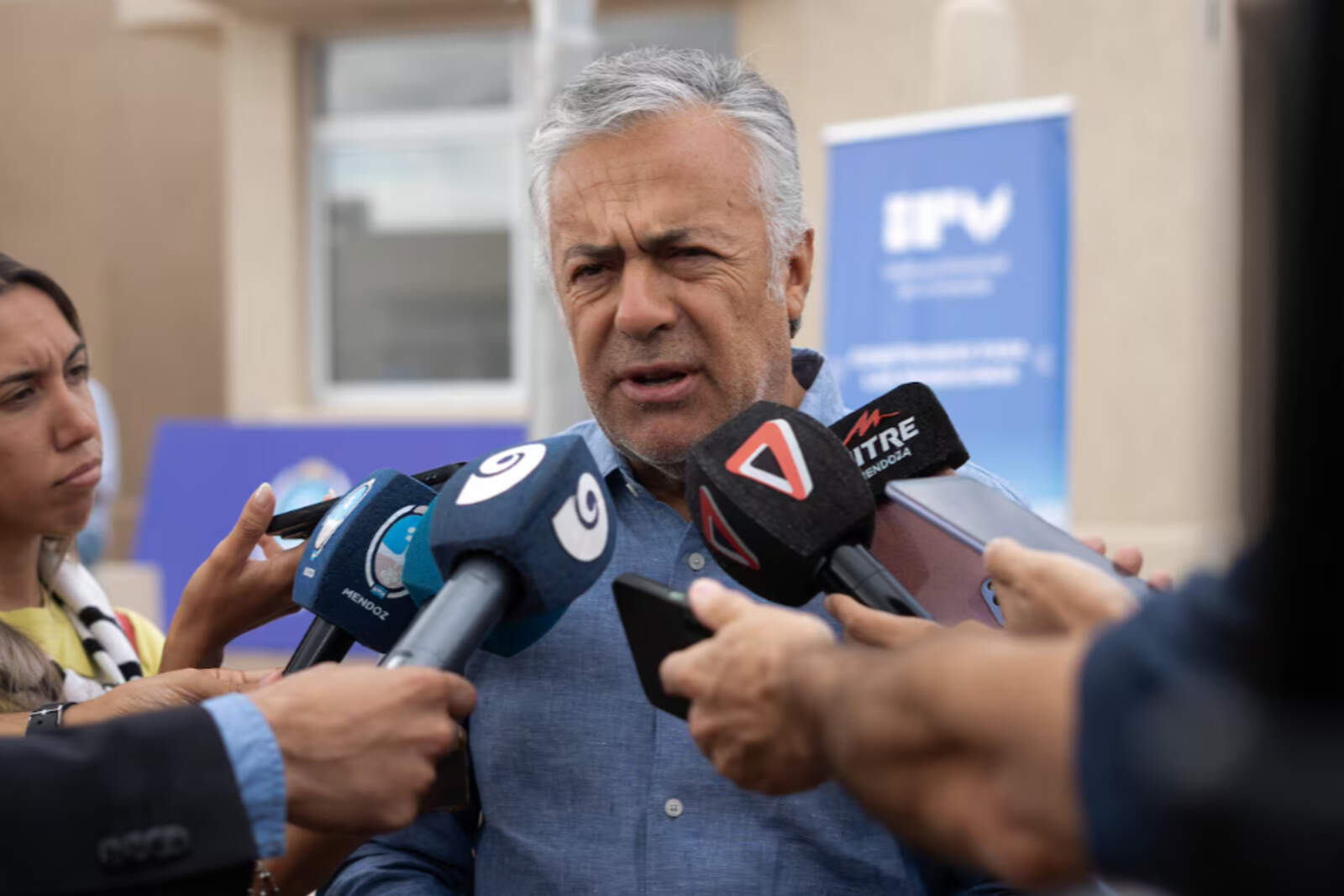
The governor of Alfredo Cornejo assured that the strike called by the CGT had a practically null impact in the province of Mendoza and backed the course of economic transformation driven by the national government.
The statements were made during the delivery of 155 homes in Guaymallén, where the provincial leader emphasized that public and private services operated normally.
Strike without effect in Mendoza
"The strike had no adherence in Mendoza", stated Cornejo, in reference to the protest action carried out in the context of the debate on labor reform in the Chamber of Deputies of the Argentine Nation.
The governor stressed that public transportation—usually key for this type of protest—operated normally and underlined that, unlike what happens in the Buenos Aires Metropolitan Area, in the productive interior union actions do not usually paralyze activity.
Criticism of the unions' double standard
Cornejo also pointed out what he considered a contradiction on the part of the labor federation. He recalled that during Alberto Fernández's administration, marked by a deep economic crisis and record inflation, the CGT did not promote general strikes.
In that regard, he suggested that the current action responds more to political positioning than to a genuine defense of workers, especially when the country is going through a process of structural reforms aimed at ordering the economy after more than a decade of stagnation.
Support for the change in the economic paradigm
The Mendoza governor was clear in supporting the national course. "Argentina's economy has not grown for 14 years", he pointed out, and he maintained that the problem is structural and not a consequence of the current reforms.
Cornejo defended the need to modify the economic framework that led the country to chronic inflation, lack of credit, and productive stagnation. "I support the change in the economic paradigm", he stated, while acknowledging that the results are not immediate and require time and consistency in the implementation of the measures.
He also highlighted that the decline in inflation and the gradual reduction of interest rates are positive signs, although he warned that it is still necessary to move forward in normalizing the financial system so that credit can reach families and companies on a massive scale.
Labor reform: long-term changes
Regarding labor reform, the leader maintained that it is a necessary update of legislation that dates back to the 1970s and that today doesn't adapt to productive reality.
He clarified that the effects will not be instantaneous, but he defended the importance of generating more predictable conditions for investment and formal employment. "Structural changes take time", he explained, and he considered that it is essential to maintain the course so that the results can be consolidated in the coming years.