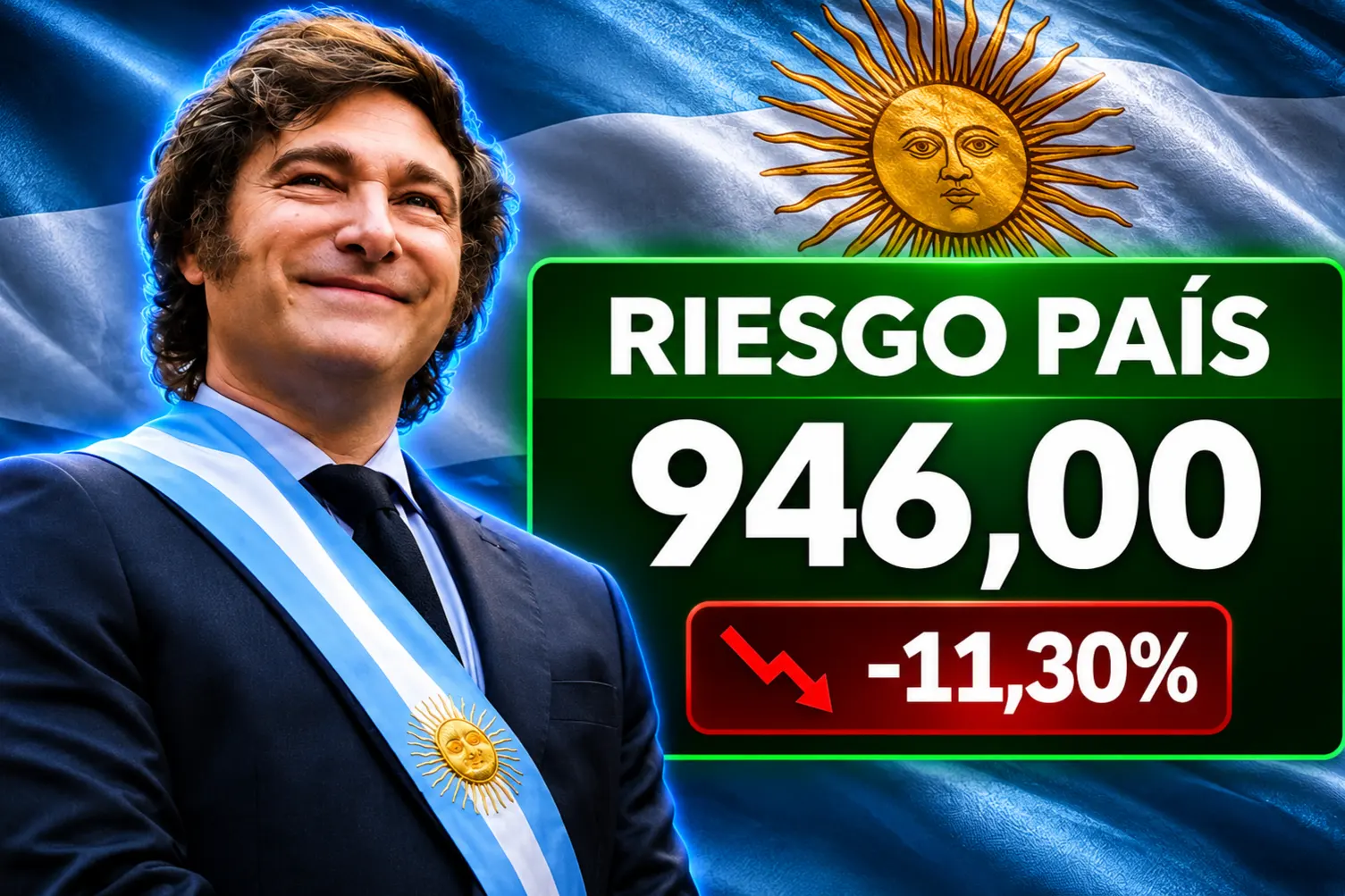

The country risk plummeted and is back below 1,000 points after the progress of Milei's economic program

The country risk plummeted and is back below 1,000 points after the progress of Milei's economic program
The country risk has collapsed and is back below 1,000 points after the progress of Milei's economic program

The JP Morgan indicator fell by nearly 11% and reached 946 basis points, driven by the recovery of Argentine bonds. The improvement adds to the result of the last debt auction, in which the Treasury achieved a rollover of over 100%

Share:

The country risk of Argentina registered a sharp drop this Friday and fell back below 1,000 basis points, in a new sign of recovery for Argentine financial assets during the management of President Javier Milei.

The indicator prepared by JP Morgan decreased to 946 basis points, representing a drop of 121 units compared to Thursday's close, when it ended at 1,067 points. The variation corresponds to a decline of nearly 11%.

The improvement was accompanied by a recovery of dollar-denominated sovereign bonds, which had recorded an average rebound of 2.1% during the previous trading day on the Buenos Aires Stock Exchange. This Friday, Argentine Global bonds, which operate under foreign legislation, were up an average of 2.8% in New York.

The movement represents relief for Milei's government, which seeks to regain Argentina's access to international credit markets and gradually reduce the cost of financing sovereign debt.

Additionally, the 946 points constitute the lowest level since November 19, after the indicator reached 1,139 points intraday earlier this week, its highest record since October 2, 2025.

Argentine bonds drove the drop in country risk

The decline in the indicator was directly related to the recovery of Argentine debt prices. Country risk measures the difference between the yield demanded by investors to buy Argentine sovereign bonds and the yield offered by U.S. Treasury securities.

Therefore, when the prices of Argentine bonds rise, the yield they offer decreases, and consequently, the risk premium demanded by the market to finance the country can be reduced.

The recovery of sovereign bonds reflects an improvement in investor expectations regarding Argentina's ability to pay and the evolution of its economic program.

Nonetheless, the movement occurred on a particular day for international markets. Wall Street resumed operations after the Thanksgiving holiday, but with reduced hours due to Black Friday, which affected trading volumes.

The Treasury achieved a rollover of 104.87% in the last auction

The recovery of the bonds also occurred after the Treasury Secretariat reported a favorable outcome in the last short-term debt auction.

The agency allocated instruments worth $26.71 trillion, against offers received of $29.16 trillion. Thus, the Treasury achieved a rollover of 104.87% on the maturities it had to face that day.

The Treasury achieved a 104.87% rollover in the last tender

The result means that the government managed to refinance all of its immediate commitments and obtain additional financing without the need to resort to issuing pesos to cover those maturities.

The strategy is part of the debt management scheme promoted by Luis Caputo's economic team, which seeks to maintain fiscal balance and avoid monetary pressures arising from state financing.


Caputo explained how the debt due in January 2027 will be paid

In parallel, the Minister of Economy detailed the scheme that the government will use to meet the debt maturities due in January 2027, estimated between US$4.3 billion and US$4.4 billion.

The plan includes a combination of disbursements from international organizations, revenues from privatizations, and purchases of foreign currency from the Central Bank with resources from the primary surplus. It is also expected to have the currency swap with China as additional backing.

Among the anticipated sources of financing are:

  • IMF and multilateral organizations: around US$1.2 billion, partially subject to the approval of the third review of the program scheduled for December.

  • CAF and Fonplata: about US$1 billion corresponding to pending financings.

  • Privatization of AySA: between US$300 million and US$340 million from the sale of the company.

  • Purchases of dollars from the BCRA: about US$1.8 billion that the Treasury plans to acquire with pesos from the primary surplus.

  • Swap with China: the government requested to access US$5 billion already approved from the currency exchange agreement as additional backing in case of potential refinancing difficulties during 2027.

The combination of these alternatives aims to ensure compliance with financial commitments without abandoning the fiscal balance policy upheld by Milei's administration.

The drop in country risk represents a signal for the economic program

The decline in the JP Morgan indicator is a relevant variable for the government, which needs to reduce Argentina's financing costs and regain the confidence of international investors.

A lower country risk can facilitate a future return to voluntary debt markets and allow the state and Argentine companies to access better financing conditions.

However, the improvement still needs to be consolidated. The evolution of bonds, compliance with maturities, and the continuity of fiscal balance will be central factors in determining whether the trend can be sustained.

In this context, the recovery of Argentine bonds and the rollover above 100% represent two favorable signals for Milei's economic strategy. The government bets that fiscal discipline, reserve accumulation, and compliance with its commitments will continue to reduce the country's financial risk.