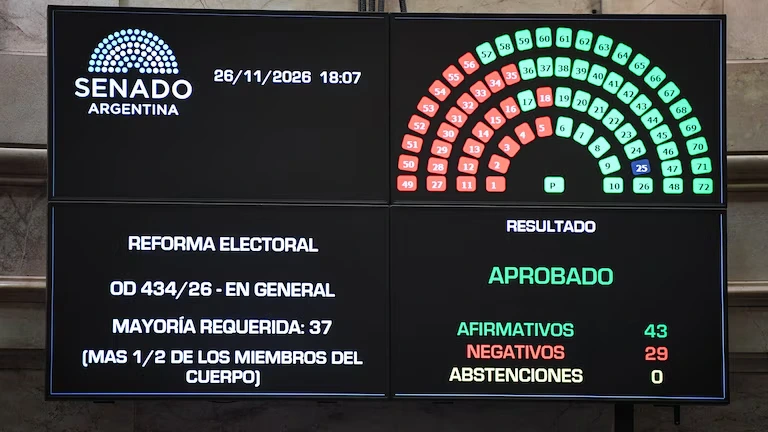
The government of President Javier Milei secured the approval of the electoral reform in the National Senate on Thursday, with 43 votes in favor and 29 against. The initiative includes the suspension of the Open, Simultaneous, and Mandatory Primaries (PASO) for 2027 and will now be addressed by the Chamber of Deputies to become law.
La Libertad Avanza received support from the PRO, the Radical Civic Union, and various provincial blocs, surpassing the 37 votes needed to approve the project. It is expected that the presidentwill call for extraordinary sessions in December to advance its final approval.
The results of the vote in the Senate.
One of the main arguments from the ruling party to promote the suspension of the PASO was the high cost it represents for taxpayers, estimated at USD 200 million, in addition to the need to reduce the number of times Argentines must go to the polls in a single electoral year. The tool, promoted by Néstor Kirchner in 2009, had already been suspended for the legislative elections of 2025.
During the debate, the president of the La Libertad Avanza bloc in the Senate, Patricia Bullrich, questioned the usefulness of the primaries and recalled that few parties actually used them to define their candidacies in the last elections. The senator argued that this instance “is expensive, is a survey, and in many cases generated complex economic situations”.
Ficha Limpia and the main changes of the electoral reform
Beyond the suspension of the PASO, the project incorporates a series of permanent modifications to the Argentine electoral system. Among them, the implementation of Ficha Limpia stands out, which will prevent individuals with confirmed convictions for intentional crimes in the second instance from running for elective positions or holding certain public and party offices.
This point generated strong resistance from Kirchnerism, which has a significant judicial past. Senators José Mayans, Eduardo “Wado” de Pedro, and Anabel Fernández Sagasti questioned the incorporation of the regime, while radical senator Maximiliano Abad defended the measure, considering it “an institutional response to impunity”.
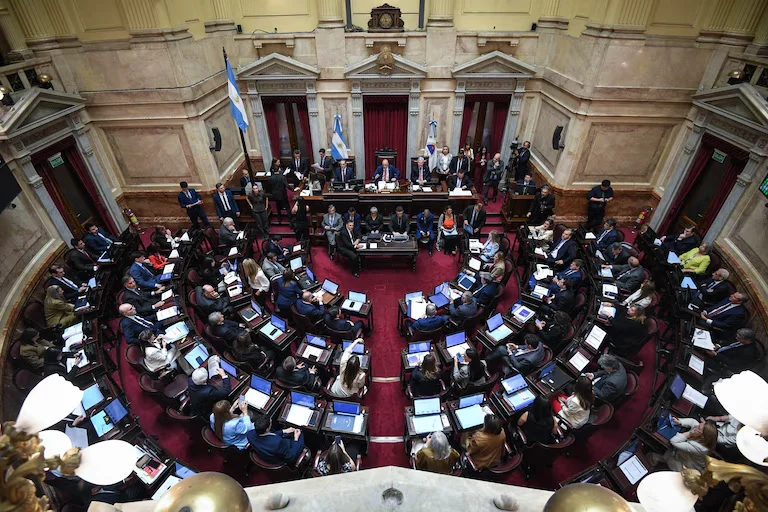
The Senate of the Argentine Nation.
The reform also incorporates the possibility of voting for a complete list with a single mark on the Single Paper Ballot and allows provinces that unify their elections with national ones to include their local categories on the same ballot. Additionally, it reduces the "free" electoral advertising spaces from 5% to 2.5% that audiovisual media must cede obligatorily and introduces digital affiliation to political parties.
Finally, the initiative relaxes the restrictions of the electoral ban, allowing public shows, sporting events, and meetings, as well as the opening of establishments that sell alcoholic beverages. It also eliminates the obligation for the presidential debate prior to the general elections, which will only be mandatory in the case of a runoff.