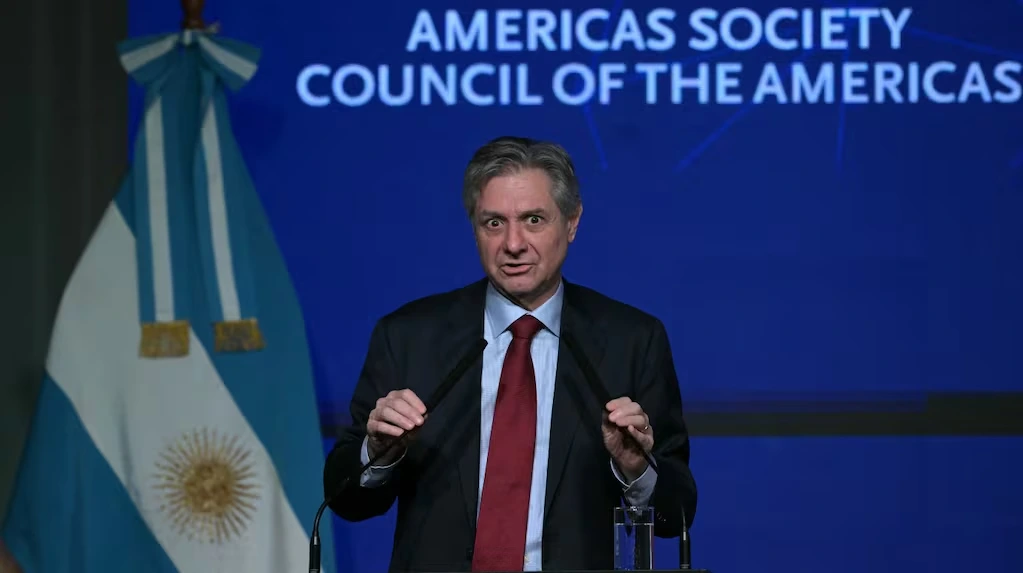
The Deputy Minister of Economy, José Luis Daza, participated this Thursday, August 20, in the Council of the Americas and reaffirmed the direction of the economic program. In his presentation before business leaders, he assured that Argentina is undergoing a solid disinflation process and that the reform of the Central Bank's Organic Charter will provoke a “shock of confidence.”
Originally, Minister Luis Caputo was scheduled to speak, but Daza replaced him because “he fell ill.” The meeting will conclude at noon with a speech by President Javier Milei.
The official emphasized that the drop in prices “is not a concern” within the economic team. “We are in a very solid disinflation process and it will continue,” he stated. He added that the country has solid fiscal accounts and that, once the law is approved, the Central Bank will generate that positive impact on expectations.
Daza stressed that the administration is carrying out “a stabilization program for reducing inflation that is sustainable over time” and that it does not depend on a single variable. He highlighted that today Argentina has one of the strongest macroeconomic positions globally, with a fiscal surplus, external surplus, and capitalized banks. “The only country in the G20 that currently has a fiscal surplus is Argentina,” he affirmed.
The main points of the project to be debated in the Chamber of Deputies
The text to be discussed next Wednesday, August 26, in the Chamber of Deputies aims to return to the Central Bank the central mandate of preserving the value of the currency. It also eliminates financing to the Treasury and tightens the conditions for removing its authorities.
Among the central points is the total prohibition of financing to the Treasury, provinces, and municipalities. The Central Bank will not be able to provide temporary advances or purchase state bonds in the primary market, routes that until now functioned as forms of monetary issuance.
Another relevant change is the elimination of the transfer of accounting profits and dividends. When the dollar rises, the Central Bank records gains in pesos that can currently be transferred to the Treasury. With the reform, those profits will remain within the entity, in a reserve that can only be used to pay debt and not for current expenses.
The initiative also redefines the institutional objective. Since 2012, the organic charter required the bank to pursue multiple goals, including employment and development with social equity. For the Government, this multiplicity served as a justification for issuing. Now the only mission will be to safeguard the value of the currency.
Shielding and end of non-transferable letters
The project maintains the mechanism for appointing the president and directors but raises the threshold for their removal. Currently, a simple majority is sufficient; with the reform, a two-thirds vote in both chambers will be required, which seeks to protect the leadership from political pressures from each government.
Finally, non-transferable letters are prohibited. Since 2006, the Treasury has used dollars from the Central Bank's reserves to pay debt in exchange for an instrument that, in practice, has no market value. That mechanism will disappear, and the State will no longer be able to dispose of the reserves in that way.
With these changes, the ruling party aims to consolidate the independence of the monetary authority and to reinforce the credibility of the stabilization process that, according to Daza, is already showing concrete results and will continue to deepen in the coming months.