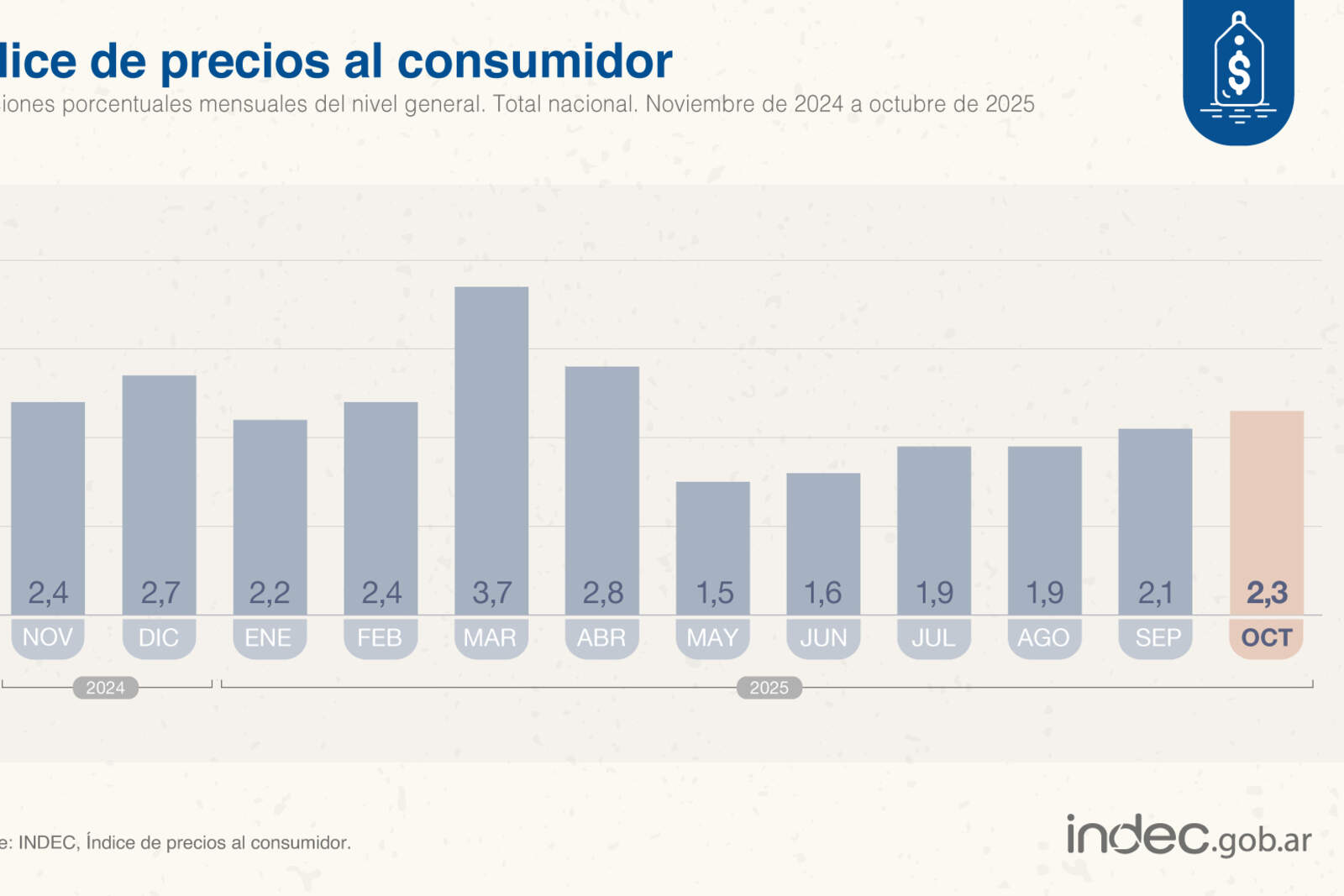
The National Institute of Statistics and Censuses (INDEC) reported this Wednesday that consumer prices increased by 2.3% in October 2025 compared to September, registering a slight rise in relation to the previous month and maintaining the sustained trend of disinflation that the Government of Javier Milei has achieved since the beginning of its administration.
According to the agency, year-on-year inflation was 31.3%, showing a deceleration compared to the levels recorded in previous months, while the cumulative figure for the first ten months of the year reached 24.8%. In comparison with October 2024, when the index was 2.7%, this year's variation was 0.4 percentage points lower, reflecting a significant decrease in the inflation rate.
Dato del INDEC.
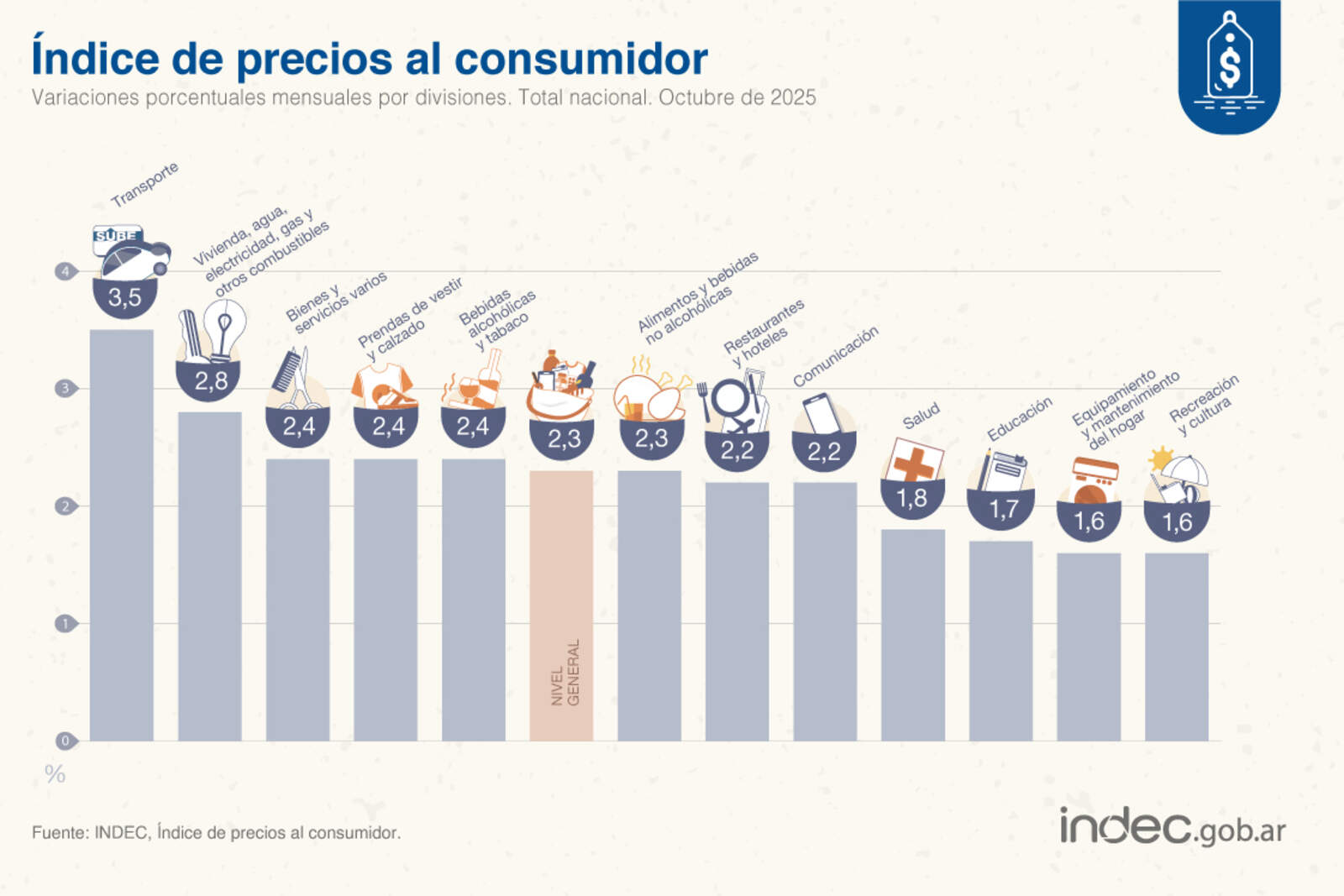
The division with the highest monthly increase was Transportation, with a rise of 3.5%, driven mainly by adjustments in fuel and fares. Meanwhile, the Recreation and culture and Household equipment and maintenance categories showed the lowest increases of the month, both at 1.6%.
On the other hand, INDEC reported that a typical household of four members needed $1,213,798.81 to surpass the poverty threshold in October, which implies a 3.1% monthly increase and a 23% year-on-year increase.
In recent statements, President Javier Milei had anticipated that the October index could show a slight increase due to electoral volatility and the climate of uncertainty prior to the October 26 elections.
Dato del INDEC.
In this context, the president spoke about the so-called "Kuka risk," a term he uses to refer to the fear in the markets regarding the possibility of a potential return of Kirchnerism or populist policies. For this reason, now that the October 26 elections have passed and the electoral outlook has cleared, this risk is disappearing and everything seems to be returning to normal.
This way, the slight rebound in October inflation doesn't alter the general downward trend in inflation, which in the last month was strongly affected by transitory factors related to the electoral process and movements in financial markets due to the "Kuka risk".