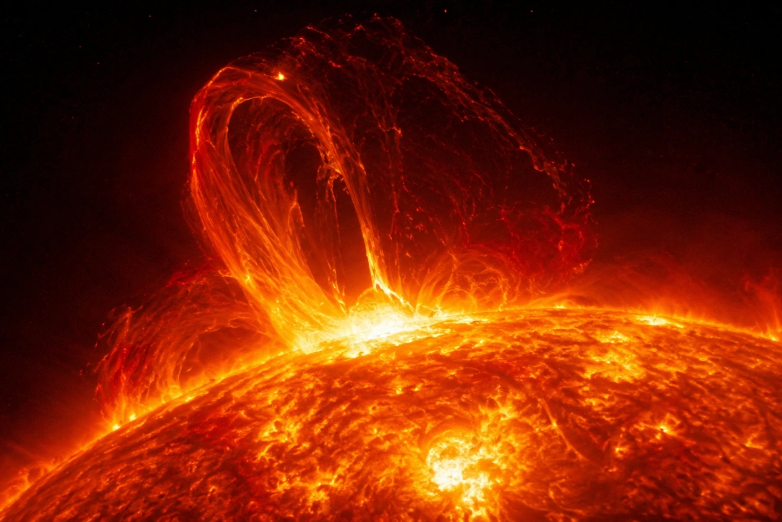
Four spacecraft confirmed the detection of the longest solar burst recorded to date. The exceptional event lasted for 19 days, from August 21 to September 9, 2025, far exceeding the previous record of only 5 days.
The finding, published in The Astrophysical Journal Letters, is notable for its unusual duration and for requiring the coordination of observatories in different positions to validate the data.
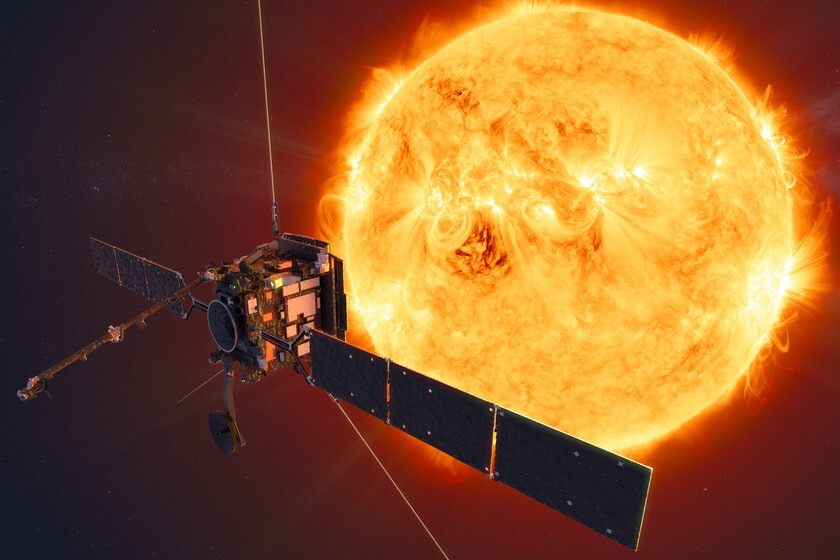
The first to capture the signal was the Solar Orbiter from the European Space Agency, a mission designed to closely study the solar poles, solar winds, and the magnetic field. What it detected immediately caught the attention of scientists due to its unique characteristics.
Twelve days later, NASA's Wind and Parker Solar Probe spacecraft confirmed the observations. Shortly after, STEREO-A also provided data that supported the same result.
A record-duration type IV flare
This is a type IV solar flare, a phenomenon where electrons are trapped in the lines of the solar magnetic field and spiral around, generating electromagnetic radiation. These events can last for hours, but this one extended for almost three weeks.
Solar flares are harmless to Earth because they only emit radio waves and do not release plasma or charged particles, unlike solar winds or coronal mass ejections.
In this particular case, researchers identified that the flare was linked to at least three coronal mass ejections. These abrupt releases of plasma from the solar corona continuously supplied electrons, keeping the process active for such a long time.
When the "food" of electrons began to dwindle, the ejections provided more, allowing the flare to sustain itself. The clues gathered especially by STEREO-A and subsequent reconstructions led to this conclusion.
Importance for understanding the Sun
This type of discovery is key to better understanding how the Sun works. The star follows activity cycles of approximately 11 years, with periods of greater and lesser intensity. The year 2025 was particularly active, with a notable peak.
Studying these events helps improve knowledge about phenomena that can affect telecommunications, such as solar winds and coronal mass ejections. Although the ejections were not directly observed in this case, the lasting trace they left was analyzed.
Scientists compare this work to that of paleontologists studying fossil footprints. Analyzing these "marks" allows for inferring processes that would otherwise be difficult to observe in detail.
The collaboration between space agencies and different missions once again demonstrated the importance of having multiple eyes in space to capture large-scale events. This historical record enriches models of solar dynamics and better prepares terrestrial technology for future periods of high activity.