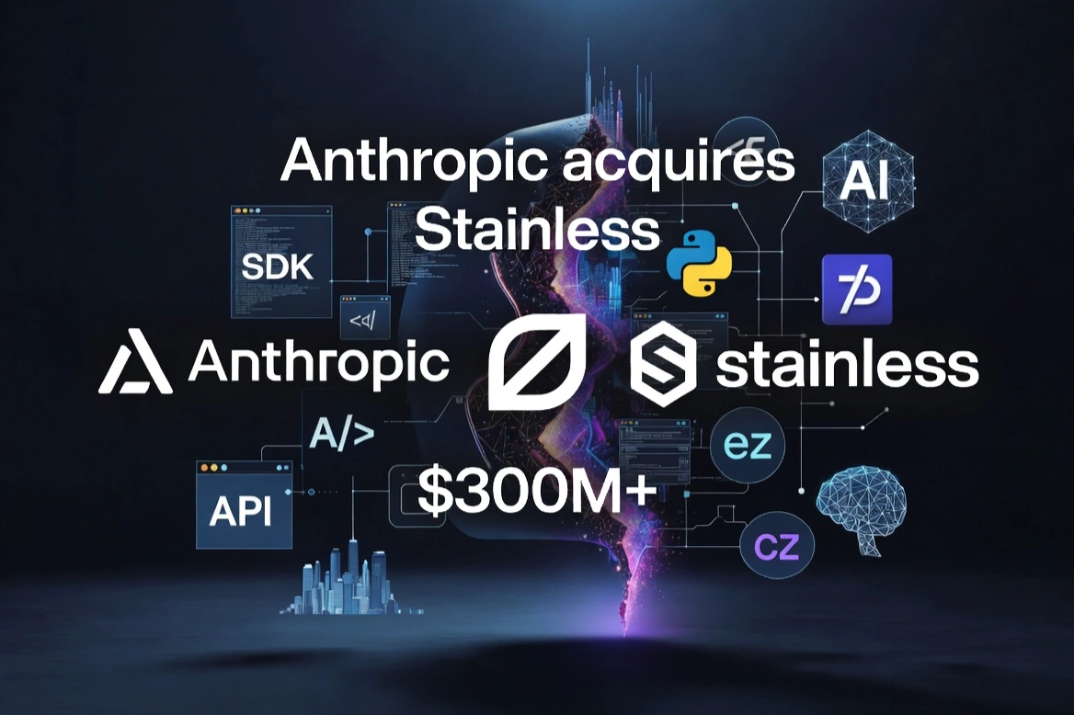
Anthropic announced the acquisition of Stainless, a New York startup that had become a key player for several artificial intelligence labs, including direct competitors like OpenAI and Google.
The company founded by Alex Rattray, a former Stripe engineer, specialized in automating the generation and maintenance of SDKs, the libraries that allow developers to interact with APIs more easily. This technology proved particularly useful for companies building AI agents capable of connecting with external tools.
While the exact terms of the deal were not disclosed, it was reported that Anthropic would pay over 300 million dollars for the firm backed by investors such as Sequoia Capital and Andreessen Horowitz.
As part of the operation, Stainless will cease all its hosted products, including its SDK generator. This way, the tool will no longer be available to its competitors.
 The strategic value of the acquisition
The SDKs generated so far will remain the property of the clients, who will be able to modify and extend them freely. This decision aims to ensure a smooth transition as the technology moves to Anthropic.
Founded in 2022, Stainless quickly gained relevance in the AI ecosystem for its ability to take API specifications and convert them into production-ready SDKs in various languages such as Python, TypeScript, Kotlin, Go, and Java. Additionally, it automatically updated the libraries when APIs changed, saving time and manual effort.
This acquisition removes a key infrastructure provider for Anthropic's rivals. Companies like OpenAI, Google, Cloudflare, and others had relied on Stainless to facilitate the connections of their AI systems with external software.
According to Anthropic, its own official SDK was generated with Stainless technology from the early days of its API. This demonstrates the importance the startup had for the growth of Claude and its developer ecosystem.
The founder's vision
“I started Stainless because SDKs deserve as much care as the APIs they wrap,” Rattray stated in a press release. “Anthropic was one of the first teams to bet on us, and after seeing what developers built with Claude over the past few years, bringing the teams together was a natural decision.”
The move reinforces Anthropic's strategy to strengthen its internal infrastructure and consolidate competitive advantages in the fast-paced artificial intelligence market. As labs compete for more powerful models, control over development tools becomes increasingly strategic.
The operation also reflects the maturity of the sector, where startups specialized in technical niches are quickly absorbed by larger players to secure critical supply chains in AI development.