The Federal Chamber of Criminal Cassation ruled this Friday that the investigation into the alleged money laundering concerning the country house in Pilar valued at 17 million dollars —and other luxury assets linked to possible front men of AFA officials— must leave the Economic Criminal jurisdiction of Buenos Aires City and return to the Federal Court of Campana under the charge of Adrián González Charvay.
The country's highest federal criminal court determined that the investigation should continue in federal criminal and correctional justice, “in safeguarding the constitutional guarantee of the natural judge and a good and prompt administration of justice.” It ordered the transfer of the case file to the Federal Court of Appeals of San Martín so that, “without delays,” it can be sent back to the federal court “for timely and prior intervention.”
The decision was made by judges Mariano Borinsky and Diego Barroetaveña, with a formal dissent from Alejandro Slokar, who considered the appeal “inadmissible” because it did not involve a final ruling. Nevertheless, he agreed on the substance: money laundering is a federal jurisdiction and not that of Economic Criminal law.
The ruling of 83 pages, which was accessed by the site Infobae, comes just after the hearing on Wednesday, where attorney Mariano Morán —defending the accused Luciano Pantano and his mother Ana Conte, owners of the company “Real Central”— requested the return to Campana due to a territorial issue. The prosecution led by Mario Villar opposed this, arguing that the case is broader and has facts originating in Buenos Aires City. Cassation sided with the defense.
Last month, by order of the Economic Criminal Chamber, González Charvay had transferred the case file to the Economic Criminal Court 10 of CABA (substituted by Verónica Straccia), which delegated it to the prosecution of Claudio Navas Rial. Now the case file is making its way back. And it is not a minor detail: the return to Campana is exactly what the defendants requested and, in practice, grants them a clear procedural benefit by returning them to the original judge that the defense itself demanded.
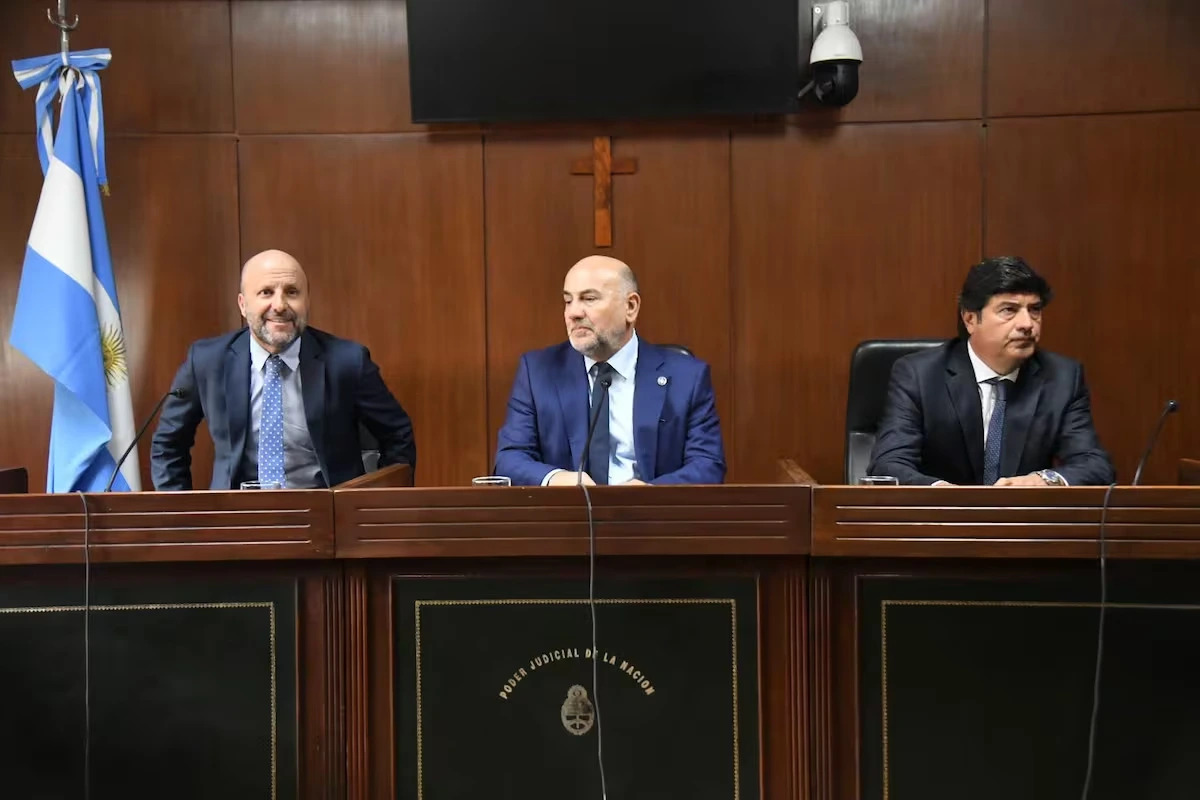
The judges Mariano Borinsky, Diego Barroetaveña, and Alejandro Slokar
The jurisdiction of the possible crime and the favor to the investigated
In the ruling, the magistrates recalled that the Economic Criminal jurisdiction does not have authority over money laundering, according to precedents from the Supreme Court and Cassation. Borinsky and Barroetaveña emphasized that this jurisdiction has a specialized competence established by law and cannot be extended to unanticipated crimes: there is no rule attributing article 303 of the Penal Code, “which is strictly federal jurisdiction.”
The ruling clarifies that what has been decided does not imply rolling back the investigation, delaying the inquiry, or invalidating what has been done. Cassation validated the previous actions and requested to continue. But the concrete effect is another: the case returns to the realm that the defense of the alleged front men requested, in a case that targets luxury assets linked to the AFA and objects found that would belong to treasurer Pablo Toviggino.
How the case began
The investigation began in December 2025 following a complaint against Pantano and Conte. According to the accusation, those listed as owners of the country house in Villa Rosa, Pilar, would not have income to justify such an investment. They are being investigated as alleged front men for AFA officials. During a raid, objects were found that, according to the investigation, would belong to Toviggino. A fleet of 54 collectible and high-end vehicles valued at nearly 4 million dollars was also linked, discovered in a warehouse.
The first judge, Daniel Rafecas, had sent the case file to Economic Criminal law, which rejected the jurisdiction. After successive motions, the National Chamber of Appeals in Economic Criminal law ruled in June that the case should remain in Economic Criminal Court 10. The defense appealed, and the matter reached Cassation, which now, for the first time, examined the substance and ruled in favor of returning to Campana.
Pilar Estate associated with the AFA
The justice that moves but for whose benefit
The Cassation decision presents itself as a technical ordering of competencies. In practice, it benefits the defendants: it returns the judge that their lawyer requested, moves the case file once again, and generates the typical back-and-forth of Argentine justice that delays and confuses more than it clarifies. While the case continues to target possible front men of AFA leadership and a luxury estate that is difficult to justify, the highest federal criminal court grants the investigated the procedural scenario they requested.
Chiqui Tapia and the AFA leadership are not listed as defendants in this phase, but the investigation surrounds them permanently: the million-dollar estate, Toviggino's objects, high-end vehicles, and the suspicion of front men. Every judicial movement that favors the accused —even if only for reasons of “natural judge”— fuels the feeling that the system continues to provide breathing room to those under scrutiny in one of the most sensitive cases in Argentine football.
The investigation continues. Cassation ordered to proceed “without delays.” It remains to be seen if this time the case file stops circulating between jurisdictions and starts producing concrete results, or if the return to Campana ends up being another chapter in a story that, for now, continues to favor the investigated.