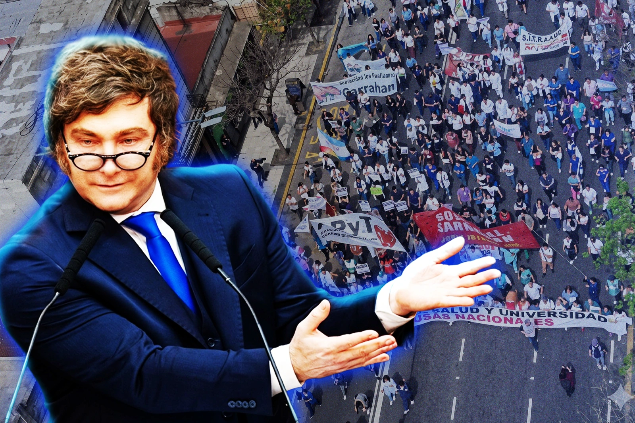
The opposition university march held yesterday turned out to be a failure and highlighted a marked decline in attendance, amid questions regarding its increasing politicization.
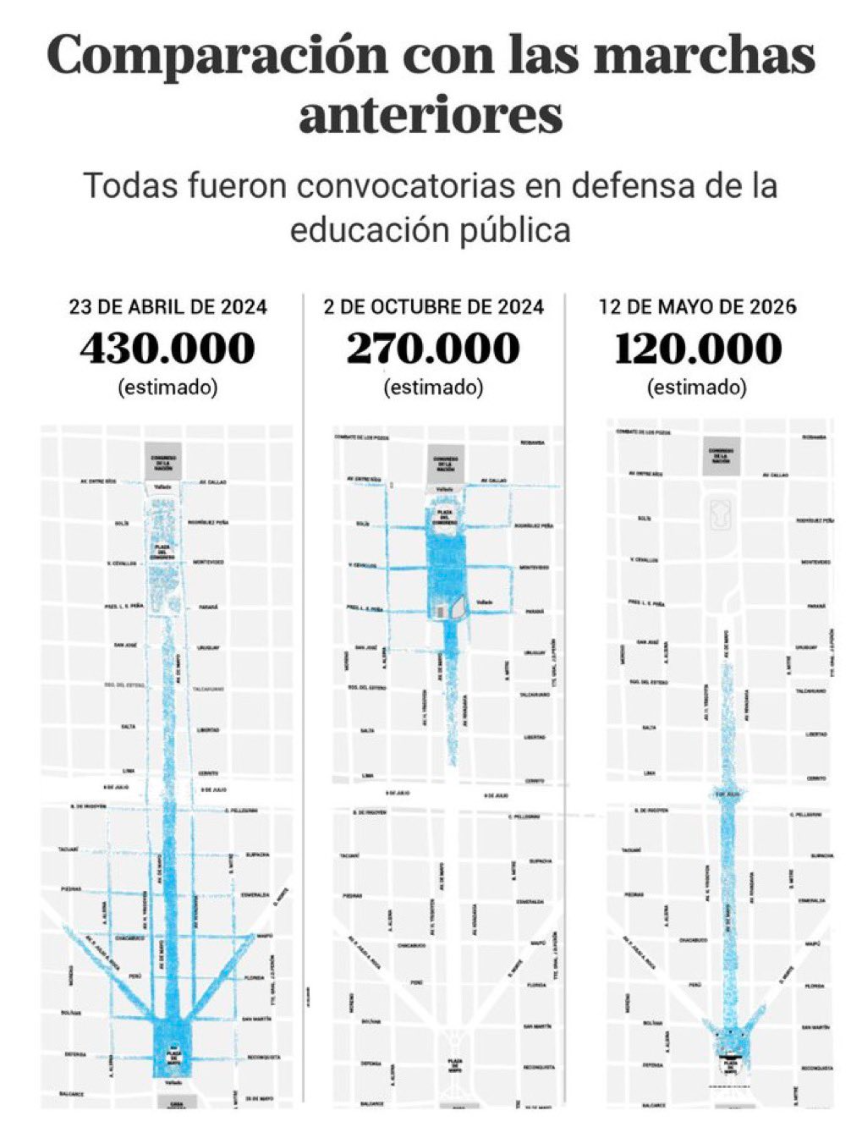
According to a calculation made by La Nación, the mobilization gathered 120,000 people in Plaza de Mayo and surrounding areas, a figure significantly lower than those recorded in previous editions of the same demand.
The drop in attendance is noticeable when compared to prior protests. In the first march, held in April 2024, 430,000 attendees were estimated in the same area, while in the second, in October of that same year, the turnout reached 270,000 people.
Massa at a university march against Milei.
In this context, the latest mobilization shows a 72.09% drop compared to the first, which represents 310,000 fewer people on the streets.
The protest, driven by false arguments and a supposed "defunding" of universities, took place in a scenario where different sectors began to question the nature of the call.
As could be seen, participation was strongly influenced by party politics, which directly impacted the level of attendance.
In this sense, opposition parties, unions, and Kirchnerist union leaders used a noble cause like public education as a tool for wear and tear against the Government of Javier Milei.
This dynamic was reflected in the visible presence of political and union structures that, far from broadening the call, seem to have generated the opposite effect.
The call according to the year.
One of the most notable aspects was the strong presence of party flags and representatives of traditional politics, which alienated independent sectors.
The mobilization had the support of various political and union groups. Among them, La Cámpora, the Left and Workers' Front - Unity, the National UCR, the Communist Party, and the CGT stood out, along with other unions linked to Kirchnerism.
At the same time, the composition of the protesters was also questioned, as there were few genuine students, which fueled criticism regarding the authenticity of the demand and its real representation of the university sphere.
With these numbers, the latest march not only reflects a sustained decrease in attendance, but also reopens the debate on the impact of politicization in this type of demonstration.