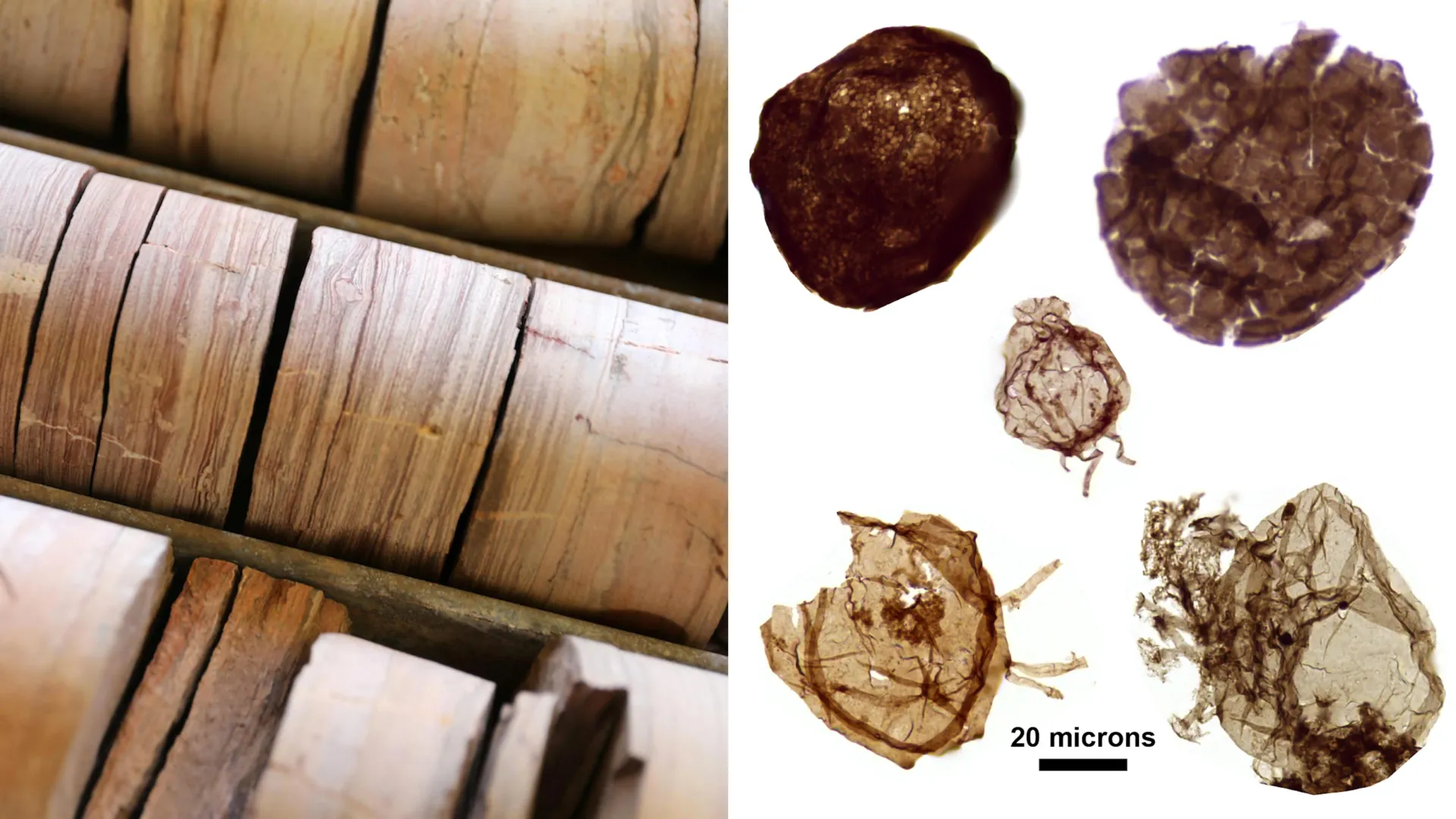
A study published in the journal Nature provided a key piece to understand how complex life emerged on Earth. Scientists analyzed rock cores extracted decades ago in northern Australia and found more than 12,000 fossils of microscopic organisms that lived between 1.7 and 1.4 billion years ago.
These remains correspond to some of the oldest known eukaryotes. Eukaryotes are cells with a nucleus and specialized structures, unlike bacteria and archaea, which are much simpler. All current animals, plants, algae, and fungi descend from them.
The rock cores are preserved in a deposit in Darwin and come from drilling conducted by mining companies. Many are mudstones formed from sediment at the bottom of an ancient inland sea that covered much of northern Australia.
By dissolving and examining the residual organic material under the microscope, the team identified a large number of fossils. They also studied the chemistry of the rocks to reconstruct the environment in which the sediments were deposited.
1.7-billion-year-old fossils reveal a crucial clue to the rise of complex life
Oxygen as an Indispensable Condition
The results show a clear pattern: eukaryote fossils appeared in environments ranging from muddy coastal plains to open sea, but only in those places where oxygen was available. In samples from oxygen-free environments, only simple prokaryotic forms were found.
This indicates that even the oldest known eukaryotes, from about 1.7 billion years ago, depended on oxygen. The finding reinforces the hypothesis that this gas played a central role in the evolution of cellular complexity.
Today, almost all living eukaryotes need oxygen to obtain the large amount of energy that their metabolism demands. Aerobic respiration allows for the release of much more energy than anaerobic processes. However, in recent years, eukaryotes capable of living without oxygen have been discovered, raising questions about whether this dependence existed from the beginning.
The geological record also suggests that when eukaryotes began to evolve, oxygen was much scarcer, and marine habitats without this gas were the norm. That is why the new study is particularly valuable: it offers direct evidence from the distant past.
A Window to the Origins of Complexity
It is known that the last common ancestor of all current eukaryotes arose from the symbiotic union of at least two prokaryotic microbes: an archaea and a bacterium. The Australian fossils show a level of cellular complexity not observed in prokaryotes and typical of eukaryotes.
The rocks of the Northern Territory contain the oldest known eukaryote fossils globally, with ages reaching 1.75 billion years. Studying them allows for the reconstruction not only of the biology of these organisms but also of the world in which they lived.