

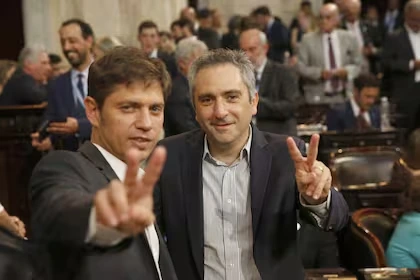
Amid growing criticism of the disastrous management in the Province of Buenos Aires, the financial handling of the government led by Kirchnerist governor Axel Kicillof is once again under severe political and institutional scrutiny. Lawyer Silvina Martínez publicly exposed that the Provincial Agency for Childhood and Adolescence (OPNYA), an area under the Ministry of Community Development led by Andres Larroque, has a hefty budget of $184 billion pesos for the fiscal year 2026.
This gigantic pool of resources, theoretically intended for the promotion and protection of rights, youth criminal responsibility, the management of care homes, homes, and specialized institutions for vulnerable children and adolescents, is now under suspicion of fueling a “corruption machine” for the benefit of the governmental structure.
The controversy escalated to the judicial level following a formal complaint filed with the Attorney General's Office of the Province of Buenos Aires by D. A., an active Minority Assistant and employee of the agency.
In her presentation, the worker requested the urgent intervention of a specialized prosecutorial unit to investigate the alleged commission of crimes against the Public Administration, also demanding comprehensive audits and the adoption of precautionary measures to preserve physical documentation, servers, and computer records. The complainant specifically requested an investigation into the performance of a director of a facility under the entity, leaving open the possibility of extending the charges to higher levels of the state hierarchy.
The core of the presentation exposes the articulation of a “mechanism similar to the Chocolate Rigau system”, characterized by the illicit demand for “kickbacks” or “very significant commissions” on the salary allocations granted to staff.
According to the details provided by Silvina Martínez, the provincial State disburses funds corresponding to guard shifts and overtime into the bank accounts of employees; however, workers are coerced into returning up to half of that money to the agency's authorities.
As an illustrative pattern of the maneuver, if an agent is credited with 100 overtime hours, they only keep 50 and must hand over the remaining 50 to the administrative leadership. Although it was initially justified to the subordinates that this exaction aimed to finance the “purchase of medications for housed minors” and maintain the structure, the advancement of the scheme demonstrated the existence of a spurious circuit appropriated by officials.
The irregular scheme is not limited to salary fraud but also includes the existence of 7 boxes or black boxes disconnected from any transparent control. The requested investigation covers in detail the following opaque niches: