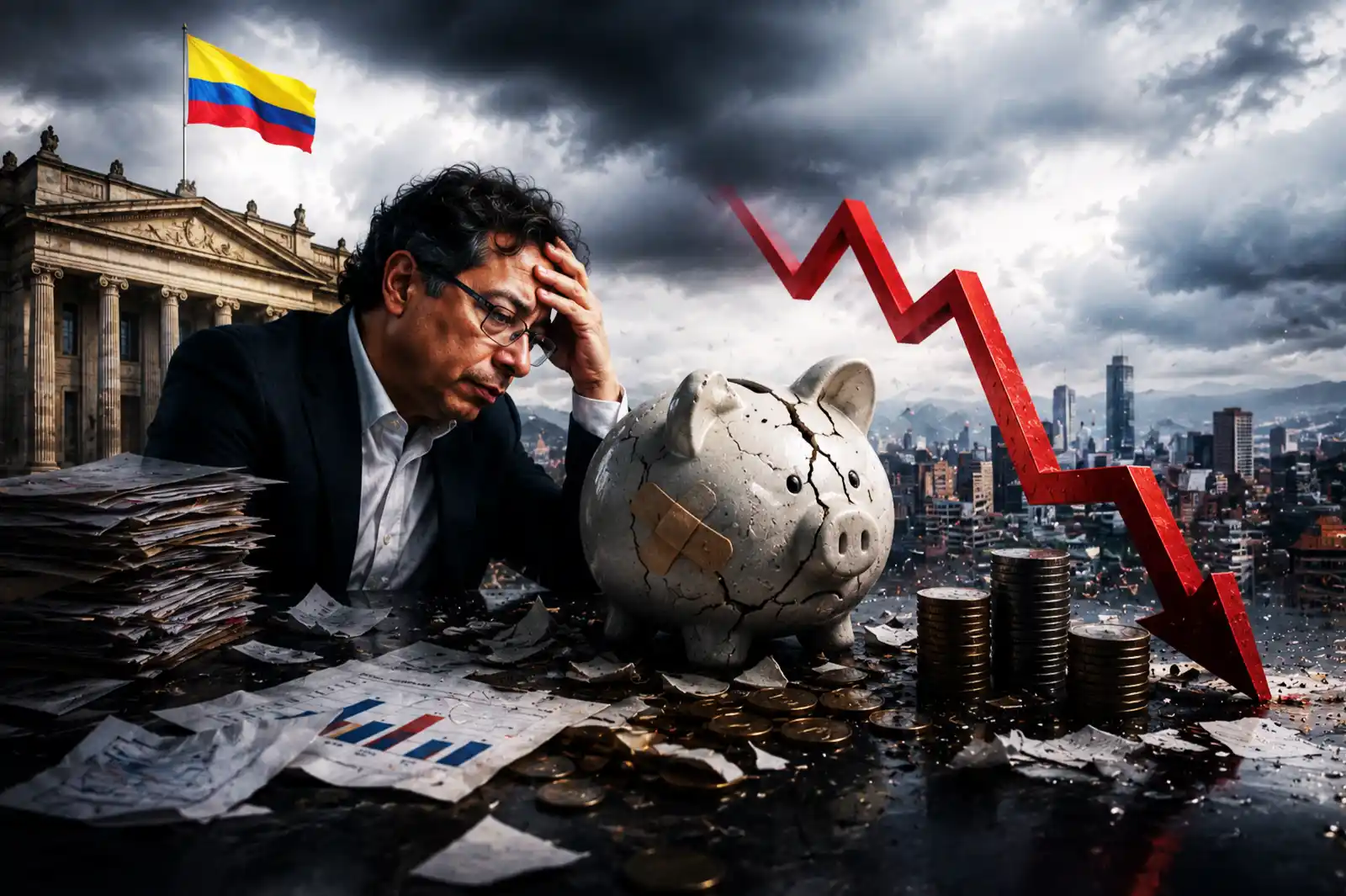
A report from The Economist Intelligence Unit warned that Colombia could close 2026 with the third largest fiscal deficit in the world, in a scenario that seriously compromises the stability of its public accounts and reflects the disaster that the communist government of Gustavo Petro will leave behind.
The projection estimates a 6.6% imbalance of the Gross Domestic Product (GDP), a level that would place the country only behind Brazil (7.3%) and Poland (7%) among 43 economies analyzed.
The study, which evaluates key variables such as the budget balance, the current account, and the performance of sovereign bonds, reflects a sustained deterioration in key economic indicators.
Gustavo Petro
In this context, the projected result for Colombia not only exceeds the official target of the Ministry of Finance by 1.3 percentage points, but also consolidates a negative trend in fiscal management.
The warning comes amid questioning of the management of the communist Gustavo Petro, under whose leadership the country has climbed to one of the worst positions in the global ranking in terms of deficit.
The report states that fiscal imbalances will be a constant in many economies, although it emphasizes that the Colombian case stands out for its magnitude.
In addition to the deficit, the analysis includes other indicators that reinforce the picture of fragility. A current account of -2.5% of GDP and an interest rate of 11.8% for 10-year sovereign bonds are projected, factors that directly affect the cost of financing and the perception of risk in international markets.
Gustavo Petro
“There has been no effort in recent times to reduce public spending, so a deficit of 6.6% is indeed very possible,” stated Hernando Zuleta, dean of Economics at the University of the Andes.
The impact of a deficit of this magnitude is not limited to the numbers. Over time, it translates into higher taxes, debt, and decisions that negatively affect economic activity. In this sense, a persistent imbalance could force the Government to implement adjustments, either through spending cuts or tax increases.
If the projections are confirmed, Colombia would face a scenario of increasing pressure on its economy, with less room for maneuver and higher financial costs, a situation that will be inherited by the elected president, the right-wing Abelardo de la Espriella.