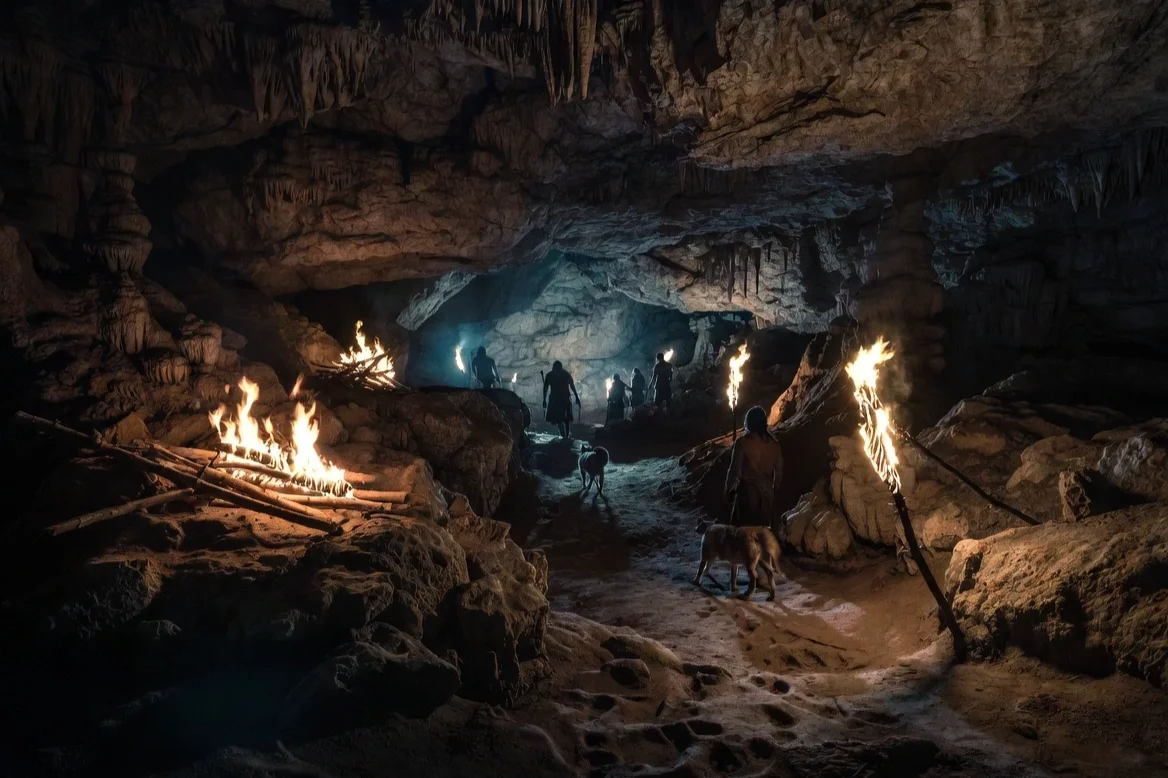
About 14,400 years ago, a small group of people ventured into the depths of the Bàsura cave in northern Italy. The surprising thing is that they were not alone: they were accompanied by a dog. A recent study reconstructed this underground journey, one of the oldest known in Europe, and revealed fascinating details about how they moved in total darkness during the last Ice Age.
The researchers combined archaeology, pollen analysis, carbon studies, and practical experiments to understand the journey. The cave, located near Toirano in Liguria, preserves fossilized human and canine footprints, along with charcoal remains on the walls and ceilings. This allowed them to piece together the puzzle of an exploration that lasted about two hours and covered approximately 800 meters.
The landscape of the time was cold and dry, with steppes and scattered pine forests. In the so-called "Room of Mysteries," dozens of fragments of charcoal appeared, mostly from young branches of Scots pine. This changed an idea that had been held for decades.
The light they used in the darkness
Instead of large torches, as was previously believed, the group used small lit pine branches as portable light sources. They were thin branches, less than three centimeters in diameter, easy to obtain in the environment and very effective.

To confirm this hypothesis, scientists conducted tests in a similar cave. Five volunteers, a number similar to the estimated prehistoric group, used dry pine branches. The results were clear: two branches were enough to light the way for the entire group, with visibility of up to 10 meters once their eyes adapted to the dim light.
The flames produced little smoke and less glare than a traditional torch. This made it easier to move through narrow tunnels. The best way was to carry one light in front and another behind while walking with one hand resting on the shoulder of the person in front to avoid getting lost.
Precise fuel for the expedition
Each branch burned at a rate of about four centimeters per minute. According to calculations, they needed about 20 branches of 30 centimeters to go to and return from the Room of Mysteries. The charcoal marks left in the experiments matched exactly with those found on the walls of the actual cave.
This finding shows that Upper Paleolithic humans developed a simple but very effective technology. The pine branches were lightweight, lasted long enough, and produced little smoke, making them ideal for exploring deep caves. Additionally, the presence of the dog suggests that a close relationship between humans and canines already existed at that time.
The first excavations in Bàsura date back to the 1950s, when some thought the footprints belonged to Neanderthals. Later, radiocarbon dating confirmed that they belonged to the Epigravettian period, in the final stages of glaciation. The "Bàsura Revisited" project, initiated in 2016, allowed for this new understanding with modern techniques.
Ultimately, this study not only reconstructs a key moment in prehistory but also highlights the ingenuity of our ancestors in facing hostile environments with resources from their surroundings. A feat that continues to amaze thousands of years later.