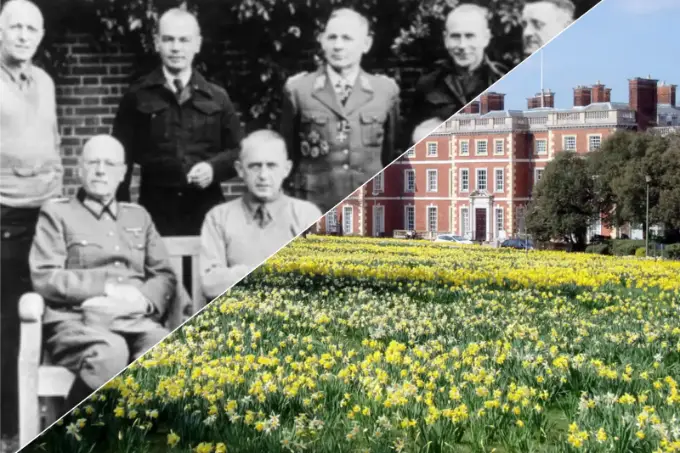
The British housed Nazi officers at Trent Park, an elegant residence with hidden microphones in almost every corner, and let them talk among themselves
In the midst of World War II, the United Kingdom faced a delicate problem: it needed to learn the secrets of the German military machinery, but high-ranking prisoners were well aware of when they were being interrogated. The British response turned out to be much more subtle and effective than any formal questioning session.
Instead of applying direct pressure, the authorities gathered dozens of German generals and officers in a sophisticated mansion north of London. There, they were offered comfortable rooms, a library, English classes, service staff, and even occasional outings. The idea was simple: treat them as if they still held their status so they would let their guard down and converse naturally.
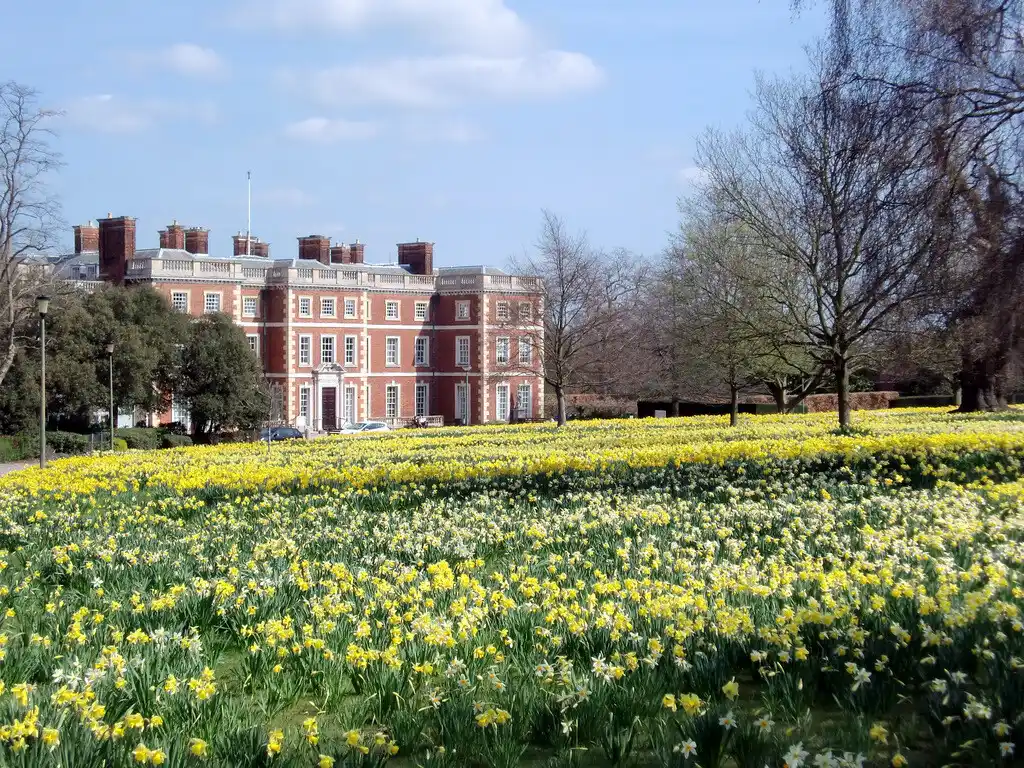
This was the Trent Park House residence, also known as the House of Secrets, on the outskirts of London.
Before the war, Trent Park had been the complete opposite of a detention center. Its owner, the politician and collector Sir Philip Sassoon, had turned it into a neogeorgian-style residence filled with antiques, Chinese wallpapers, and works by artists like John Singer Sargent. Figures such as Charlie Chaplin and Winston Churchill had passed through its halls. Sassoon died in June 1939, and shortly after, the British government requisitioned the property for a completely different use.
Thomas Kendrick, a key figure in British espionage, had already tested hidden microphone systems with prisoners of war. He saw Trent Park as the ideal setting to expand that technique. Between 1942 and 1945, 84 generals and 22 lower-ranking officers passed through there. The key to the plan was that the place did not resemble a conventional prison at all.
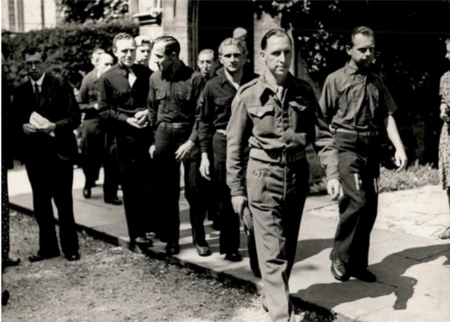
Prisoners of war from Trent after a religious service at Christ Church, Cockfosters
Microphones underfoot
While the generals chatted calmly on the upper floors, the entire house was wired. There were hidden microphones in flower pots, lamps, pool tables, and rooms. Even the gardens and some trees were set up to capture conversations. The wires led to secret rooms in the basement, where the so-called “secret listeners” worked in shifts day and night.
The prisoners had been warned that they could be spied on, but the deception worked so well that two of them even commented that the mansion clearly was not being monitored, because if it were, they would have noticed. The strategy of treating men accustomed to privilege as if they were still important proved extraordinarily effective.
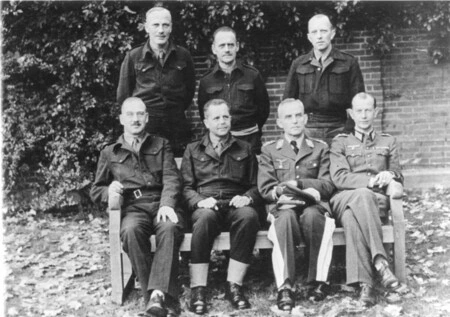
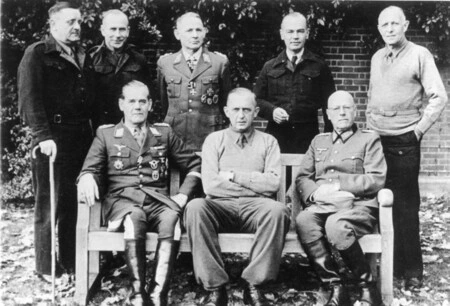
German officers at Trent Park
The device was not limited to waiting for spontaneous chats. The British invented Lord Aberfeldy, a fictional Scottish aristocrat played by a young interrogation officer. The supposed lord presented himself as responsible for the well-being of the prisoners and feigned some sympathy for Hitler to gain trust and provoke confidences that the microphones immediately picked up.
When the listeners began to have difficulties with German slang and colloquial expressions, the service incorporated German-speaking refugees from Germany, Austria, and Czechoslovakia. Many of them were Jews who had fled precisely from the regime whose conversations they were now listening to.
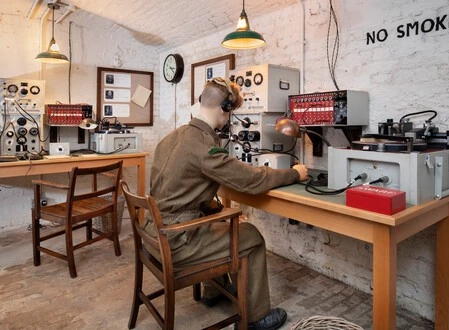
Room M in the basement of Trent Park, where he listened to and transcribed conversations of the prisoners.
The secrets of the V weapons
The operation provided valuable data on the navigation systems of German bombers, information that was combined with the work of Bletchley Park. The greatest achievement came when the conversations revealed details of the secret V weapons program. The British heard references to rockets capable of reaching great heights and ended up obtaining information about the V-2, the first long-range ballistic missile.
This intelligence helped identify the importance of the Peenemünde research center, which the RAF bombed in August 1943. The attack delayed the program: the first V-1 did not fall on London until June 13, 1944, a week after the Normandy landings, and the first V-2 did so on September 8.
German officers stationed in Trent
Not everything that was heard was technical. Some conversations included confessions and comments about Nazi atrocities. General Dietrich von Choltitz, the last German commander of Paris, spoke of his involvement in the liquidation of Jews. For the refugees working on the other side of the wires, many of whom had lost family members in the Holocaust, those words were particularly painful.
The United Kingdom decided not to use those recordings in war crime trials. Revealing them would have meant exposing one of its most valuable intelligence methods, just as a new adversary was emerging: the Soviet Union. Trent Park continued to operate as a listening center until November 1945, and the information obtained there also helped to understand the Soviet threat that would lead to the Cold War.
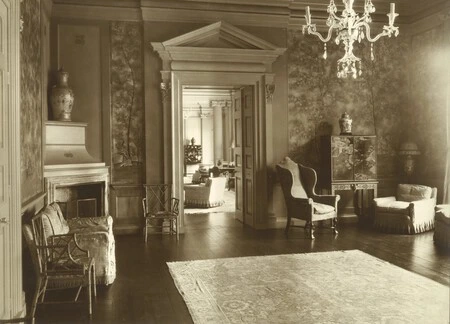
The salon of Philip Sassoon at Trent Park House in the late 1930s
The listeners had signed the Official Secrets Act, and many never told their families what they had done during the war. Some took the secret to their graves. Today, the mansion is the Trent Park House of Secrets museum and still retains part of the original wiring.
The central idea remains an example of British intelligence: instead of locking the generals in a cell and asking them questions, they installed them in a luxury residence, hid microphones everywhere, and let them interrogate each other.