The recent declassification of SIDE files exposed in greater detail the objectives, structure and strategy of the left-wing terrorist group Montoneros during the 1970s.
Among the central points that emerge from official documents, a specific warning stands out: the intention to “infiltrate the Justicialist Party” as a mechanism to condition its political leadership and access spaces of power, something that, at present, can be said to be an achieved objective.
According to the records, Montoneros is defined as “the symbiosis of left-wing revolutionary Peronism and progressive Christian currents infiltrated by Marxism, who see socialism as the only valid proposal for the exercise of power”. Within this framework, the reports detail a series of objectives structured at different levels.
The objectives of Montoneros
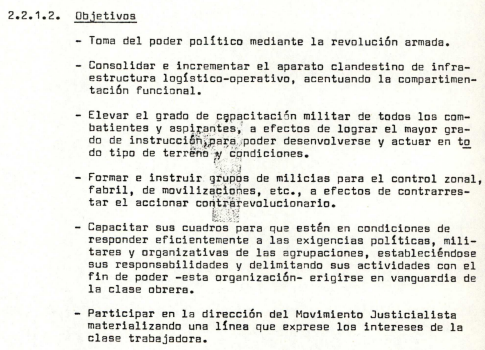
At the political-military level, the documents indicate as their main goal the “Seizure of political power through armed revolution
”. The objectives of Montoneros.
Added to this is the need to “Consolidate and increase the clandestine logistic-operational infrastructure apparatus” and “Raise the degree of military training of all combatants and aspirants”, with the objective
of acting in all types of scenarios.
In addition, the intention is established to “Form and train militia groups for industrial zone control, mobilizations, etc., in order to counteract counterrevolutionary action”, together with the preparation of cadres capable of intervening in the different areas of the organization.
One of the most important points appears in the strategy of political integration. According to the documents, Montoneros sought to “participate in the leadership of the Justicialist Movement by materializing a line that expresses
the interests of the working class.”
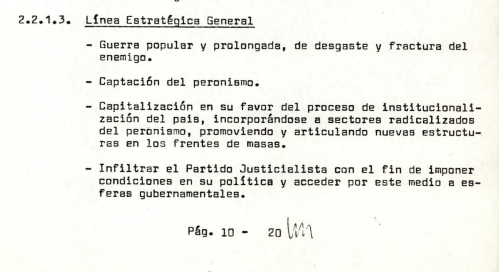
Along the same lines, the central objective is detailed: “To infiltrate the Justicialist Party in order to impose conditions on its politics and to access governmental spheres through this means”.
The “General Strategic Line” of Montoneros includes the “popular and prolonged war, of attrition and fracture of the enemy”, the “Recruitment ofPeronism” and the “Capitalization in its favor ofthe process of institutionalizing the country, incorporating radicalized sectors of Peronism”.
Regarding tactics, the documents mention actions such as “Kidnappings and/or murders against leading figures”, “Kidnappings for logistical purposes”, “Intimidatory attacks” and the use of political and social structures to expand their influence, including acting through Peronist Youth, Peronist University Youth and the Union of Secondary Students.
The objectives of Montoneros.
“Infiltrating the Justicialist Party”
As revealed by SIDE documents about Montoneros's objective of infiltrating Peronism to gain access to political office, today it can be seen that, during the governments of Néstor Kirchner and Cristina Kirchner, numerous leaders linked to that terrorist group, and other similar organizations, occupied and hold relevant positions in
politics.
Among them is Nilda Garré, who was Minister of Defense and Security and was close to the leadership of the guerrilla organization in the 1970s. Also included is Jorge Taiana, currently a national deputy, with a background in Peronist Youth, armed struggle and links with
their structures.
In turn, Carlos Kunkel was one of the closest collaborators of Kirchnerism and played an active role in the JP and Montoneros, while Juan Carlos Dante Gullo served as a reference for the Peronist Youth of the Regionals, the political arm of Montoneros.
Other names mentioned include Esteban Righi, who was Attorney General of the Nation and former minister of Héctor Cámpora, Horacio Verbitsky, who recognized his past as an intelligence officer for Montoneros, and Rafael Bielsa, all with different levels of participation or links to spaces associated with the terrorist organization.
Declassified documents allow us to observe with greater precision the strategic guidelines defined in the 1970s, in particular with regard to inclusion in traditional political structures.
The explicit reference to “infiltrating the Justicialist Party” is once again becoming relevant in the analysis of the link between those strategies and the subsequent presence of leaders with that past in positions of power within the State.