Researchers observed that the gas around the black hole shows a perfect Keplerian motion, similar to that followed by planets around the Sun. This allowed for an accurate calculation that most of the mass is concentrated at the center, confirming the presence of the supermassive black hole.
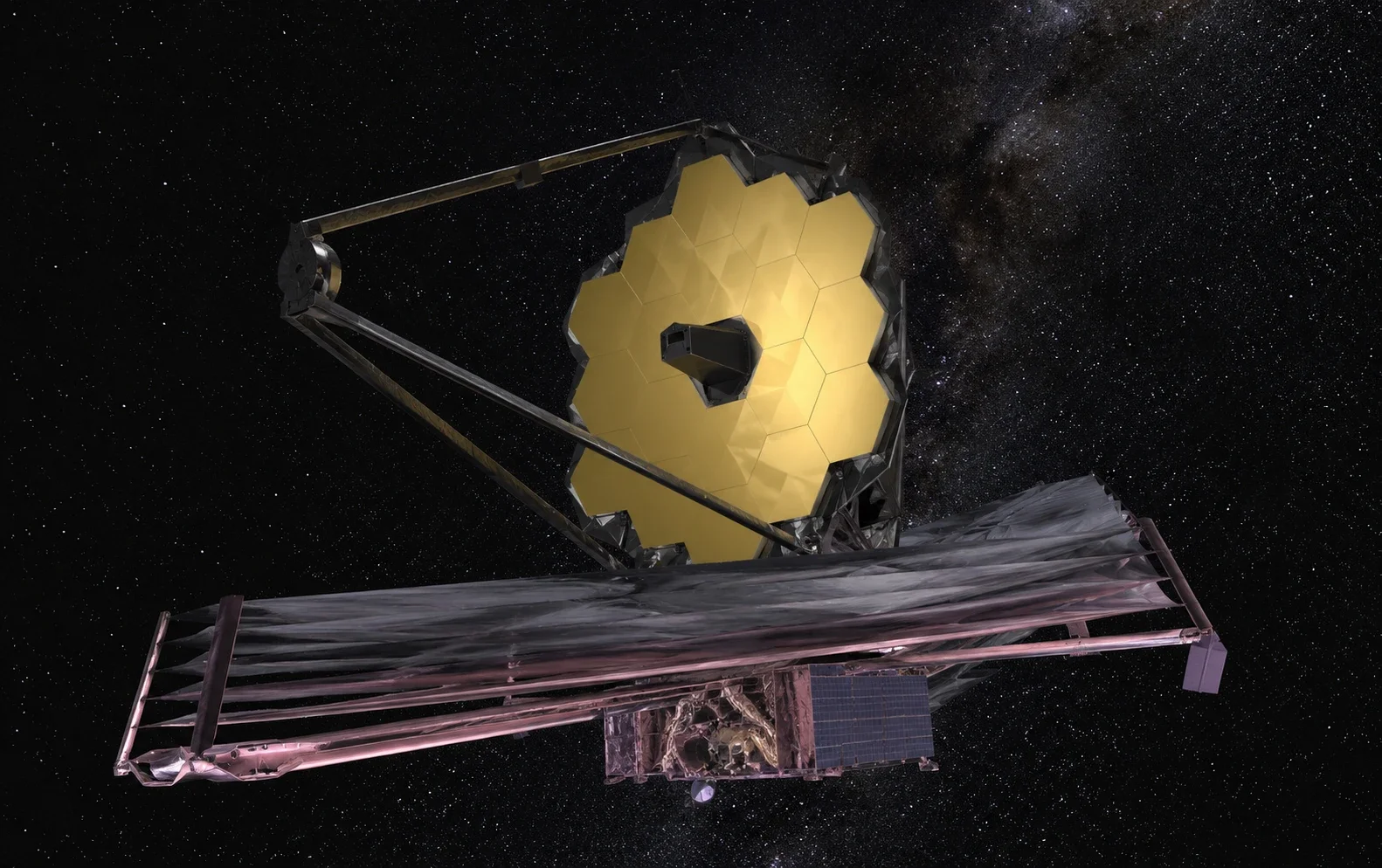
The James Webb Space Telescope has once again surprised the scientific community by detecting evidence of a supermassive black hole that existed long before its galaxy formed. This discovery challenges traditional ideas about the origin of these massive objects.
According to researchers, this black hole did not go through the usual phase of stellar collapse nor did it feed on material from an already formed galaxy to grow. Instead, it seems to have emerged almost directly in the early moments of the cosmos.
Professor Roberto Maiolino from the University of Cambridge, one of the authors of the study, described the results as "a complete overhaul of the classic scenarios of how black holes form and grow."
For decades, science accepted that large black holes originated from massive stars within existing galaxies, which collapsed and devoured nearby material. However, this new case shows a giant that reached enormous size without the need for that process.
A finding in the primitive universe
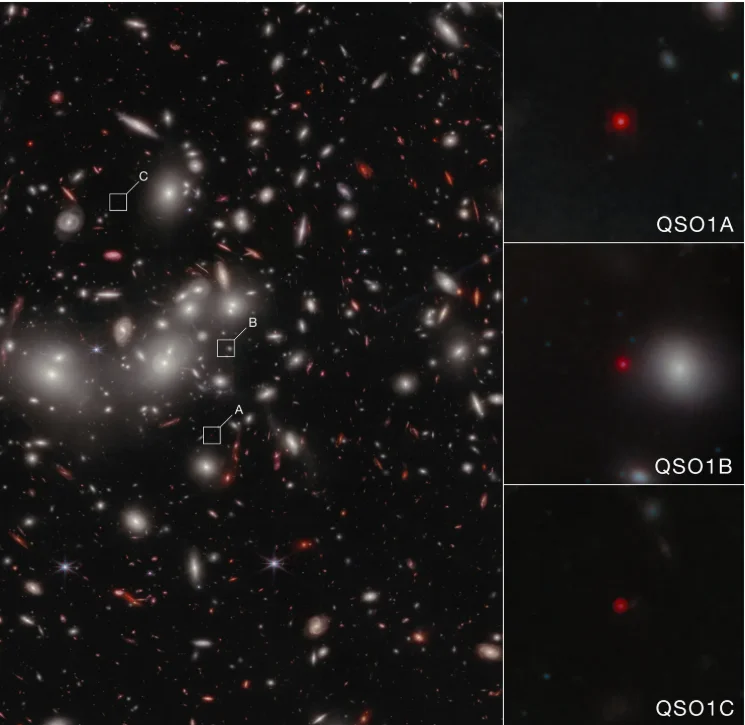
The object, located in the region known as Little Red Dot QSO1 within the Abell 2744 cluster, is about 13 billion light-years away. It has a mass equivalent to 40 million times that of our Sun and existed just 700 million years after the Big Bang.
This is the first case in which scientists were able to directly measure the mass of a black hole in the early universe. Until now, measurements were indirect and based on assumptions.
Researcher Ignas Juodžbalis explained that if the mass were more distributed among stars, the gas would not rotate in such an orderly manner.
Implications for cosmology
This finding raises questions about the formation mechanisms in the early stages of the universe. It was traditionally thought that at least a billion years were needed for black holes of this size to emerge, but evidence indicates that it happened much faster.
Some astrophysicists suggest that dark matter could play a key role. As it decayed, it could have heated the hydrogen gas enough for gravity to quickly concentrate it into giant clouds that collapsed into supermassive black holes.
Although this explanation is still theoretical and depends on confirming the properties of dark matter, it helps align calculations with observations.
The James Webb has been detecting signals from these objects for some time, but this direct measurement marks a turning point in the study of the early cosmos. The observed "red dots" usually correspond to black holes surrounded by dense gas from that era.
Experts agree that this type of discovery does not negate the Big Bang but enriches the understanding of how the universe evolved in its first hundreds of millions of years. The Webb's ability to observe in such detail continues to rewrite chapters of cosmic history.