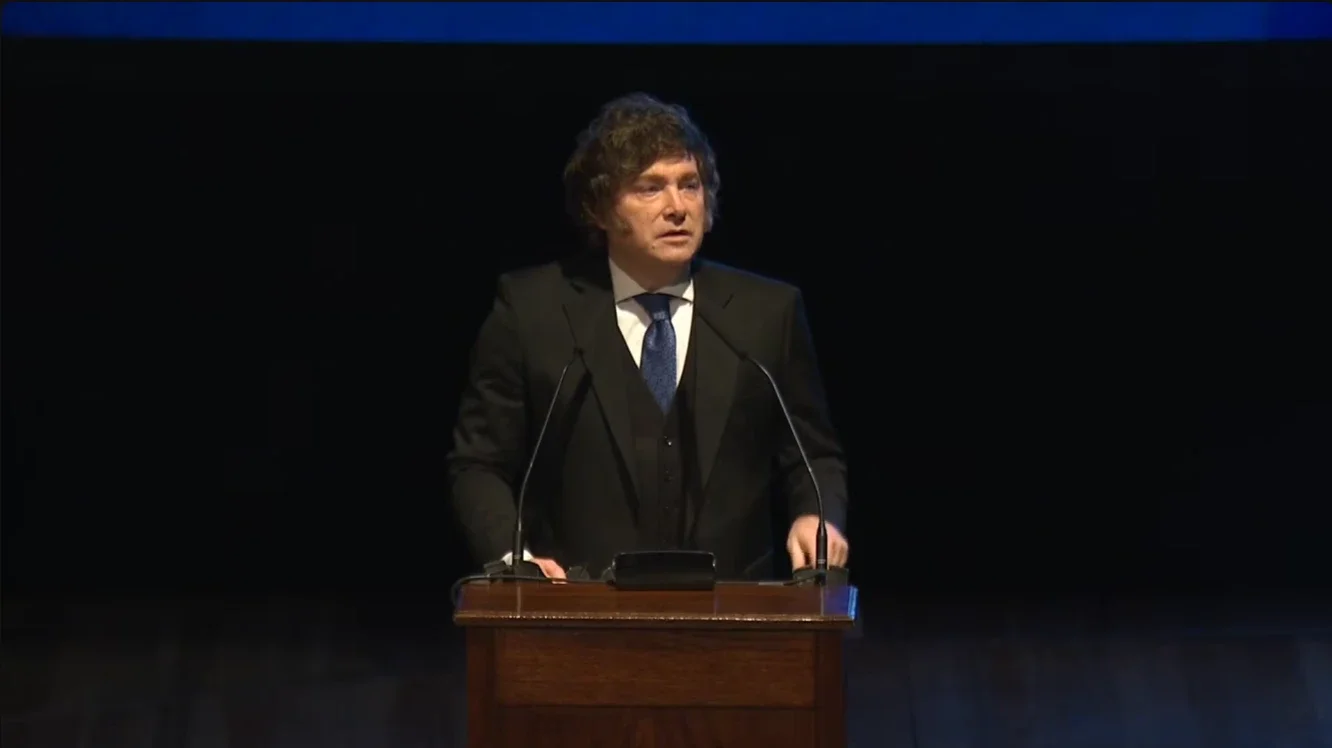
President Javier Milei led the Tribute to the Rebbe of Lubavitch on Monday night at the Palacio Libertad, as part of the commemoration of the anniversary of the passing of Rabbi Menachem Mendel Schneerson, one of the most influential spiritual figures in contemporary Judaism.
The presence of the president once again marks his strong bond with the Jewish community and his international alignment with Israel, amid a regional scenario marked by the escalation of the conflict in the Middle East and the defense of Western values.
Javier Milei delivered a tribute speech at the Palace of Liberty
At the beginning of his speech, Milei announced that he would share with those present a fragment from the epilogue of his new book, which was inspired precisely by an event like the one taking place this Monday at the Palacio Libertad. The President recounted that, while progressing in the writing of Morality as State Policy, various teachings began to emerge related to his conversations with his personal rabbi.
In this context, he recalled an anecdote from his first celebration of the Jewish New Year, when he was asked to choose three wishes: wisdom to distinguish between good and evil, courage to choose good, and temperance to stay on that path. He then shared that when he mentioned this choice, they pointed out that these had been the same wishes attributed to King Solomon.
Milei stated that "there are texts written to inform, texts written to convince, and others written because not doing so is a betrayal.” With this definition, the President gave his speech a more personal and doctrinal tone, linking his new book with a reflection on the moral dimension of politics and capitalism.

In that vein, he asserted that “if one embraces Judeo-Christian values, their spiritual life resonates in harmony with their material life,” and proposed that “it is not an intuition or a metaphor,” but “a law as rigorous as any economic law.”
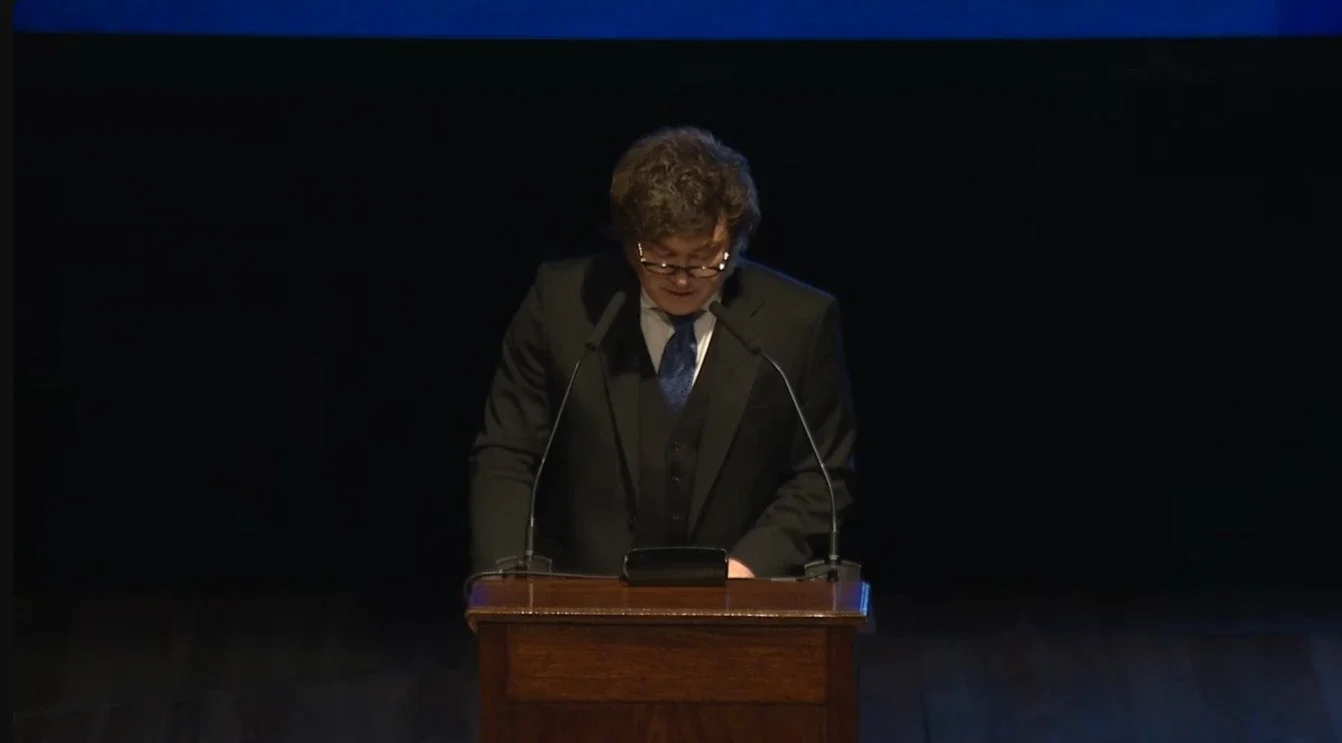
The president closed his speech before a packed auditorium
During the conference, Milei reviewed and provided a rationale for the compatibility between the Ten Commandments and capitalism, which he even presented as founding principles of a free, responsible, and value-creating society. From that perspective, the President linked the Judeo-Christian tradition with the defense of property, work, and individual responsibility.
To conclude his presentation, Milei once again questioned the culture of state dependency and stated that “for years, the idea was established that it was possible to live on subsidies without generating any wealth”. He then emphasized that, “fortunately, Argentines have awakened and understood that real prosperity requires effort, responsibility, production, and value creation”.