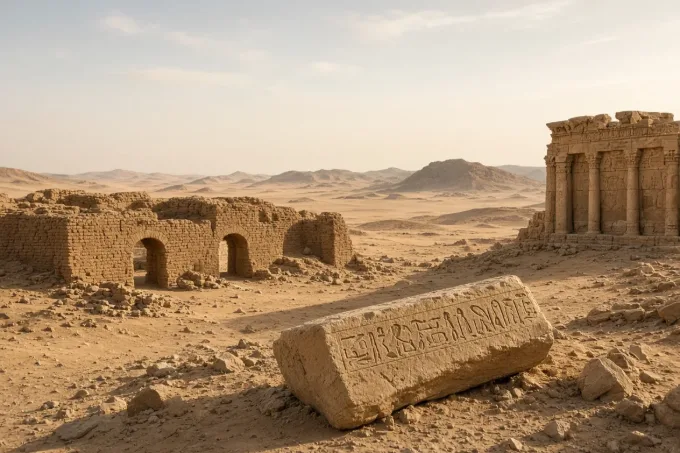
In the north of the Sinai Peninsula, Egyptian authorities announced a series of findings at the site of Tell Abu Saifi that strengthen its possible identification with the ancient city of Mesen. The announcement, disseminated through local media, details architectural remains and an epigraphic element of particular relevance.
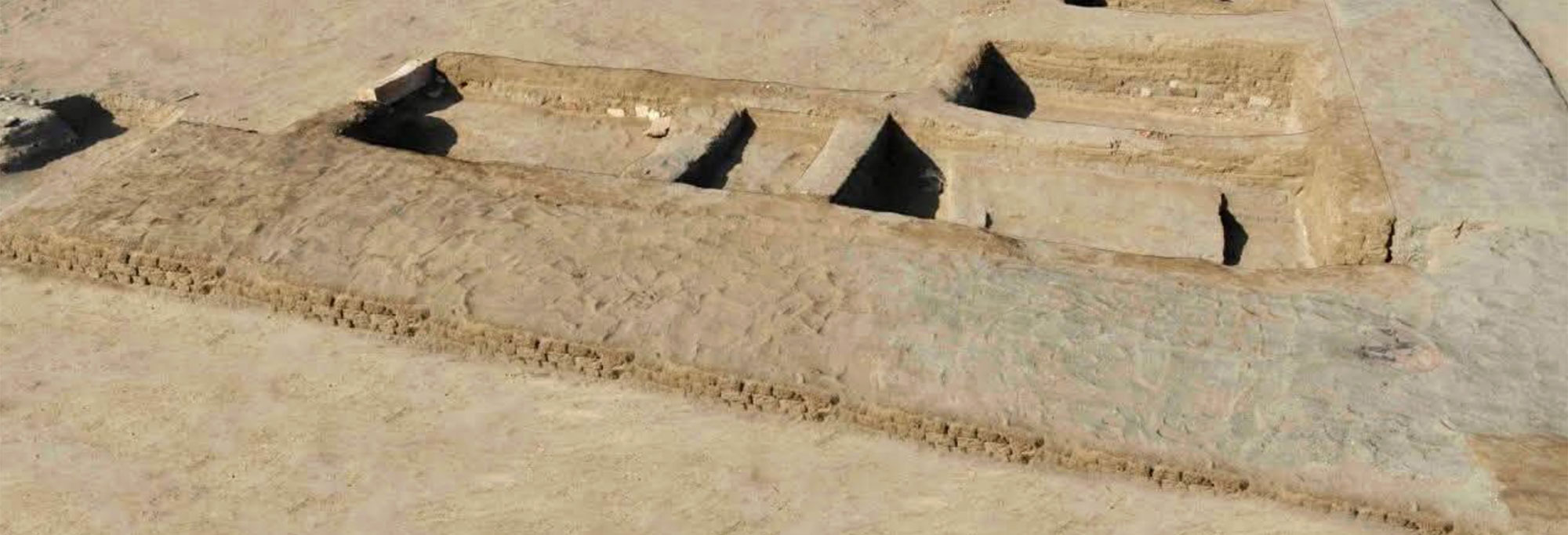
The excavations documented a mudbrick enclosure wall, along with its access points or gates. Remains of what is interpreted as a temple were also recovered. These elements provide concrete data about the organization of the site during the New Kingdom period.
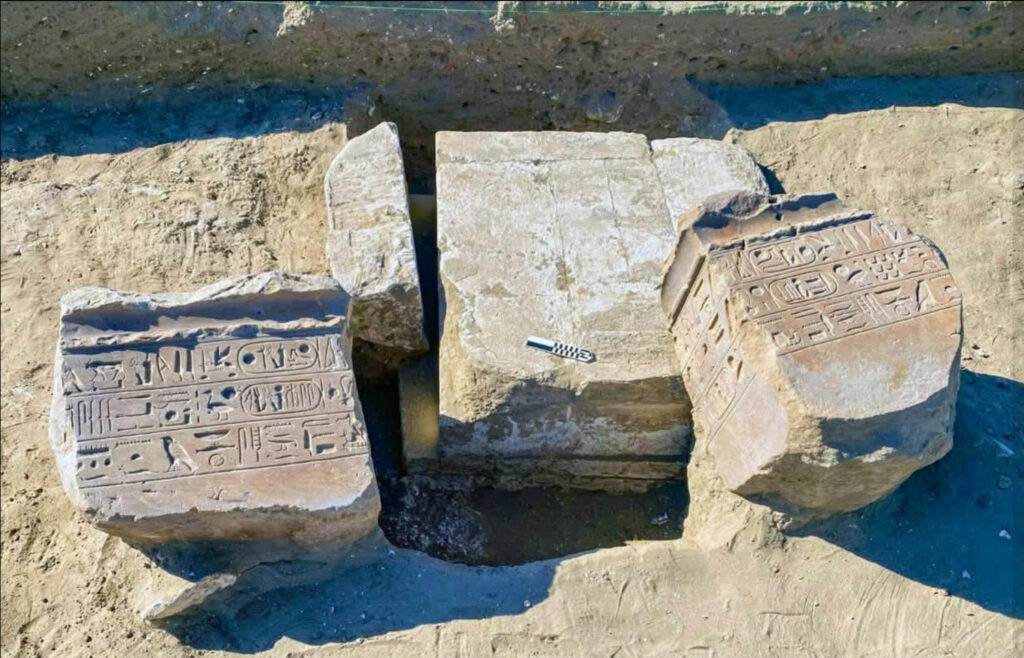
The most notable finding was an imposing sandstone lintel that appeared broken in two. The piece features inscriptions on three of its faces. These inscriptions include the titles of Ramses II and a text referring to restoration work carried out on a statue of the deity Horus.
In that inscription, Horus is specifically mentioned as the “Lord of Mesen.” This reference is key, as it directly connects the site with the toponym known from historical sources.
A city mentioned in ancient texts
Mesen appears in New Kingdom documents as a locality associated with the Way of Horus, the military route that connected the Nile Delta with the Levant. For centuries, its exact location remained unconfirmed, despite recurring mentions in official and administrative texts.
The new data recovered at Tell Abu Saifi offer for the first time a set of material evidence suggesting that the city could be buried in this sector of northern Sinai. The lintel mentioning Horus as Lord of Mesen constitutes the most solid element of that possible identification.
The presence of a walled enclosure and temple structures is consistent with the profile of a settlement of considerable size, possibly linked to the control of the military route. The quality of the sandstone lintel and the nature of the inscriptions reinforce the idea of a place with official activity during the reign of Ramses II.
Although much remains to be investigated, the set of discoveries provides a concrete archaeological argument in the discussion about the location of Mesen. Until now, hypotheses were based almost exclusively on written sources.
Implications for the study of Sinai
The work at Tell Abu Saifi adds to other recent efforts to better understand the Egyptian occupation in the northern strip of Sinai. The area played a strategic role as a corridor between the Nile Valley and Asian regions, and the remains of fortifications and temples help reconstruct that landscape.
The mention of the restoration of a statue of Horus suggests that the worship of this deity occupied a central place at the site. The epithet “Lord of Mesen” was already known to Egyptologists from texts, but until now, no such explicit material support had been recovered in an excavated context.
Authorities highlighted that these findings strengthen the association of the site with the lost city. Future campaigns will allow for the expansion of the layout of the enclosure, a more detailed study of the temple remains, and the search for potential new epigraphic documents that confirm or nuance the identification.
For now, the sandstone lintel with the titles of Ramses II and the reference to Horus stands out as the most eloquent piece. Its discovery opens a concrete avenue for further investigation into one of the most elusive toponyms in the historical geography of the Egyptian New Kingdom.