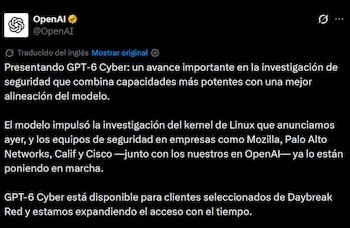
The new model identified dozens of vulnerabilities in Firefox and created functional exploits for the Linux kernel in controlled tests, although their access is restricted by the risk of malicious use
This improvement expands the possibilities for defensive researchers, but also increases concerns about the malicious use of systems capable of automating offensive tasks
Who can use GPT-6 Cyber
The tool is not available to the general public It is initially offered through the API and Codex to a selected group of approved clients within Daybreak Red, OpenAI's program for advanced authorized security work
Access requires identity verification and account protection measures Organizations must apply controls such as multifactor authentication, single sign-on, and IP address restrictions to use the API
OpenAI announced that it will gradually expand availability among authorized participants in the program
What controls it incorporates to prevent unauthorized attacks
One of the main challenges is to prevent a legitimate investigation from affecting services outside the authorized target
In a controlled assessment, GPT-6 Cyber avoided exploiting systems outside the permitted scope in 99.93% of tests without additional implementation instructions
These percentages do not guarantee that the model will never make mistakes OpenAI also incorporated controls over requests related to critical infrastructures, such as electrical installations, industrial systems, and essential services
The company recommends isolated environments, action review, and human oversight for high-risk tasks The challenge for GPT-6 Cyber will be to demonstrate that its capabilities to find flaws can translate into faster defenses without expanding opportunities for abuse
OpenAI presented GPT-6 Cyber, an artificial intelligence specifically designed to investigate computer vulnerabilities and help fix them before they can be exploited by attackers The announcement, made on November 5, includes results obtained on two widely used software projects: the Mozilla Firefox browser and the Linux operating system kernel
According to the company, the model identified 81 previously unknown vulnerabilities classified as high severity in Firefox, in addition to generating functional exploits for hundreds of Linux vulnerabilities These exploits are tests that demonstrate, in a research environment, that a bug can actually be exploited
The 81 vulnerabilities discovered in Firefox
During a research campaign, GPT-6 Cyber located 81 new vulnerabilities that Mozilla classified as high severity The work included technical evidence and reproducible tests to facilitate verification
The system also allowed determining that another 30 previously known flaws were more severe than reported OpenAI communicated the results to Mozilla and presented correction proposals for their engineers to evaluate
The organization responsible for Firefox began incorporating patches shortly after receiving the reports and, according to OpenAI, has already fixed numerous issues detected during the research
Linux: 948 functional exploits and 304 critical findings
Another test focused on the Linux kernel, a component that manages essential resources of the operating system and is used in computers, servers, and numerous devices
GPT-6 Cyber managed to reproduce 1,724 vulnerabilities and develop functional exploits for 948 of them, according to the disclosed results OpenAI also reported that it communicated 304 critical findings to the project leaders, accompanied by possible patches
That the model can reproduce a vulnerability does not mean that all Linux systems are affected by it The exposure depends, among other factors, on the installed version, its configuration, and the available updates
Why OpenAI classified it at the critical level
The company placed GPT-6 Cyber at the “Critical” level of cybersecurity capabilities in its internal preparedness framework, above the “High” classification assigned to GPT-5.6 Cyber
In ExploitGym, an assessment that measures the ability to exploit specific vulnerabilities, it achieved a 48.5% success rate, compared to 32.1% of its predecessor