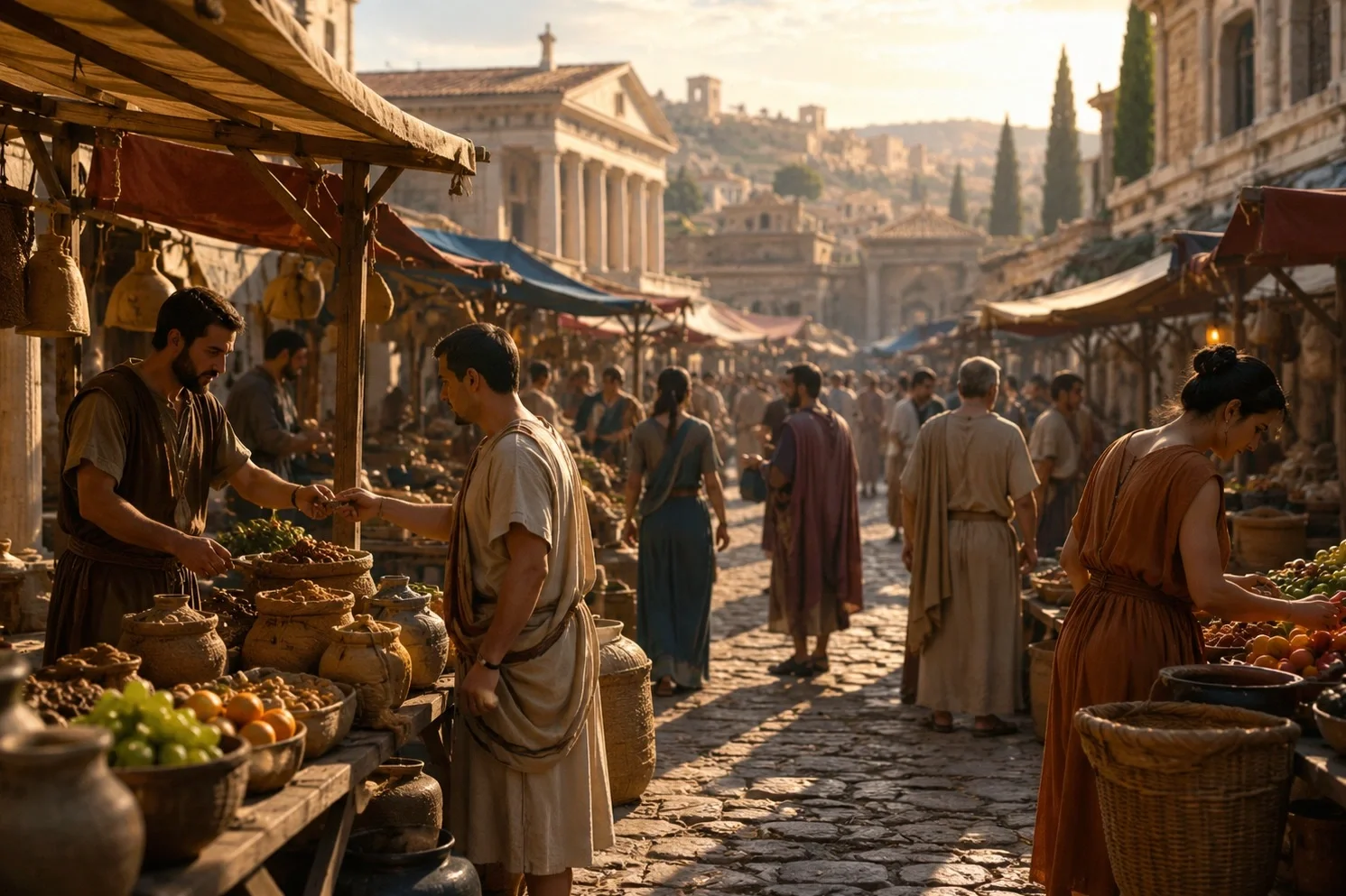

Prosperity has always emerged where markets have flourished.

Prosperity has always emerged where markets have flourished.
Imagen de Editorial Team
porEditorial Team
Argentina

The exchange drove human development from the earliest civilizations.

Nuevo
Agregar La Derecha Diario en
Compartir:

When we talk about capitalism, it is often presented as a relatively recent creation that emerged in Europe just a few centuries ago. The most widespread image usually places the origin of modern markets alongside the Industrial Revolution, English factories, and classical economic thought. However, history shows something quite different.

Long before stock exchanges, central banks, or large global corporations, human societies were already trading, investing, lending money, recording contracts, and developing sophisticated mechanisms to coordinate exchanges. Markets did not suddenly appear in modernity. They accompanied practically the entire evolution of civilization.

The archaeological evidence found in ancient Mesopotamia, in territories that today correspond to Iraq and Syria, shows that more than 4000 years ago there were already private merchants, financing, accounting records, and prices that varied according to supply and demand. Many Babylonian tablets discovered by archaeologists do not contain epic tales or religious matters. They are receipts for commercial transactions.

This reveals something important: even in the earliest great human civilizations, economic exchange already occupied a central place.

The prosperity of those societies did not arise solely from political or military authority. It also depended on trade networks, economic incentives, and the circulation of goods between different regions. Merchants connected cities, transported scarce products, and generated mechanisms of cooperation that were much more complex than is often imagined about the ancient world.

A similar phenomenon occurred in other great civilizations.

China alternated for centuries between periods of strong state control and stages of greater economic freedom. And, curiously, the moments of greatest technological and commercial expansion often coincide with the most open periods to exchange and private initiative. Many decisive innovations in history emerged there: paper, gunpowder, compass, printing, and metallurgical advances that transformed the world.

In India, early forms of business partnerships and highly sophisticated trade networks appeared. In Persia, infrastructure systems and trade routes were developed that connected vast territories. Even in Mesoamerica, organized urban markets existed long before the European arrival.

The global economic history seems to show a fairly constant pattern: societies prosper when they manage to facilitate exchange, protect certain stability, and allow people to find incentives to produce, trade, and innovate.

This does not mean that ancient civilizations were completely free, far from it. They all coexisted with different levels of political power, privileges, and restrictions. But even so, the spaces where trade could develop tended to generate more economic dynamism than those dominated exclusively by centralized planning or bureaucratic control.

The difference between one society and another was not only in natural resources. Many times it depended on how the institutions regulating economic life were organized.

Because markets are not simply places where buying and selling occur. They are mechanisms of social coordination. They allow millions of people, without knowing each other, to cooperate to produce goods, distribute resources, and meet needs in a relatively efficient manner.

A farmer produces food without knowing who will end up consuming it. An entrepreneur invests without personally knowing all of his future customers. A merchant transports goods between different regions guided by price signals and opportunities. This system of spontaneous coordination existed long before modern economic theories.

History also shows another interesting phenomenon: periods of greater commercial openness often coincide with times of cultural exchange, technological advances, and the expansion of knowledge.

The famous Silk Road did not only transport goods. It also moved ideas, techniques, discoveries, and new forms of economic organization. Trade often functioned as a much more powerful tool of integration than politics.

In the present, much of the economic debate continues to revolve around similar issues. Competitiveness, innovation, attracting investments, and institutional stability once again occupy a central place in global discussion.

And perhaps one of the most important lessons that history leaves us is that progress rarely appears in closed, rigid, or disconnected societies from exchange. The civilizations that managed to expand and develop were, in general, those capable of creating environments where trading, producing, and innovating was possible.

Perhaps that is why markets survived empires, wars, religious changes, and political transformations for thousands of years.

Because they were not a modern trend.

They were a constant of human civilization.


La Derecha Diario logo
ESX logoInstagram logoYouTube logoTikTok logoFacebook
ARGENTINABOLIVIAECUADORISRAELMEXICOURUGUAYDERECHA DIARIO TV
  • ES
    XInstagramYouTubeTikTokFacebook
  • DERECHA DIARIO TV
  • Secciones
  • ARGENTINA
  • BOLIVIA
  • ECUADOR
  • ISRAEL
  • MEXICO
  • URUGUAY
  • Países
  • La Derecha Diario logoLA DERECHA DIARIO
  • La Derecha Diario México logoLA DERECHA DIARIO MÉXICO
  • La Derecha Diario Uruguay logoLA DERECHA DIARIO URUGUAY
  • La Derecha Diario Ecuador logoLA DERECHA DIARIO ECUADOR
  • La Derecha Diario Bolívia logoLA DERECHA DIARIO BOLÍVIA
  • La Derechadiario República Dominicana logoLA DERECHADIARIO REPÚBLICA DOMINICANA
  • La Derecha Diario Israel logoLA DERECHA DIARIO ISRAEL
  • La Derecha Diario Estados Unidos logoLA DERECHA DIARIO ESTADOS UNIDOS
  • Temas
  • GUERRA EN IRÁN
  • JUICIO POR YPF
  • El Diario
  • QUIENES SOMOS
  • AUTORES
  • PUBLICIDAD
  • DONAR
La Derecha Diario logo
TwitterInstagramYouTubeTikTokFacebook
Derecha Diario TV

Nosotros

  • Quienes Somos
  • Autores
  • Donar

Privacidad

  • Protección de datos
  • Canales
  • Sitemap
  • RSS

Contacto

  • info@derechadiario.com.ar
PUBLICIDAD

Noticias relacionadas

The oldest rock art in the world discovered in Indonesia

The oldest rock art in the world discovered in Indonesia

The marriage of Ramses II to the Hittite princess that sealed the peace

The marriage of Ramses II to the Hittite princess that sealed the peace

In the era of drones, the U.S. revives the bayonet as a combat tool.

In the era of drones, the U.S. revives the bayonet as a combat tool.

Scandal at UNRWA: a student from a UN school called to "kill Jews" and become a martyr

Scandal at UNRWA: a student from a UN school called to "kill Jews" and become a martyr

Ex Continent: Brussels frees the logistical mastermind behind the Bataclan massacre

Ex Continent: Brussels frees the logistical mastermind behind the Bataclan massacre

Zohran Mamdani suffered a humiliating trolling on Twitch during an official broadcast.

Zohran Mamdani suffered a humiliating trolling on Twitch during an official broadcast.






