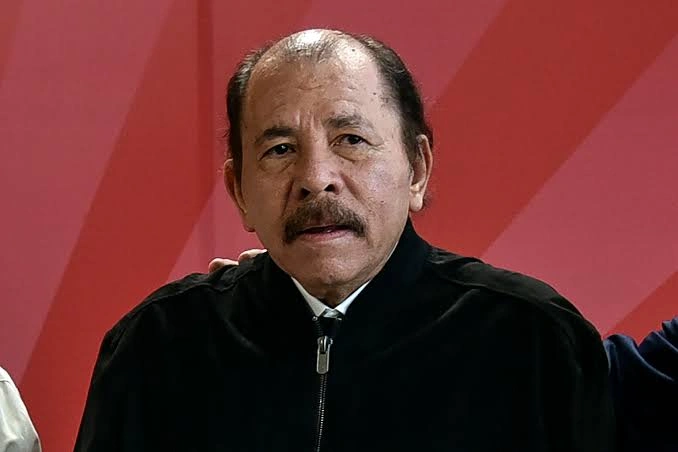
The Daniel Ortega regimehas reinforced its control over religious demonstrations in Nicaragua by vetoing thousands of Holy Week processions.
The measure, which has been repeated for several consecutive years, consolidates a scenario where faith is relegated to the private sphere, far from the streets that were historically its most vivid expression.
According to different reports, more than 20,000 processions have been banned in the last three years, in a policy that not only limits religious freedom, but also profoundly alters one of the country's most deep-rooted cultural traditions.
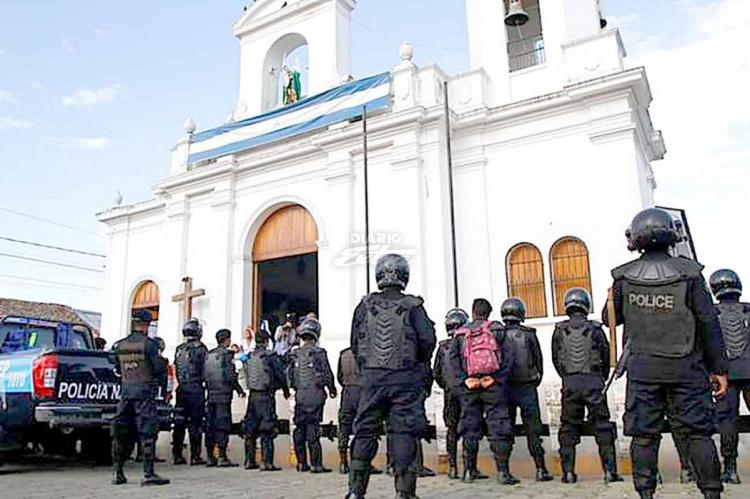
Nicaraguan police surrounding a Catholic church
Nicaraguan Holy Week, with its symbolic and popular richness, has been for generations a community and spiritual meeting point that
is now severely restricted.
Since 2023, the Ortega dictatorship has imposed a total ban on processions on public roads, allowing only celebrations inside temples, under strict surveillance.
This decision has been interpreted by various sectors as part of a broader strategy of social control, in which any collective demonstration, even religious, is viewed with suspicion.
The background of these measures dates back to the 2018 protests, when the Catholic Church assumed a critical role in the face of the communist regime.
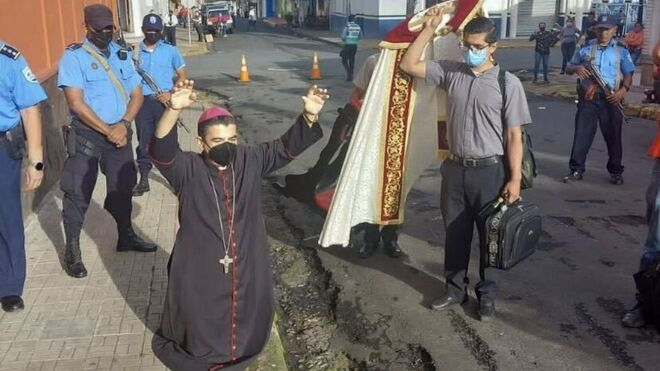
Nicaraguan father arrested for protesting against the Ortega regime
Since then, the bond between the two parties has steadily deteriorated, leading to increasing restrictions, vigilance over the clergy, and limitations on
public expressions of faith.
In this context, the prohibition of processions is not an isolated event, but part of a systematic policy aimed at reducing the influence of the Church in public life.
The consequence is a society where centuries-old traditions are displaced by administrative decisions that prioritize control over coexistence.
Beyond the religious level, the impact of these measures is also felt on the social fabric. The processions not only represent acts of faith, but also spaces of identity, culture and community cohesion
.
Their absence leaves a gap that is difficult to fill and raises questions about the future of civil liberties in the country.
In short, what is happening in Nicaragua goes beyond religion: it reflects a model of power that, in its quest to consolidate, advances even on the most profound expressions of the cultural and spiritual life of its people.