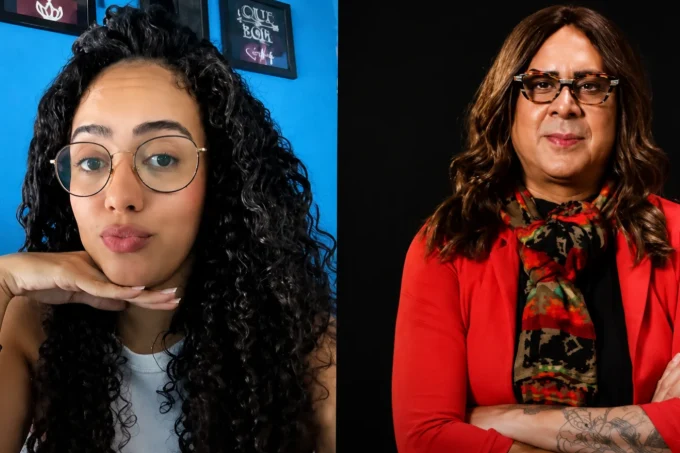
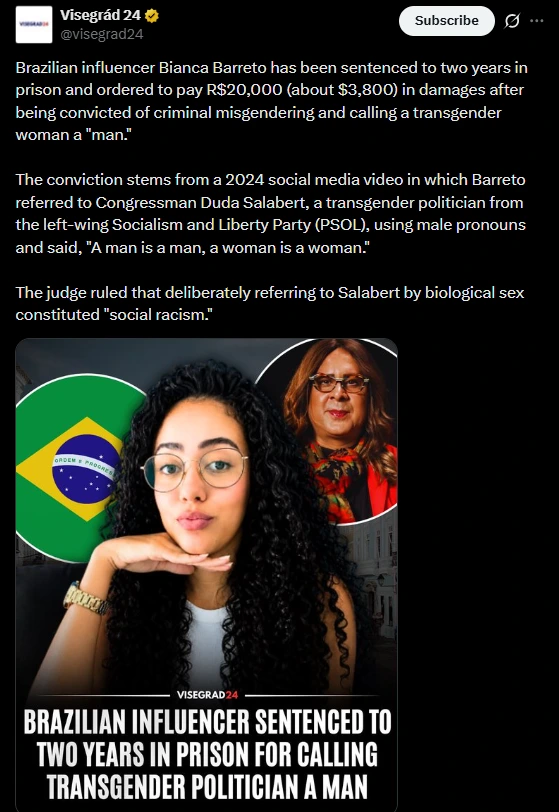
The Justice of Brazil has once again become the center of controversy after sentencing influencer Bianca Barreto to two years in prison for publicly expressing her views on the gender identity of a trans political leader. In addition to the prison sentence, Barreto will have to pay R$20,000 in damages, about US$3,800.
The case has generated strong criticism because the conviction stemmed from words expressed on social media, without any description of a threat or a call to violence against the person involved.
For many critics of the ruling, this represents a new advance of state power over freedom of expression, particularly regarding the ability of citizens to express controversial opinions on issues of sex, gender, and identity.
The phrase that led to a prison sentence
The case began from a video posted by Barreto in 2024, in which she referred to Duda Salabert, a leader of the leftist Socialism and Liberty Party (PSOL), using masculine pronouns.
In the video, the influencer stated: "A man is a man, a woman is a woman".
The Justice system considered that Barreto had deliberately used Salabert's biological sex to refer to her and determined that this behavior constituted "social racism".
The result was a two-year prison sentence, in addition to the financial compensation.
The phrase that ended in a prison sentence
An opinion can lead to a person being imprisoned
The seriousness of the case lies not only in the financial penalty but fundamentally in the fact that a person can be deprived of their freedom for expressing a particular conception of sex and gender.
Barreto was not convicted for organizing an assault, threatening Salabert, or inciting her followers to attack her. The conviction occurred due to the content of her words.
This point is particularly concerning for those who advocate for a broad conception of freedom of expression: if the State can determine what way of referring to a person constitutes a crime and penalize someone for using a different definition, the line between protecting rights and censoring opinions becomes dangerously blurred.
The controversial use of the concept of "social racism"
Another of the most questioned aspects of the decision is that the court framed Barreto's statements as "social racism".
The use of a figure designed to combat discrimination to punish a discussion about gender identity raises questions about the expansion of criminal law into areas that historically belonged to public debate.
A democracy can and should protect individuals from violence, threats, and persecution. But protecting someone from an assault should not mean protecting them from an opinion they find offensive.
In a free society, ideas can be rejected, criticized, and even considered unpleasant. What is much more serious is that the State transforms those opinions into crimes.
The debate on freedom of expression in Brazil
The conviction of Bianca Barreto reopens a fundamental discussion: how far can the State go to impose certain forms of language?
The case also involves a political leader, making the discussion about the right to publicly question her positions and identity even more relevant.
Freedom of expression should not be reserved exclusively for opinions accepted by the majority or for those that do not generate controversy. Its true value appears precisely when it allows for the expression of uncomfortable, unpopular, or politically incorrect ideas.
The ruling against Barreto represents, from this perspective, a concerning precedent. That a person could end up sentenced to prison for publicly stating that she believes a man is a man and a woman is a woman is an alarming sign regarding the state of freedom of expression.
The debate can be intense, positions can be diametrically opposed, and words can generate rejection. But the response in a free society should be more discourse, not prison.