

At the beginning of 2026, the Argentine economy was going through a period of transition marked by contrasts, but with a clear axis: the consolidation of a process of macroeconomic stabilization sustained by the fiscal surplus and a monetary policy aimed at normalizing the exchange rate regime. After years of structural imbalances, the organization of public accounts is positioned as the central pillar of the economic program. In this context, international organizations such as the Inter-American Development Bank project growth of close to 3.8% by 2026, placing Argentina as the fastest expanding economy in the region. This scenario responds to a combination of factors: structural reforms, investment incentives and a sustained reduction in fiscal pressure
.Key tools include the Incentive Regime for Large Investments (RIGI), which has allowed the unlocking of large scale projects in strategic sectors such as oil and mining. Added to this is the reduction of withholding from regional economies and the reduction of import tariffs, measures that lowered the cost of capital goods and productive inputs
, strengthening competitiveness.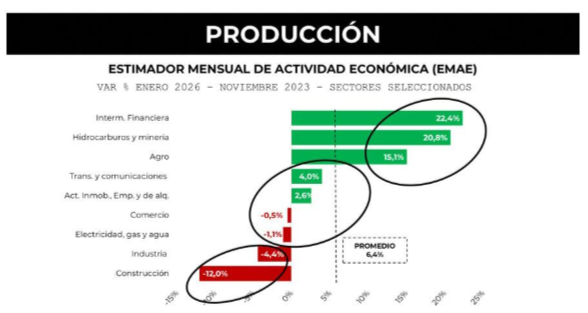
Dynamic sectors: the drivers of the new model The new
economic scheme shows strong sectoral heterogeneity. While the aggregate level of activity shows growth, certain sectors are clearly leading. Economist Daniel Garro, director of Value International Group, says: “Everything that is energy, oil, gas, agro-industry, agriculture and financial services are the strongest part and will continue to be consolidated in the future.” In addition, he emphasizes that: “macroeconomics orders the scenario so that microeconomics resolves its efficiency”, referring to the impact of the reforms
.Along the same lines, José Vargas, director of Evaluecon, describes the model as one of “two engines”, where activities with comparative advantages lead growth. It identifies Vaca Muerta, mining (lithium and copper), agro-industry and the knowledge economy as the main winners
.The data support this trend: Financial intermediation:
+24.7% in 2025
Mining and quarrying: +8% Energy surplus:
USD 7,815 million
For his part, Osvaldo Giordano, president of Ieral, points out that between November 2023 and January 2025, activity grew 6.4% according to the EMAE, although with strong disparities.Highlights: “Financial intermediation, mining and hydrocarbons and agriculture are the most dynamic sectors. Industry and construction record strong declines.” For Giordano, the future will depend on the depth of the reforms: “It depends on many factors, a very important one being the speed at which reforms that improve the environment for productive activity are progressing
.”The impact of sectors such as Vaca Muerta already generates indirect effects on the real economy. According to Vargas: “The impact of Vaca Muerta is channeled through value chains such as logistics, transportation, infrastructure and industrial metalworking services.” Garro, meanwhile, warns of an emerging demographic phenomenon: “There are beginning to be a lot of moves, people moving from big cities to the interior”, stressing that the interior is more efficient “as there are no longer distributive policies”. While Giordano is cautious, he recognizes that full development will come with energy infrastructure that allows abundant and cheap gas, boosting new industries