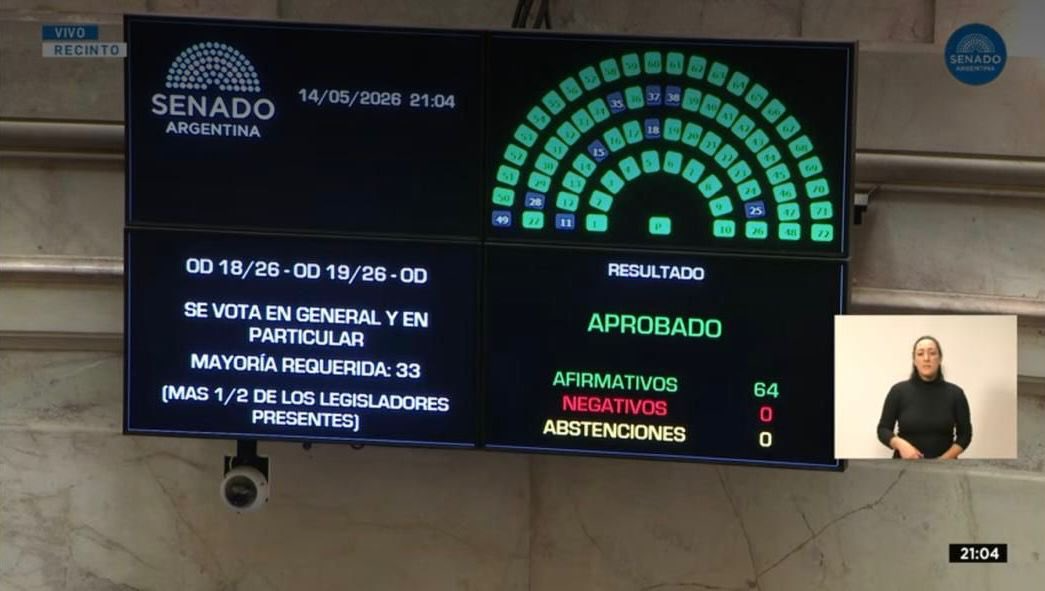
Argentina took a new step in its strategy of commercial opening and deepening international ties. The Senate approved this Wednesday the Free Trade Agreement between MERCOSUR and Singapore, the first agreement of this kind signed by the South American bloc with a Southeast Asian country. The initiative was unanimously supported in the upper house and represents a strong boost for Argentine exports and the arrival of investments.
The agreement was originally signed on December 7, 2023, in Rio de Janeiro and has now progressed in the Argentine Congress with half legislative approval. From the Foreign Ministry, it was highlighted that the agreement opens the door to new strategic markets in Asia and positions Argentina in a key region for global trade.
The agreement was approved unanimously.
One of the central points of the treaty is that 100% of Argentine exports will enter Singapore with zero tariffs. It is a highly developed economy, with a per capita GDP exceeding USD 90,000 and one of the main financial and logistical centers in the world. The agreement also aims to facilitate investments, especially in sectors related to energy, mining, and knowledge-based services.
During the committee discussion, the Secretary of International Economic Relations, Fernando Brun, stated that the agreement will enhance Argentine exports and strengthen the country's international integration. He also explained that Singapore serves as a strategic platform for future negotiations with other Asian countries such as Japan, South Korea, Vietnam, and Indonesia.
Brun also emphasized that Singapore has enormous investment funds and that currently only a small percentage of those resources reaches Latin America. He explained that the treaty seeks to create conditions to attract part of that capital to Argentina, in a context where the Government of Javier Milei is betting on a more open economy, integrated into the world, and with greater involvement from the private sector.
The progress of the treaty also marks a change in direction compared to previous years, when MERCOSUR remained practically stagnant in terms of new trade agreements. While much of the world deepened its economic integration, Argentina accumulated decades of isolation, bureaucratic hurdles, and loss of competitiveness.
With this new understanding, the Government seeks to consolidate a foreign policy focused on trade, investments, and generating sustained economic growth. For the Government, greater international openness is key to increasing exports, generating private employment, and recovering the dynamism of the Argentine economy.