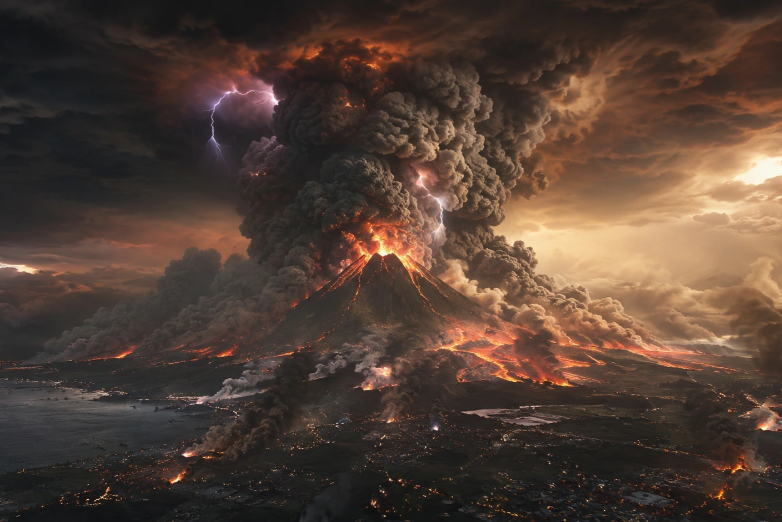

74,000 years ago, the Earth experienced one of the most devastating volcanic eruptions in the last 2.5 million years. The supervolcano Toba, located in what is now Indonesia, released an enormous amount of ash that affected the entire planet. Scientists believe this caused years of darkness and intense cold, leading some to think that humanity was close to extinction.
However, recent archaeological findings in Africa and Asia show a different story. Instead of collapsing, communities of Homo sapiens demonstrated a remarkable capacity for adaptation. They developed new tools, changed their survival strategies, and showed notable flexibility in the face of extreme conditions.
The eruption was more than 10,000 times greater than that of Mount St. Helens in 1980. It launched 2,800 cubic kilometers of volcanic material into the atmosphere and left a gigantic crater. Near the site, acid rain and layers of ash destroyed vegetation and wildlife. Still, our species survived.
 Was humanity on the brink of extinction?
For years, the Toba catastrophe hypothesis suggested that a volcanic winter lasting up to six years reduced the global population to fewer than 10,000 individuals. Genetic studies support the idea of a population bottleneck, with lower genetic diversity in modern humans. But the debate remains open: was Toba the cause, or were there other factors?
To answer this, archaeologists use tephra, volcanic material that includes microscopic fragments called cryptotephra. These volcanic glasses travel great distances and have unique chemical signatures that allow for the identification of the exact eruption.