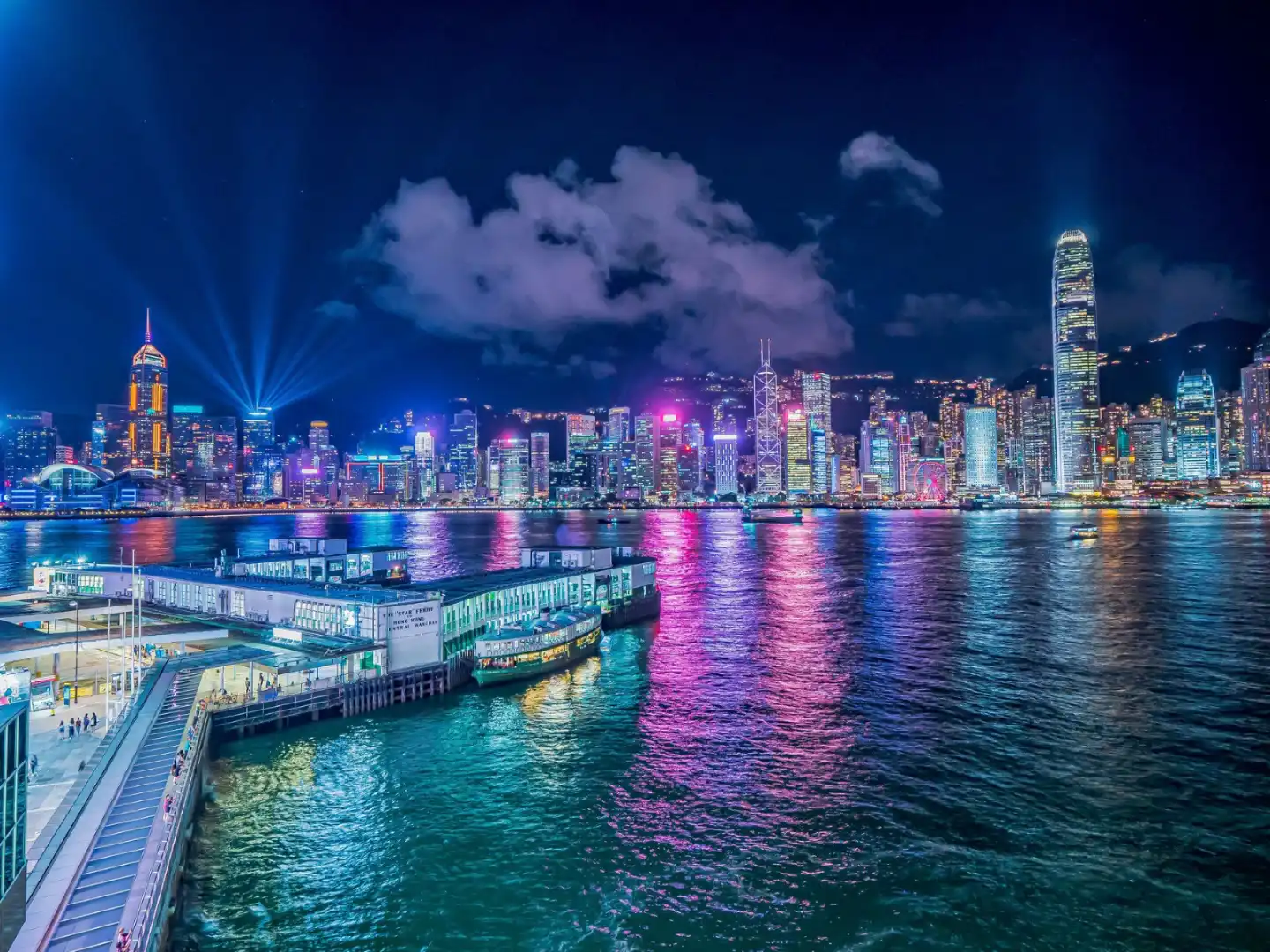
The story about the strong economic growth of Hong Kong exposed the ultra-Kirchnerist journalist Ernesto Tenembaum during his program on Radio Con Vos.
While conversing with Diego Iglesias, who is traveling in China, Tenembaum tried to find the reasons behind the extraordinary development of the city and pointed to a possible planning and socialist measures by the Chinese regime, although he ended up being educated about the economic history and liberalism applied in the great Asian metropolis.
The exchange began when Iglesias described the economic magnitude of Hong Kong and its evolution: "In fact, I arrived in Hong Kong on the plane and crossed the bridge by car. Well, today there are 17 million people here, 46 years later. 46 years later, it is the third city in terms of GDP in all of China."
"If you compare the GDP of China, of this city, just of the city, with that of Argentina, they are almost the same, because the GDP here is 550 billion dollars", the journalist explained.
In light of that data, Tenembaum sought an explanation for such growth. However, his argument was marked by his strong ideological bias, and he ended up discovering a completely different reality.
"Now, what happened? What made that city grow like this? What triggered that? It must be a planned process, right? The Chinese government, because there is little spontaneity in China. The Chinese government decides, there is going to be a big city," he wondered.
The economic freedom applied in Hong Kong
Iglesias, on the other hand, explained the economic reforms implemented in China starting in 1980 and, particularly, the experiment carried out in Shenzhen.
"To understand modern China, the China we know today, which surprises us all when compared to the image we had of China decades ago, you have to understand Shenzhen, because Shenzhen is the first city that transformed into a special economic zone", he pointed out.
Hong Kong
As Iglesias explained, in 1980 the Chinese Communist Party, under the leadership of Deng Xiaoping, decided to carry out an experiment that involved applying a market economy in Shenzhen, while the rest of the country maintained the communist system.
In this context, measures such as: price liberation, the system of supply and demand, tax incentives, zero tariffs for machinery and raw materials destined for export products, and fewer bureaucratic obstacles than in the rest of China were implemented.
Iglesias maintained that those conditions allowed Shenzhen to transform, and when the experiment began to show positive results, the model started to spread to other areas of the country.
"And so they were transferring and creating more special economic zones in China. And then, well, the model transformed into what we know today, which is, I don't know, socialist capitalism or this very particular model that only China has and cannot be transferred anywhere else in the world", he concluded.
The exchange highlighted Tenembaum, who sought an explanation based on state planning to understand the development of Hong Kong and its surroundings, but ended up being educated about the success of the market economy.