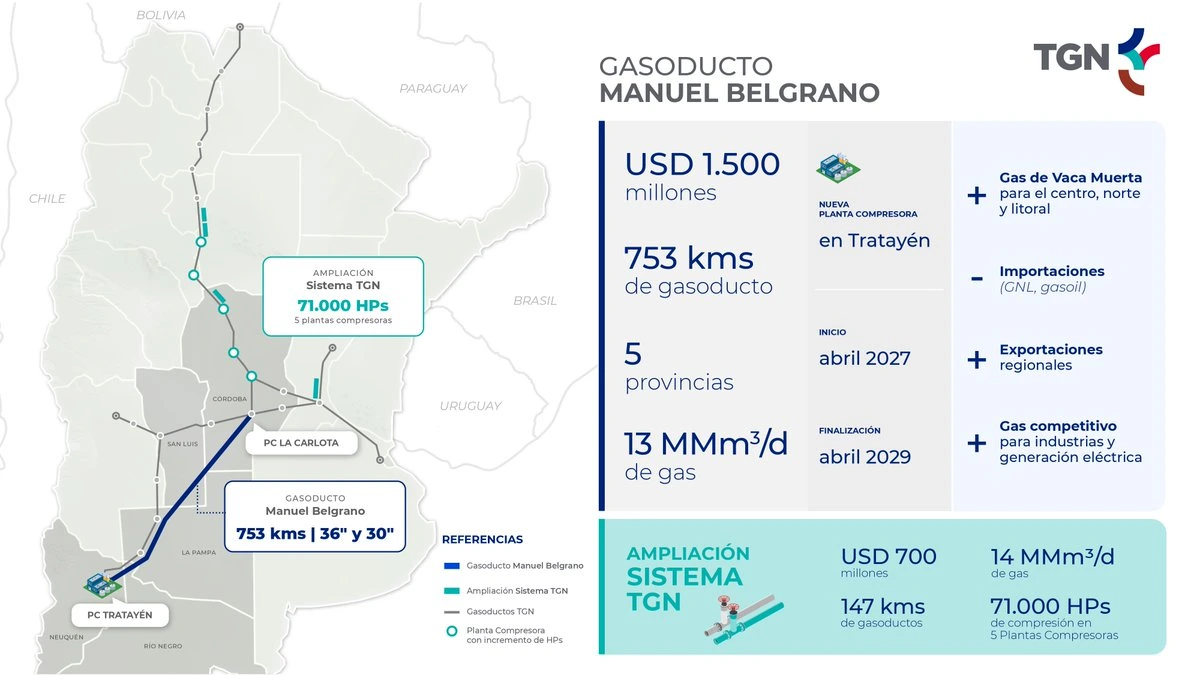
Transportadora de Gas del Norte (TGN) announced an investment project of approximately USD 2.2 billion to build the Manuel Belgrano Gas Pipeline and expand its current transportation system, aiming to transport a greater production from Vaca Muerta to the center, north, and coast of Argentina.
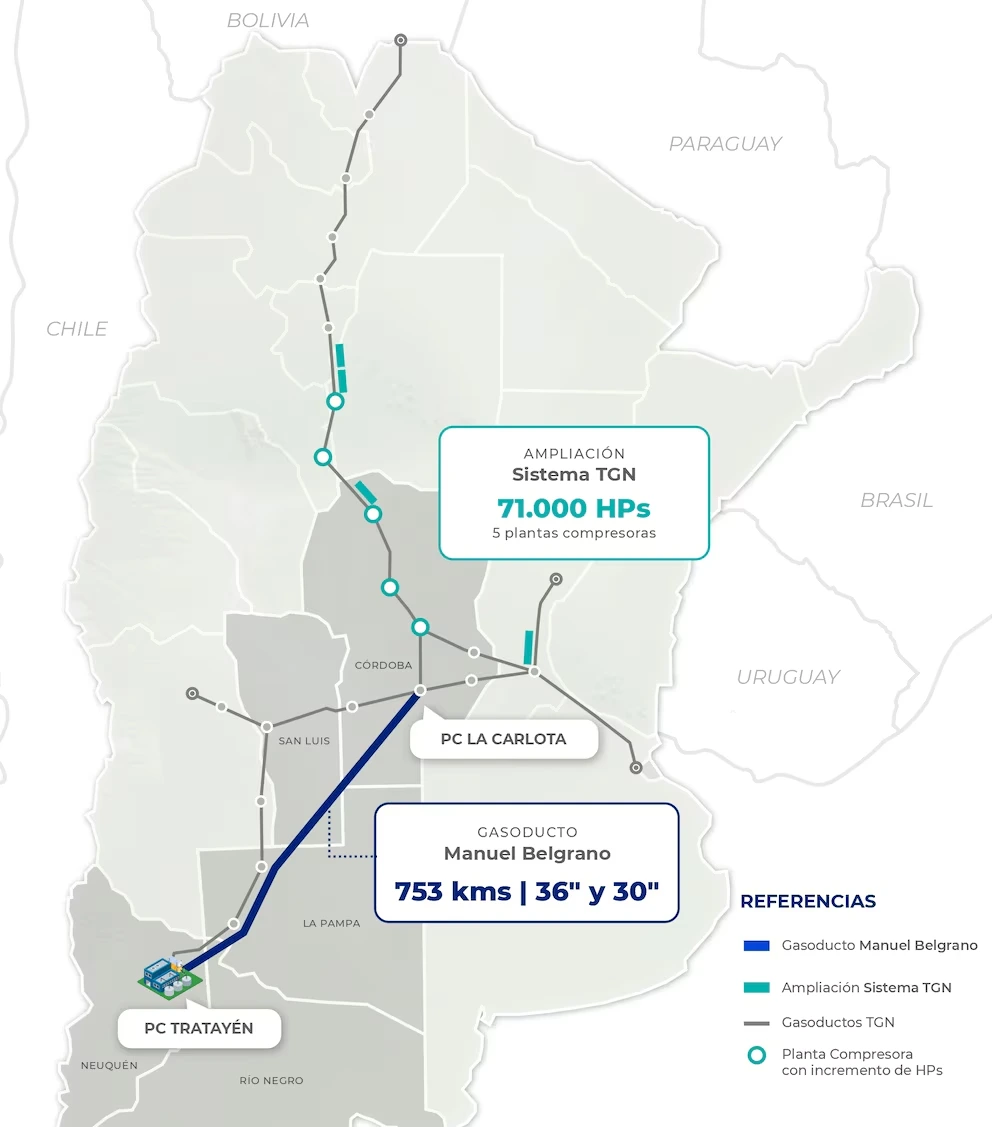
The main work will require about USD 1.5 billion and will consist of a 753-kilometer gas pipeline between Tratayén, Neuquén, and La Carlota, Córdoba. The route will cross Neuquén, Río Negro, La Pampa, San Luis, and Córdoba.
The project will have an estimated initial capacity of 13 million cubic meters of gas per day, and the company expects it to be operational by April 2029. Its goal will be to primarily supply industries and power plants, in addition to generating new capacity to export gas to neighboring countries.
In addition to the USD 1.5 billion for the new pipeline, up to USD 700 million will be added for complementary works on the TGN System. These investments include 147 additional kilometers of pipelines and up to 71,000 HP of new power distributed among five compressor plants.
According to estimates released by the company, the infrastructure would allow for an annual reduction of approximately USD 700 million in fuel imports such as LNG and diesel, by replacing them with locally produced gas. At the same time, it would open the possibility of generating additional exports of about USD 450 million per year.
At the peak of construction, TGN estimates that the project will require around 2,000 jobs. The company also highlighted that the expansion will allow for the evacuation of greater volumes from the Neuquén basin, including gas associated with the growth of oil production.
Manuel Belgrano Gas Pipeline
The process will begin with a call for a capacity tender for the new gas pipeline scheduled for the end of September. The submission and awarding of bids is projected for the end of November. Additionally, TGN announced that it will present the project to the Ministry of Economy to request its adherence to the Incentive Regime for Large Investments (RIGI).
The initiative thus aims to resolve energy transportation restrictions, expand supply with production from Vaca Muerta, and simultaneously strengthen the substitution of imports and the regional gas exports.