





At a national level
Just like in CABA, the most recent report from the poverty nowcast prepared by the Torcuato Di Tella University (UTDT) reveals a new drop in poverty rates in Argentina.

These figures represent a huge decrease compared to the first quarter of the year






Just like in CABA, the most recent report from the poverty nowcast prepared by the Torcuato Di Tella University (UTDT) reveals a new drop in poverty rates in Argentina.
In a recent report published by the Institute of Statistics and Census of the City of Buenos Aires, a significant reduction in poverty and extreme poverty levels in the Argentine capital during the fourth quarter of 2024 was revealed.
These data reflect a remarkable improvement in the living conditions of the residents of Buenos Aires, which reflects the success of the economic policies implemented by the Government of Javier Milei, whose administration achieved an impressive economic recovery.
According to the report, poverty fell and affects 19.3% of households (260,000 households) and 24.2% of people (746,000 people) in the city.
These figures represent a substantial decrease compared to the first four months of the same year, amid the economic crisis inherited from Kirchnerism, when 30.4% of households (411,000) and 35.1% of people (1,083,000) were in poverty.
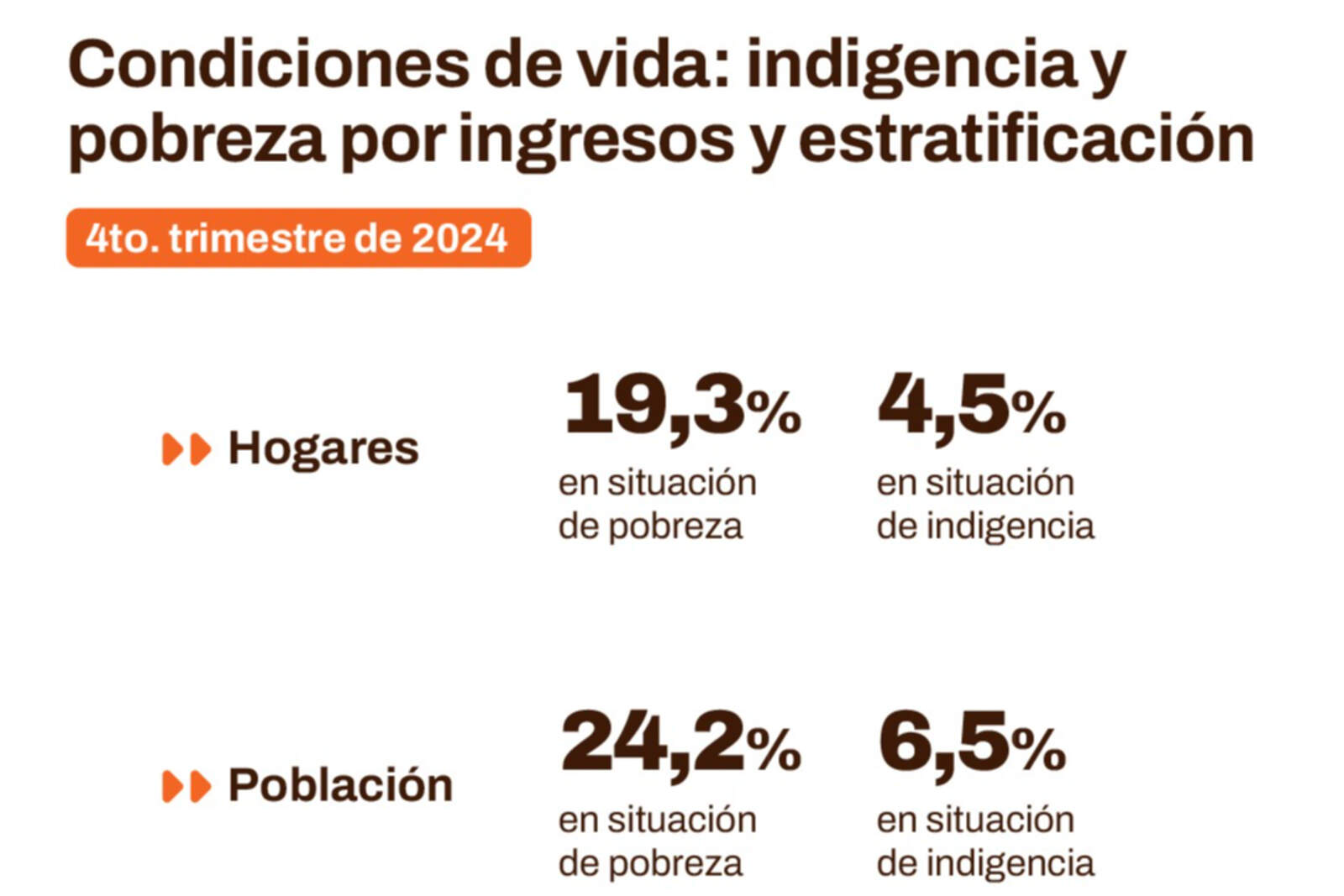
Meanwhile, extreme poverty experienced an even more pronounced reduction, dropping from 10.8% of households (146,000) to 4.5% (60,000 households), and from 15.3% of people (471,000) to 6.5% (200,000 people). These numbers demonstrate a positive trend that highlights the effectiveness of the economic measures promoted by Milei's Government.
At the same time, the reduction in poverty and extreme poverty didn't occur only in CABA, but also at a national level, with a percentage of poor people close to 30%, after having reached more than 50% due to Kirchnerism.
This report, based on updated data from the Permanent Household Survey (EPH) of INDEC, estimates that the national poverty rate for the fourth quarter of 2024 stands at 35%, while for the January-February bimonthly period of 2025 it dropped to 33.6%.
However, an impressive piece of news is that, for the semester from September 2024 to February 2025, poverty fell to 34.9%, the lowest figure since 2019.
Additionally, according to the study, the poverty rate was 38.8% for the third quarter of 2024, 35% for the fourth quarter, and 33.6% for the January-February bimonthly period of 2025, a drop that hadn't been seen for many years.
In terms of people, projections indicate that 10 million Argentines have come out of poverty compared to the beginning of last year.