The data comes from the latest Monthly Gross Domestic Investment (IBIM) report prepared by OJF
Compartir:
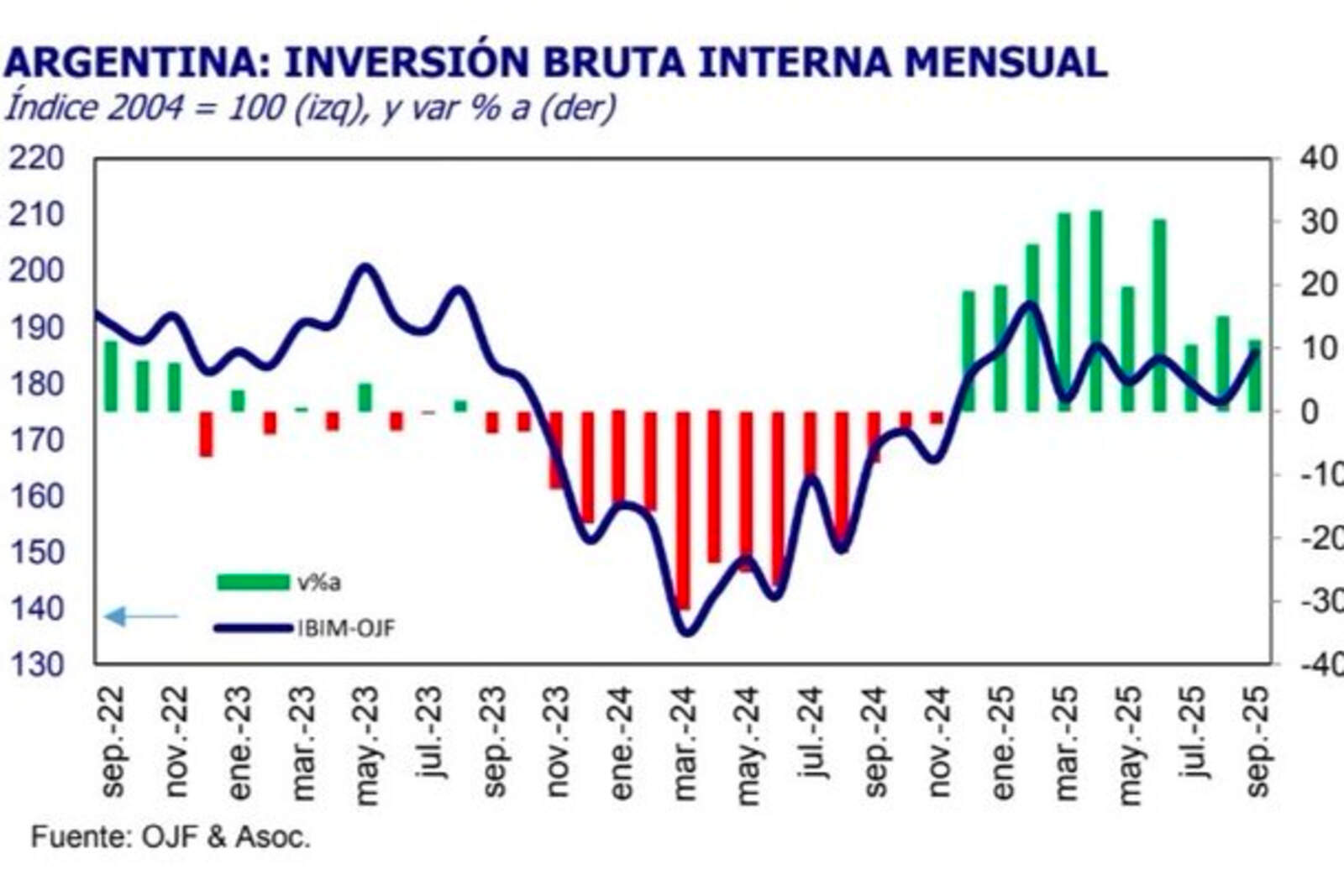
Real investment in Argentina recorded a remarkable 11.3% year-on-year growth in September, reaching the equivalent of 7.929 billion dollars, according to the latest Monthly Gross Domestic Investment (IBIM) report prepared by OJF.
This progress reflects the success of an economic program favorable to investment, driven by the policies implemented by the Government of Javier Milei, which sought to provide legal certainty and improve macroeconomic stability.
The breakdown of the data reveals that the largest contribution came from the machinery and equipment sector, which in September recorded a 22.1% growth. This result marks sustained progress so far this year, with a cumulative increase of 40.4% in the first nine months of 2023.
Los datos de OJF.
Investment in imported machinery stood out with a 40.6% increase, while investment in domestic machinery showed a slight decrease of 0.1%. This behavior indicates that Argentine entrepreneurs are confident in strengthening their productive capacity, particularly through state-of-the-art equipment that can increase the country's industrial and technological efficiency.
Meanwhile, the construction sector showed a slight contraction of 0.6% in September, accumulating 3.2% growth so far this year. Despite this slight monthly decrease, overall investment keeps positive figures and the dynamics of the construction sector could regain momentum with the continuation of policies that foster stability and investor confidence.
Javier Milei, presidente de Argentina.
The OJF report highlights that, although investment still depends largely on machinery imports, the current context reflects a new stage of economic order and predictability that Milei's Government has promoted. Expectations regarding the evolution of the dollar and exchange rate stability are consolidating as determining factors for investment decisions, and the current economic policy seeks precisely to reduce these uncertainties.
In this context, in a scenario of exchange rate calm and a government committed to fiscal discipline, as is currently the case, a multiplier effect on investment can be caused, encouraging the modernization of productive infrastructure, industrial development, and job creation. The combination of pro-investment policies and greater economic predictability is laying the foundation for Argentina to consolidate sustained long-term growth.