
The Judiciary and the Constitution

The Judiciary and the Constitution
Imagen de Editorial Team
porEditorial Team
Argentina

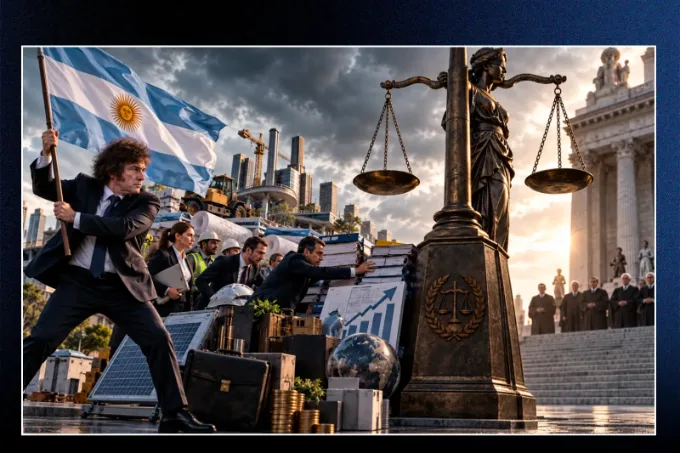
In every sense, the Judiciary is a key issue, because many of the legal and economic reforms that are so essential can be hindered, distorted, or at least delayed by some judges

Add La Derecha Diario on
Share:

It is unavoidable that people, businesses, and potential investors regain the trust that Justice has lost. Therefore, we must continuously and deeply analyze what to do to have a better Judiciary and continue recovering the freedoms that statism has taken away from people for 80 years.

The predominance that Peronism has had in the Senate since 1983 has allowed and still allows it to decisively influence the appointment of all judges.

This is not limited to the agreement of the Supreme Court judges; this weakness extends to all national and federal judges, which is why Alfonsín, de la Rúa, Macri, and Milei have not been able to do without the consent of the PJ to fill judicial vacancies until today.

With the Council of the Judiciary, this fragility projected into the candidate selection process, given that this new body, created in theory to reduce judicial politicization, has not achieved that and worse: it has remained politicized throughout its journey, from the call for the competition to the senatorial agreement.

Obviously, there are judges who - beyond their political convictions - honor their positions, but those virtues are not increasing but decreasing and the negative image of the judiciary is already approaching 90%.

The 16 years in which Kirchnerism governed worsened the situation, and we are seeing the fruits of so many bad appointments, with activist judges who, when the PJK is not in power, obstruct those who have won in democratic elections.

The abuse of judicial power

The abuse of judicial power was suffered by de la Rúa, even more so by Macri, and now it is Milei's turn to see how laws approved by Congress are halted by judges who believe they have the right to decide which norms are valid and which are not, far beyond the maturity, restraint, and legal seriousness that our magistrates displayed when evaluating the constitutionality of laws just a few decades ago.

The diffuse control of constitutionality has become the tool with which Kirchnerist judges prevent the changes voted for by the people when they elected Javier Milei.

Is there a way to correct this? The enactment of a good collective actions law is one way to prevent the dictatorship of judges, but La Libertad Avanza does not yet have the legislative majority needed to approve it, because the opposition does not want a law that imposes serious conditions on class or collective actions, which they use to hinder the government's management.

There are other safeguards against these judicial abuses, but they have not been effective until today.

A system where judges are almost unaccountable

The reality is that judges are almost totally immune: very few of them have been subjected to impeachment by the Council of the Judiciary and even fewer have been removed by the Impeachment Jury.

Reasons? Several.

First, the politicization of the system, which often turns the coexistence between politics and justice into a collusion where the most basic ethical principles of the judiciary are violated, without anything happening, because the Council of the Judiciary has politics in the representatives of deputies and senators, politics in the representatives of national universities, politics in the representatives of lawyers, and politics and colleagues of the potential impeached, in the representatives of judges. Analyzing the reality of each stratum requires a space that we do not have now, but for a sample… the reality is enough.

Secondly, a well-intentioned thesis has consolidated in its origin but is exorbitant and very poorly applied in its development: "Judges cannot be judged by the content of their rulings" is mechanically repeated, without understanding that by not limiting that rule, we place a group of individuals above the laws in everything that concerns their work.

Such privilege is unconstitutional, contradictory to the crime of prevarication in the Penal Code, and allows total impunity for magistrates, attributing to them the privilege of inviolability of the King of Spain, which evidences the exaggeration of such a doctrinal principle elevated to unwritten law by those who benefit from it.


Thirdly, the Supreme Court, which could act swiftly, energetically, and rigorously against judges who abuse their power and engage in politics by preventing the enforcement of certain laws, continues – except for very rare exceptions – to measure time with a nineteenth-century slowness incompatible with the vertigo of the 21st century and acts with exaggerated self-censorship. If it only acted against those despotic judges and revoked their rulings, also denouncing them before the Council of the Judiciary, the excesses that are becoming more frequent would surely decrease significantly.

Without a better Justice, there will be no lasting reforms

Without a better Judiciary, the efforts of the people, full freedom, better laws, and more investments are not enough.

In recent years, the Judiciary has shown that it does not know, cannot, or does not want to correct its weaknesses and errors. The first obligated are the Supreme Court and each of all judges, due to their own function and because they enjoy a battery of privileges and guarantees to feel, be, and act independently and decently.

There continues to be a minority of bad judges, for whom high salaries, excellent benefits, princely retirement plans, enviable working hours, and absolute stability that even the Kirchners could not break are not enough.

What should change in the judicial system

It is not about changing everything but about changing some key points, of varied importance but similar beneficial effects. To mention just a few:

The power of the Court is enormous, greater than that which arises from the laws, because judges and officials know that their careers, promotions, and other conditions depend on it. It must be structured in such a way that no one, neither from outside nor inside the Judiciary, dominates the system and syndicates it.

The Council of the Judiciary must be profoundly restructured, with much less politics, brief competitions without delays, modern evaluations and not just academic ones, individually voted lists without manipulation in personal interviews.

The Impeachment Jury should be reduced to 3 people, preferably already retired, because no legislator, judge, or active lawyer is truly free to judge a judge who may later judge them, or whose friends and colleagues will continue to do so.

A Judicial Ethics Law is essential, like the excellent Bangalore Code of the United Nations.

Judges and officials must be truly full-time, with realistic hours and without activity in entities like the AFA or in teaching while the court is backlogged.

The administration of personnel and resources must be carried out by professionals in those activities, not by lawyers, whom no faculty trains for that.

The procedural codes must be simplified to the maximum, including the reduction of appeals to one only, except in cases of arbitrariness, with modern evidentiary means, compatible with secure computing.

The performance of the judicial system must be permanently audited. The interest rate must be a single and unique one. Expert fees must be independent of the lawsuit. Psychiatric reports must be binding, except for contrary opinions from other professionals in the same discipline: psychiatry has been a science for too many years for some judges to dismiss expert opinions because they believe they know more, just for being judges. Many fatal victims could have been saved if the guarantee-abolitionism were, at least, reasonable.

Equal before the law, including judges

The 21st century can no longer tolerate impunity. Social networks have broken the shadow that hid the powerful, whether they are politicians, businessmen, union leaders, judges, athletes, journalists, or artists. Absolutely everyone is equal before the law and must be.

Citizens must be demanding with the Judiciary, and the Judiciary must be demanding with those who violate the laws. It is not that difficult, but it requires courage.

A lot of courage.


La Derecha Diario logo
TwitterInstagramYouTubeTikTokFacebook
Derecha Diario TV

Nosotros

  • Quienes Somos
  • Autores
  • Donar

Privacidad

  • Protección de datos
  • Canales
  • Sitemap
  • RSS

Contacto

  • info@derechadiario.com.ar
PUBLICIDAD
La Derecha Diario logoLa Derecha Diario logo
ESX logoInstagram logoYouTube logoTikTok logoFacebook
ARGENTINAUNITED STATESECUADORISRAELMEXICODERECHA DIARIO TV
  • ES
    XInstagramYouTubeTikTokFacebook
  • DERECHA DIARIO TV
  • Sections
  • ARGENTINA
  • UNITED STATES
  • ECUADOR
  • ISRAEL
  • MEXICO
  • URUGUAY
  • Countries
  • La Derecha Diario logoLA DERECHA DIARIO
  • La Derecha Diario México logoLA DERECHA DIARIO MÉXICO
  • La Derecha Diario Uruguay logoLA DERECHA DIARIO URUGUAY
  • La Derecha Diario Ecuador logoLA DERECHA DIARIO ECUADOR
  • La Derecha Diario Israel logoLA DERECHA DIARIO ISRAEL
  • La Derecha Diario Estados Unidos logoLA DERECHA DIARIO ESTADOS UNIDOS
  • Topics
  • GUERRA EN IRÁN
  • LAS MALVINAS SON ARGENTINAS
  • The Newspaper
  • QUIENES SOMOS
  • AUTORES
  • PUBLICIDAD
  • DONAR

Related news

The Danger of a Superintelligent Artificial Intelligence: Panic on the Left

The Danger of a Superintelligent Artificial Intelligence: Panic on the Left

Tucker Carlson supported the Democrat Abdul El-Sayed: he seeks to be the first Muslim senator in history

Tucker Carlson supported the Democrat Abdul El-Sayed: he seeks to be the first Muslim senator in history

Cristina's Bunker K: the camporista Mariano Recalde owns an apartment at San José 1111

Cristina's Bunker K: the camporista Mariano Recalde owns an apartment at San José 1111

Falklands: one cause, one flag, one Nation

Falklands: one cause, one flag, one Nation

Ramos Napoli explained the new model for the RA-10 and a nuclear development with private capital

Ramos Napoli explained the new model for the RA-10 and a nuclear development with private capital

Milei repealed the dictatorship decree that granted royalties to La Pampa for energy generated in Mendoza

Milei repealed the dictatorship decree that granted royalties to La Pampa for energy generated in Mendoza