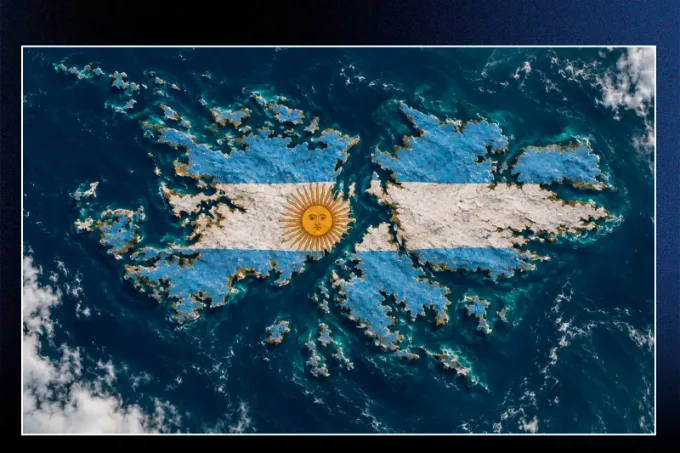

There are causes that belong to a government, a party, or a generation. And there are causes that belong to a Nation, the Malvinas is one of them.
That is why, talking about our islands is not just talking about a war. It is talking about history, about rights, about sovereignty, and about a claim that Argentina has upheld for almost two centuries.
But to defend the Malvinas, it is not enough to be emotional; we must know the reasons that support us. Because our rights did not arise in 1982, with the war. Their origins go much further back and are based on a chain of historical, legal, and diplomatic titles that begins with Spain and continues with independent Argentina.
The work of Foreign Minister Juan Aguirre Lanari in “Argentine Titles of Sovereignty over the Islands” offers a summary of those foundations, Argentina inherited from Spain the rights that the Crown exercised over those territories, and before our independence, there were precedents of discovery, occupation, and Spanish administration over the archipelago.
The expeditions of the 16th century and the cartography of the time are part of those precedents; long before the dates that Great Britain invoked to claim a supposed priority in discovery, the islands already appeared on European and Spanish maps.
But there is an even more important element, Spain effectively exercised its sovereignty over the Malvinas; in 1764, France established a colony in Puerto Luis, renaming them illes Malouines (to Spanish Malvinas), but later recognized Spanish rights. Great Britain also attempted to settle on the islands; in 1770, Spain expelled the British occupants from Puerto Egmont, and after an agreement, the British definitively abandoned that settlement in 1774.
Spain then maintained effective occupation of the archipelago until the American independence process; during that period, twenty Spanish governors succeeded each other between 1767 and 1811. A fundamental legal issue, when the United Provinces began their independence process, they inherited the territories that had belonged to Spain according to the principle of uti possidetis juris. Malvinas was part of that territorial inheritance.
In 1820, Colonel of the Navy David Jewett formally took possession of the islands on behalf of the United Provinces; later, Luis Vernet received land grants, and on July 10, 1829, the Buenos Aires government created the Political and Military Command of the Malvinas. Argentina was exercising concrete acts of sovereignty.
Until January 3, 1833, that day, a British force occupied the islands and displaced the Argentine authorities; in response to the act of violence, Argentina protested; on January 15, Minister Manuel Maza requested explanations from the British representative in Buenos Aires, Philip Gore. The protest continued through the Argentine representative in London, Manuel Moreno, without obtaining satisfaction. And during the following decades, Argentina continued to claim its rights.
It did so in 1834, 1835, and 1842; efforts continued from foreign ministers such as Francisco J. Ortiz, Norberto Quirno Costa, and Estanislao Zeballos, and later Saavedra Lamas and Bramuglia; even in 1885, Argentina offered to submit the issue to arbitration, which Great Britain did not accept. There was, therefore, no Argentine abandonment of the issue.
And there was also no silence from Corrientes; from Corrientes, Pedro Ferré called for a response to what he termed “the national seizure of the Malvinas Islands,” demanding action from a national power, an army, and national revenue to address that urgency.
The Argentine right before the world
After World War II, a new international scenario emerged. The United Nations promoted the decolonization process, and the Malvinas became part of that debate.
UN General Assembly Resolution 1514, adopted in 1960, proclaimed the need to end colonialism and established a fundamental principle, any attempt to undermine the territorial integrity of a country, in whole or in part, is incompatible with the purposes and principles of the United Nations Charter.
In 1964, Argentine representative José María Ruda presented the foundations of our position before the United Nations; in 1965, one of the most important diplomatic events in our history occurred, the General Assembly approved Resolution 2065, which expressly recognized the existence of a sovereignty dispute between Argentina and the United Kingdom and invited both governments to negotiate a peaceful solution.
The international community recognized that there was a sovereignty dispute, and furthermore, the resolution did not accept the British claim to make the will of the island's inhabitants the determining factor in the matter. It spoke of their interests, which should be taken into account.