“Reducing public spending is the only sustainable way to lower the tax burden and remove that weight that presses down on the salaries of Argentinians. It would be great if the provinces did the same: less spending and less taxes. It will come. Thank you Javier Milei for setting the course. VLLC!”, expressed the minister on social media.
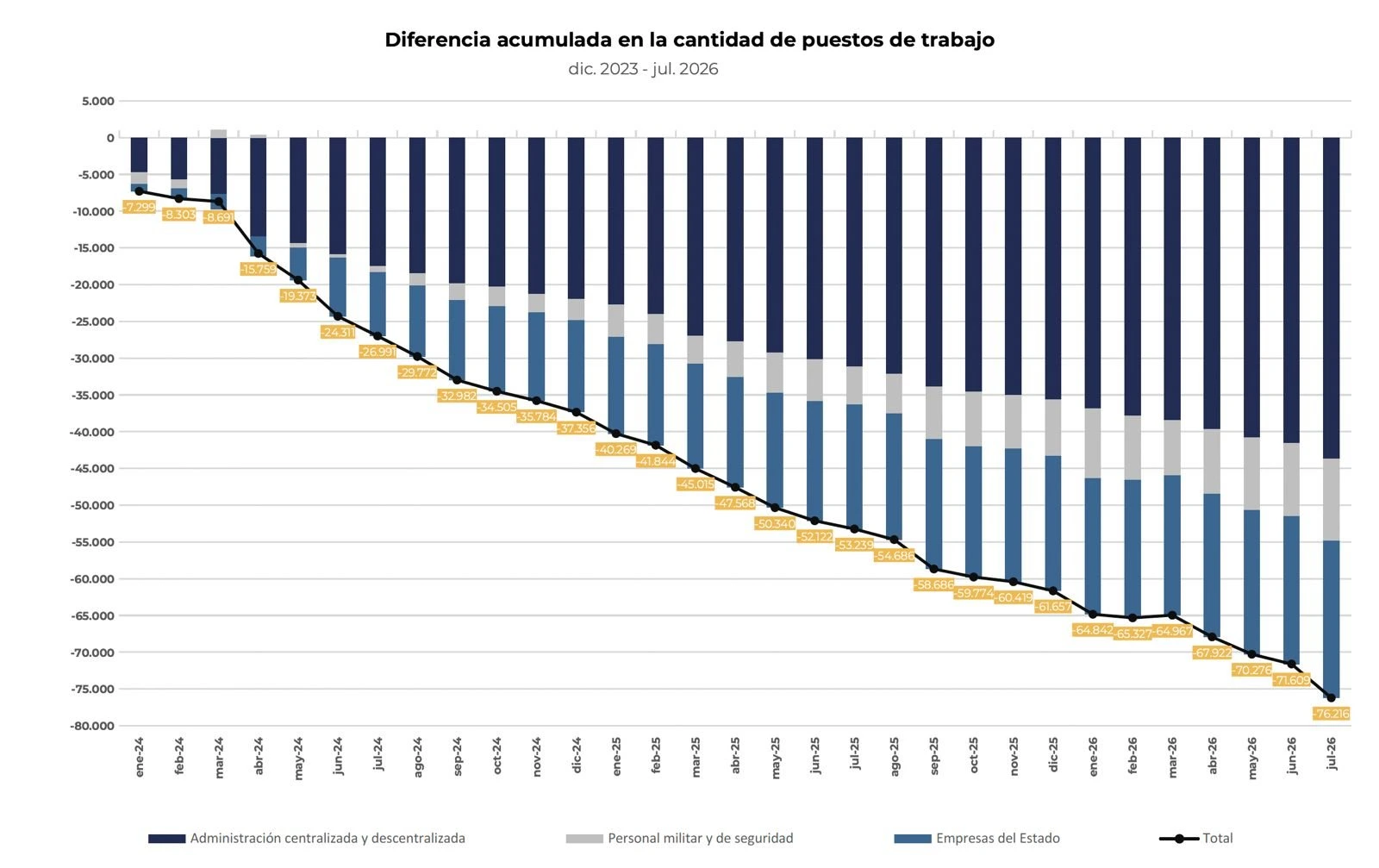
The Government of Javier Milei announced the elimination of 76,216 positions in the public sector between December 2023 and July 2026.
This was reported by the Minister of Deregulation and State Transformation, Federico Sturzenegger, who highlighted the impact of the measure on fiscal savings and tax reduction.
Through his account on X, the official published a new chart showing the evolution of the state workforce, where a sustained decline in the number of public employees during the analyzed period is evident.
The reduction of public employment
According to the published information, most of the cuts were concentrated in the centralized administration, decentralized administration, and state-owned enterprises.
According to official data, this reduction allowed for an annual savings of millions of dollars, in line with the Government's goal of reducing public spending and advancing with tax cuts, benefiting all Argentinians.
President Javier Milei
The initiative is part of the process of reorganizing the public sector promoted by the Government, which seeks to eliminate unnecessary structures and move towards a more efficient administration.
In this context, the reduction of state employment is one of the pillars of the economic strategy, focusing on reducing spending and consolidating fiscal balance.
The cut in the workforce is complemented by other measures aimed at deregulation and simplification of the State, in line with the reform program promoted by the Government since December 2023.
In this way, the national administration is advancing with a scheme of lower public spending, with a smaller State focused on essential functions, while reinforcing its message of efficiency and savings as the central axis of management.