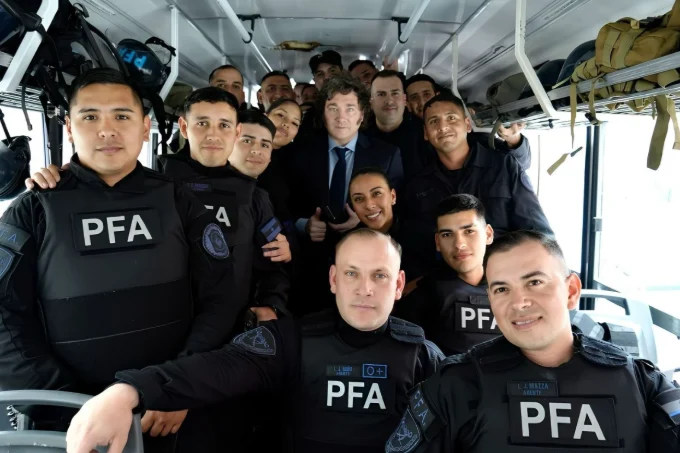

If there is one thing that characterizes the police and security forces in general, it is their high ideological homogeneity: they are all right-wing. However, they do not vote. They do not participate in the electoral process, which can be explained by two reasons: the first is the absence of a voting culture; having been extremely precarious in their jobs and marginalized from political life and institutional participation, they have become accustomed to not voting. They were never incorporated into the democratic process as subjects of rights, but only to act as its custodians.
The second reason is explained by the general occurrence that on election days they must work and are not allowed to vote; even if they want to, the electoral authorities do not include them in the list of voters for the polling stations or establishments where they must perform their duties, thus prohibiting them from casting their votes.
We see, then, how the electoral will and influence of a spectrum of more than three million right-wing voters is neutralized, including the approximately 850,000 members of the forces at all levels of governance and in all situations, multiplied by four for the family unit.
There is another factor that we must mention when describing the police ecosystem: they have high suicide rates. In the Province of Buenos Aires alone, it is four to five times higher than the average in society. More police officers die as a result of suicides than those who fall in the line of duty. While the issue of suicides is multifactorial, the impact of job precariousness on the psychological wear and tear of police officers is clear. However, we never hear any human rights organizations, leftist parties, or the usual Peronist and radical governors speak out and offer solutions regarding the epidemic of police suicides. The explanation is simple: they do not constitute their electorate. The suicides of right-wing voters are not relevant to the elite.
A question then arises: how to reverse this situation, what measures would be suitable and viable to adopt to improve the life project of the forces and involve them in politics, collectively and organically, for the first time, within the framework of democracy.
The proposal is to unionize them. A union is a governing instrument to guarantee correlating rights, such as collective bargaining, the right to strike, union protection, a tool to denounce labor exploitation and illegal orders without being exposed to sanctions or even the loss of their careers.
However, we must face a harsh truth: we do not like unions; they have always been part of the problem. We all know this, and in that line, the national government promoted the foundational law and labor reform, timid but welcome first steps.
Unfortunately, there is no plan B; given the Argentine legal context, the only reasonable option is for the national government to grant union registration to the police unions that exist, de facto and literally, in all jurisdictions of the country. It is the only power that the national executive possesses, unilaterally, to influence the issue.
Labor law is substantive law, meaning it is up to the national government to resolve the matter, according to Article 75, paragraph 12 of the National Constitution. Furthermore, this measure would not imply any budgetary expenditure for the national government and is a process that can be regulated and managed. Far from a Manichean perspective, gradual and incremental recognition of the right in the different provinces that make up the country is feasible.
The alternative would be to place expectations on provincial legislatures to enact a law recognizing the unionization of the forces, which is delusional. They respond to the governors, who would lose economic and political power in two ways: first, they would be responsible for financing the rights arising from union freedom; second, they would be deprived of the income derived from illegal collection schemes imposed, against their will, on the police.
In the Province of Buenos Aires, which has 95,000 police officers, being the largest force in the country, there are many precedents of police participation in illegal collection mechanisms, with police officers being sanctioned for refusing to participate in them. Governor Axel Kicillof hides the scandalous problem of insecurity under the rug, allowing police officers to work under precarious conditions, not allocating budgetary resources commensurate with the operational needs of the province, and overlooking their impact on the quality of citizen security service. Granting a union to the “bonaerense” would be an atomic bomb for Kicillof and his presidential aspirations.
That said, and aware of the disvalued symbolic burden that characterizes unions, it is necessary to appeal to pragmatism by recovering the figure of the union as an instrument that would allow reconfiguring the working conditions and organizational regime of the forces, with the teleology of involving them in political activities. Specifically, it would allow them to improve their salaries and establish more reasonable working hours, more liquidity in their pockets, and greater availability of time, necessary conditions for them to develop their political and electoral potential.