The patriotic general arrived on the outskirts of the city after the Jujuy Exodus, confronted his acquaintance Pío Tristán, and decided the victory with a charge of volunteers amidst the confusion
Manuel Belgrano was 42 years old when he arrived on the outskirts of San Miguel de Tucumán on September 10, 1812. A lawyer and economist by training, he had become a general due to the circumstances of the revolution. The First Triumvirate had ordered him to march towards Córdoba to save what remained of the Army of the North. However, he felt that abandoning the territory would make it much more difficult to recover. The enemy was hot on his heels, and the townspeople begged him not to leave them at the mercy of the royalists.
The decision was not easy. Belgrano believed that the lack of order could lead to the perdition of the cause initiated in May 1810. But two events ultimately convinced him. On September 3, the patriotic rear guard had repelled an attack near the Las Piedras River, with sixty dead on the other side and the capture of valuable weaponry. Additionally, Juan Ramón Balcarce had managed to gather a good number of volunteers who would train against the clock and arm themselves with machetes and knives tied to spears.
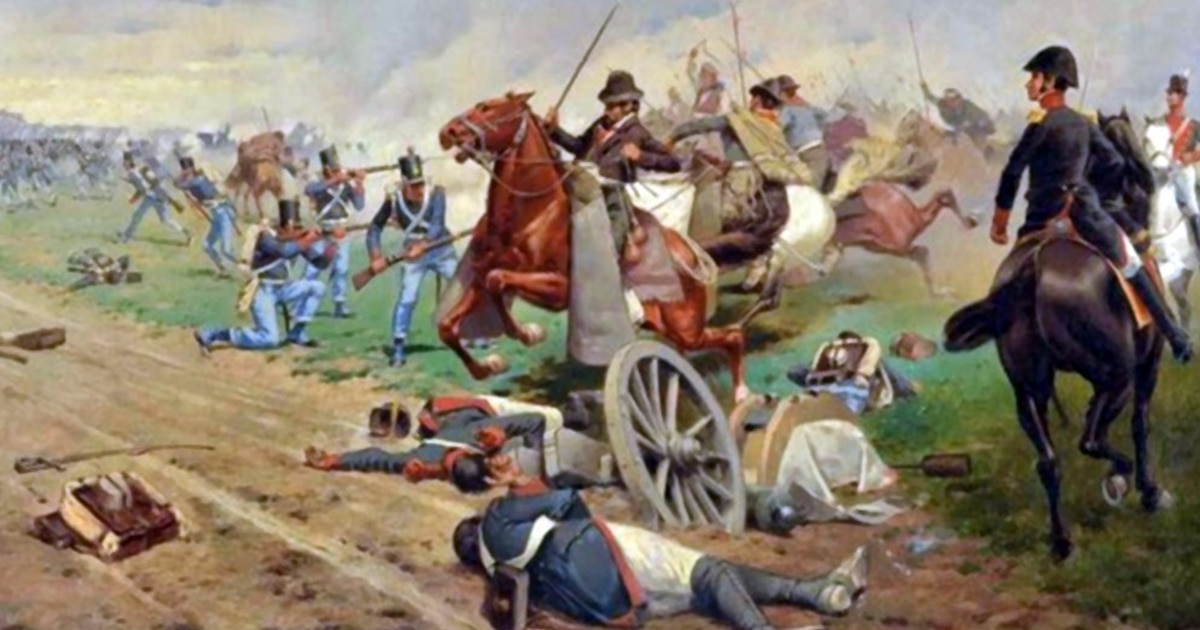
“Battle of Tucumán”. Oil painting by the painter, draftsman, and illustrator Francisco Fortuny (Spain, 1865 - Buenos Aires, 1942).
Thus, the battle that would take place on September 24 and 25 was conceived. The enemy chief was not unknown to him. Pío Tristán, a 39-year-old Peruvian, had crossed paths with Belgrano during their student days in Salamanca and later in Madrid. Slim, at one meter fifty, with a cordial and witty demeanor, but extremely stingy. Between them, there had always been a respectful, albeit distant, relationship.
When Belgrano took command of the Army of the North, he wrote to him offering the possibility of a peaceful solution. Tristán, in turn, sent fifty ounces of gold to ensure that Colonel Agustín Huici, captured after the battle of Las Piedras, was treated well. Belgrano returned the money and requested that it be allocated to the patriotic prisoners. He humorously signed “camp of the small army.”
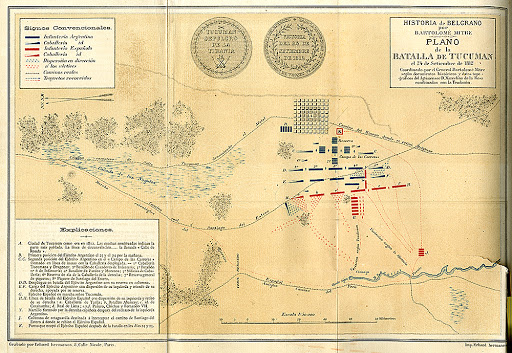
Map of the battle of Tucumán created by General Mitre and included in his book “History of Belgrano and Argentine Independence”
The strategy and the enveloping movement
Tristán was aware of his rival's precarious situation. The government had only sent about four hundred rifles, and the patriotic army suffered from a lack of discipline, inadequate weaponry, and the ravages of fever. Days before the battle, he sent a provocative letter to José Garmendia, a Tucumán resident with patriotic sympathies, announcing the Spanish victory and his desire to bathe and have lunch at his house after the battle. Garmendia's wife replied that she would prepare a gallows with the hair of the Tucumán ladies.
Belgrano planned to wait for the Spaniards north of the city, counterattack with bayonets, and disperse them with cavalry. If he were defeated, the city was entrenched, with ditches and half a dozen cannons to cover the retreat. On the 23rd, the royalists were in Nogales, twenty kilometers away. Confident in his numerical superiority, Tristán executed an enveloping movement to cut off the road to Santiago del Estero and prevent any escape.
the royalist general Pío de Tristán, who commanded the Spanish troops in the Battle of Tucumán.
Gregorio Aráoz de Lamadrid discovered the maneuver and burned nearby fields to confuse the enemy. This allowed Belgrano to surround the city from the west and form an attack line facing south: three columns of infantry, four pieces of artillery, and cavalry divided into two. In the rear, a reserve was commanded by the young Colonel Manuel Dorrego, who was only 25 years old.
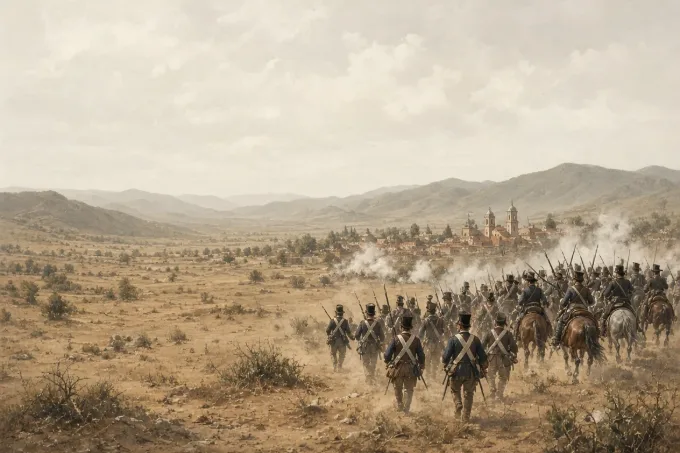
On the morning of Thursday, September 24, the Spaniards appeared in the Carreras field, south of the city. They arrived with the artillery still mounted on mules. They saw the patriotic infantry but not the cavalry. Belgrano's four cannons caused damage to the front lines. Colonel Barrera ordered a bayonet charge. Belgrano responded by sending Balcarce's cavalry against the enemy's left flank and the infantry to the center.
Battle of Tucumán: a known enemy chief of Belgrano, a struggle with an uncertain fate, and the charge that decided the victory - image 4
The decisive charge and the final confusion
The infantry under the Frenchman Carlos Forest was overwhelmed. Ignacio Warnes' battalion was retreating in confusion. Major José Superí, 22 years old, who led a battalion of pardos and morenos, was captured, and his men scattered. At that moment, the patriotic army had lost about four hundred men. Dorrego, without waiting for orders, charged with the reserve to assist Forest and Warnes. Balcarce charged with the volunteers armed with spears and machetes, along with some Dragoons and Decididos from Tucumán.
The arrival of night further disorganized the enemy. A strong wind brought a swarm of locusts. The impact of the insects on their faces and chests felt like bullet hits, and many believed they had been wounded. The royalists, confused by the combined attacks, fled. Belgrano, disconnected from his commanders during the four hours of combat, marched towards the city with about two hundred troops. There he found the infantry with the weapons captured by Dorrego, several flags, and hundreds of prisoners.
Belgrano delivers his command baton to the Virgin of Mercy.
That night he withdrew to the El Rincón estate, three leagues to the south. The next day he formed in front of the enemy and sent Colonel José Moldes with a proposal for a friendly surrender. Tristán refused. He waited for darkness and retreated towards Salta. The patriotic victory, achieved against the orders of the government and under precarious conditions, changed the course of the Northern campaign and consolidated Belgrano's figure as one of the military pillars of the revolution.