









ODSA indicated that the decline was driven by lower inflation and the government's social policies
Compartir:
The latest update from the Argentine Social Debt Observatory (ODSA), which is part of the Universidad Católica Argentina (UCA), reflected a significant improvement in the country's social indicators during 2025, thanks to the Government of Javier Milei.
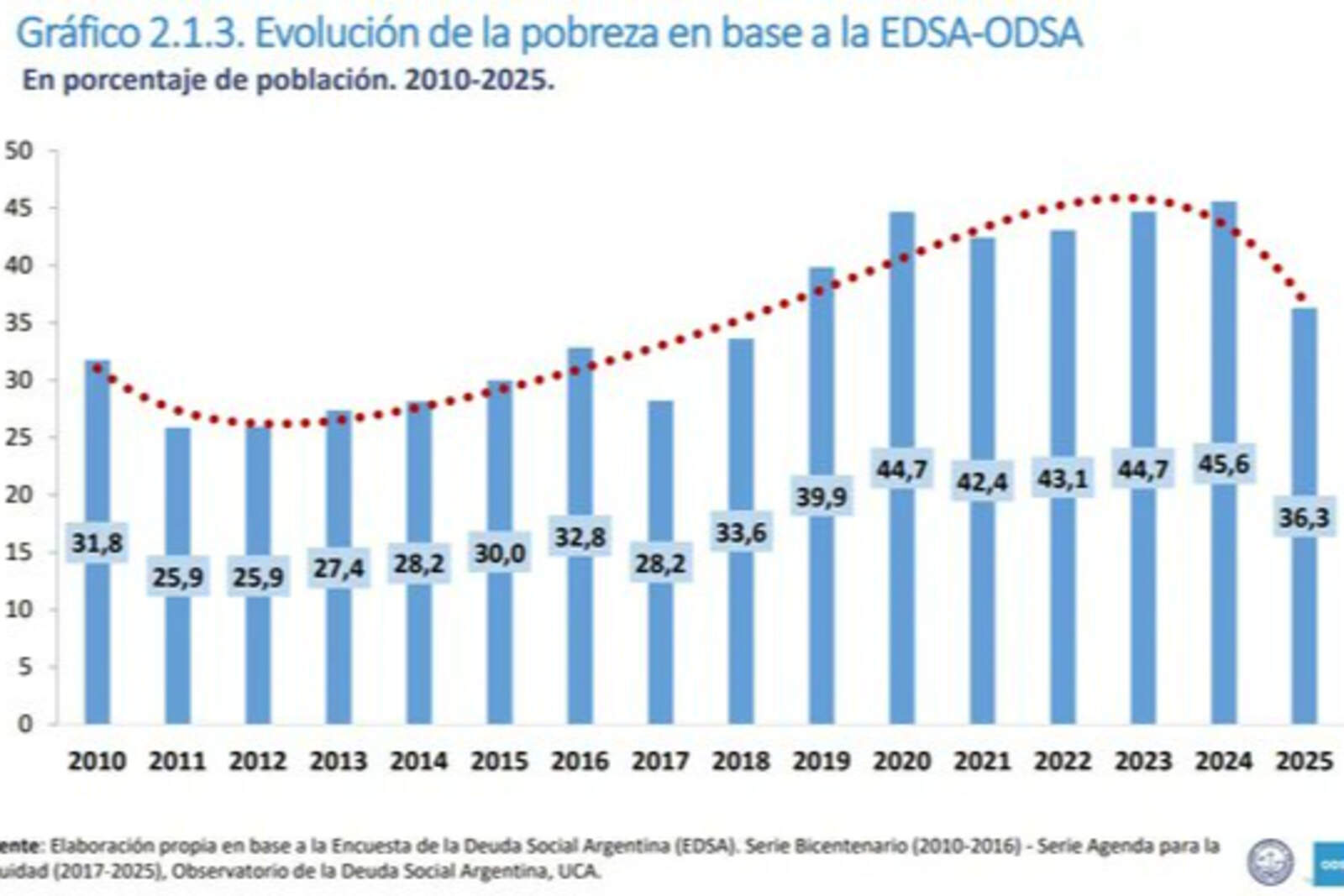
According to the report, poverty dropped to 36.3% in the third quarter of the year, thus reaching its lowest level since 2018. Meanwhile, extreme poverty stood at 6.8%. This is due to the sharp decline in inflation and the economic recovery achieved by the libertarian administration.
The study highlights that these results represent a decrease of 9.3 percentage points compared to the same quarter of the previous year and a reduction of 8.4 points compared to the third quarter of 2023, that is, the period prior to Milei's rise to power.
Los datos de la UCA.
This progress was obtained from the analysis of monetary deprivations, which includes both the measurement of poverty and extreme poverty by income as well as a set of complementary social indicators.
ODSA specified that, to arrive at these estimates, data from the Argentine Social Debt Survey (EDSA) and merged statistics from the Permanent Household Survey (EPH) of INDEC were used, in an exercise covering the period 2010-2025. In this context, variables such as the economic stress faced by households, food insecurity, and the available savings capacity among families were evaluated.
The report indicates that, since the beginning of 2025, there has been a recovery in various social areas. In addition to the decrease in poverty and extreme poverty levels, there is an improvement in households' ability to save and a reduction in the proportion of families subjected to situations of "economic stress."
Javier Milei en New York.
For UCA researchers, these advances are not coincidental but rather the result of a combination of macroeconomic factors and social policies from Milei's Government. "These relative improvements are due, in part, to inflation stabilization and the strengthening of social transfers," the organization concluded.
Although ODSA's measurement corresponds to the third quarter, the comparison with official data allows for the observation of a consistent trend. INDEC had reported that poverty in the first half of 2025 reached 31.6%, a figure that, although lower than the university's estimate due to methodological differences, also showed a downward trajectory compared to previous years.
The figures released by UCA thus add to a series of indicators that confirm a scenario of greater economic and social stability after a long period of crisis caused by Kirchnerism.