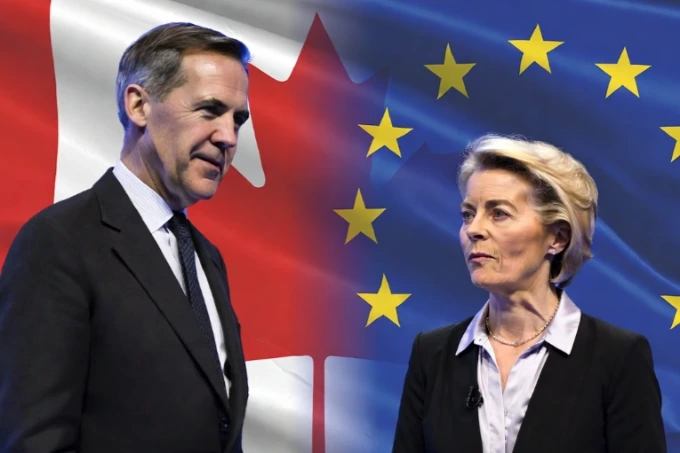
The President of the European Commission, Ursula von der Leyen, proposed on Wednesday that Canada become the first “associated member” of the European Union, in an initiative aimed at deepening economic, technological, and security ties between both parties.
The announcement was made during the annual State of the Union address, held at the European Parliament in Strasbourg, and was directed specifically at Canadian Prime Minister Mark Carney, who was present as a guest.
“I would like to work with you to open the door for Canada to be the first associated member of the EU,” Von der Leyen stated while addressing Carney.
The proposal represents a further step in the rapprochement between Canada and the European bloc. According to Von der Leyen, both parties should move from the current CETA trade agreement towards a “Alliance for the Future”, with the aim of building a common space of prosperity and economic security.
Defense, Energy, and Technology
The initiative proposed by Von der Leyen would not be limited to trade. The European Commission indicated that the new partnership could include cooperation in defense, energy, critical minerals, artificial intelligence, quantum computing, cybersecurity, and technology.
Greater integration of defense industries and a joint project related to the Arctic are also envisioned.
Canada has already taken some steps towards greater cooperation with Europe. In June, Carney's government announced that the country had become the first non-European state to join the Security Action for Europe (SAFE) initiative, allowing Canadian companies to compete for certain European defense contracts.
The Context of the Relationship Between Canada and the United States
The announcement comes at a time of trade and diplomatic tensions between Canada and the United States, under the presidency of Donald Trump.
Carney's government has been promoting a diversification of its economic and strategic relations, with a greater rapprochement to Europe. The Canadian Prime Minister had previously suggested building a “unique alliance” with the European Union, although he clarified that he did not seek to make Canada a full member of the bloc.
The “associated member” proposal still needs to be translated into a concrete institutional framework. According to information published on Wednesday, the concept does not currently constitute a standard membership category provided for by EU treaties, so its scope and conditions will need to be defined through future negotiations.
Von der Leyen presented the rapprochement as a partnership that would not be directed against third countries, but aimed at strengthening cooperation between Europe and Canada.
The proposal will be one of the main topics of the bilateral relationship in the coming months, as Brussels and Ottawa move towards a new stage of cooperation that could encompass everything from trade and critical minerals to defense and new technologies.