The story tells us that Argentina declared its independence from Spain on July 9, 1816, in the little house of Tucumán. What is often overlooked, or taught very superficially, is that the road to that point was tortuous, full of ups and downs. They reached 1816 after very hard battles where it seemed that everything was lost. The declaration of independence came just seven months after Sipe Sipe, where the Northern Army was crushed by the royalists and all the effort seemed to have been in vain.
The analogy holds for President Milei's management. The goal is clear: for Argentina to be the freest country in the world. The people bought into that maxim and reaffirmed it in the 2025 elections. But the path to that goal will have its own Sipe Sipe moments, and the "minute by minute" numbers will not always be what one expects.
This week there was one. INDEC published an EMAE with a drop not seen since the pandemic. The country risk, which had reached a low in the 400-point range, surpassed 600. And the BCRA published record levels of credit delinquency.
Placed one after the other in a banner, those three headlines describe a collapse, a failure of management. With the complete data on the table, the story is quite different, and almost no one is telling it, starting with the Government itself.
The plan is clear and the numbers support it
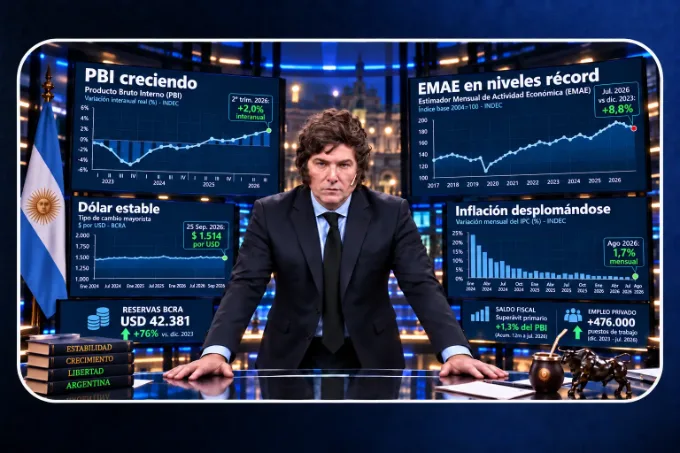
Inflation in August was 1.7%, the lowest in fourteen months. It followed a 2.1% in July, and the average for the last three months dropped to 1.9%. The disinflation path, which had stalled in the first quarter, resumed its course.
This is starting to be felt in people's pockets. In the last four months, the general wage index has outpaced inflation, and in the last twelve it is just over two percentage points above. It must be read carefully. Registered wages are still lagging behind inflation, and what drives the index are the unregistered wages, a component that INDEC measures with a five-month lag. The work is not finished, but the trend has turned around, and a wage that beats prices is the condition for consumption to reactivate.
Employment is experiencing something similar, and from the same angle: recovery is coming through informality. Unemployment rose from 7.6% to 7.9% in a year. In the same period, the number of employed grew by about 265,000 people and the activity rate increased by 0.8 points. There are more unemployed because more people went out to look for work while the number of people working also grew. With wages starting to recover, more people are deciding to return to the labor market. The pending issue is regulation, which still does not benefit either employees or employers. That is why employment is growing through the informal route, with negative effects on tax collection and social security.
Freedom is advancing. On Thursday, the Senate approved by 46 votes to 22 the reform of the Central Bank's Organic Charter. It is another step towards the independence of the BCRA and reverses the disastrous changes introduced in 2012 during the management of Mercedes Marcó del Pont. Financing the deficit through issuance, the practice that fueled inflation for two decades, is one step away from being prohibited by law.
On the external front, there are also advances. The United States launched the Andes-Atlantic Corridor, a financing framework from EXIM Bank of up to US$7 billion with a horizon of 2027 for energy, mining, ports, and railroads. Not a single dollar has been disbursed yet, but the United States has rarely put its export bank behind Argentine infrastructure.
There is no straight line, and it is not the time for sharp turns
The EMAE fell 2.9% in July compared to June, the worst monthly drop since April 2020. It is a bad figure, and it has an explanation. There were rains and snowfalls well above average and a World Cup that cut working hours. There were also gas restrictions for industry in the middle of winter, and there is an infrastructure debt that the Government needs to resolve. Construction, the most exposed to the weather, was growing 4% year-on-year in May and June before falling in July. August and September will tell if it was a bump or a change in trend. Until then, a bad month is not enough to talk about recession.
Moreover, the volatility of the EMAE is at historic highs, which makes it very risky to draw conclusions from the "minute by minute." In this term, the two largest monthly increases in the last 22 years have been recorded, excluding the post-pandemic rebound: July 2024 and March 2026, both at +2.7%. No one used those months to declare a boom, and with July, the same standard should apply.
The country risk rose due to the international context, with high rates in the United States and geopolitical tension, and also because the market is starting to price in 2027. I will return to this later. What matters is what the dollar has done in the meantime: so far in September, it has risen 1.1%, less than inflation, and the ceiling of the band remains almost 25% higher. A year ago, a similar noise ended in a run and the rescue of the U.S. Treasury. Today there is a cushion of our own, and that is the merit of Santiago Bausili and Luis Caputo.
Much has been said about credit delinquency. It is an uncomfortable indicator and deserves a more nuanced analysis than a headline. Behind that number are families that went into debt expecting that income would recover faster, and that must be acknowledged. But the level has an explanation that almost no one tells. When credit expands rapidly, delinquency almost always rises. It is logical: banks go out to seek new clients and take on more risk. The clients without risk were already inside. Now they have to go after those with risk, and risk means delinquency. The Kirchnerism and the systematic destruction of the financial system made us forget that banks have to operate as banks. And operating as banks means taking risks in their portfolios and sometimes assuming bad loans. One must not lose perspective: the 12.9% in July is just 0.1 percentage points more than in June, and the probability of default fell by 0.5 points.
Over time, the system cleans itself. The amounts lent are very low and credit remains insignificant in terms of GDP, at levels comparable to those of African countries. There is no systemic risk. Families have very low debts, so there is no deleveraging capable of dragging the economy into a recession. Comparing this to the subprime crisis of 2008 is to misunderstand how the Argentine system works: here, the securitization of portfolios is marginal and there is no secondary market to propagate the problem. It is a problem between banks and debtors, not a financial bomb.
The Government needs to tell its story
With the data in context and the noise cleaned up, the story remains favorable to the Government. The problem is that the context does not explain itself. On the day of the EMAE, Caputo gave a technically correct explanation in a post, and the headlines said he blamed the World Cup. When the explanation comes after the data, it sounds like an excuse even if it is true. If it had been established earlier, with series and time, it would have sounded like a diagnosis. And every public intervention has a cost: a decontextualized phrase or a figure is enough to fuel an operation.
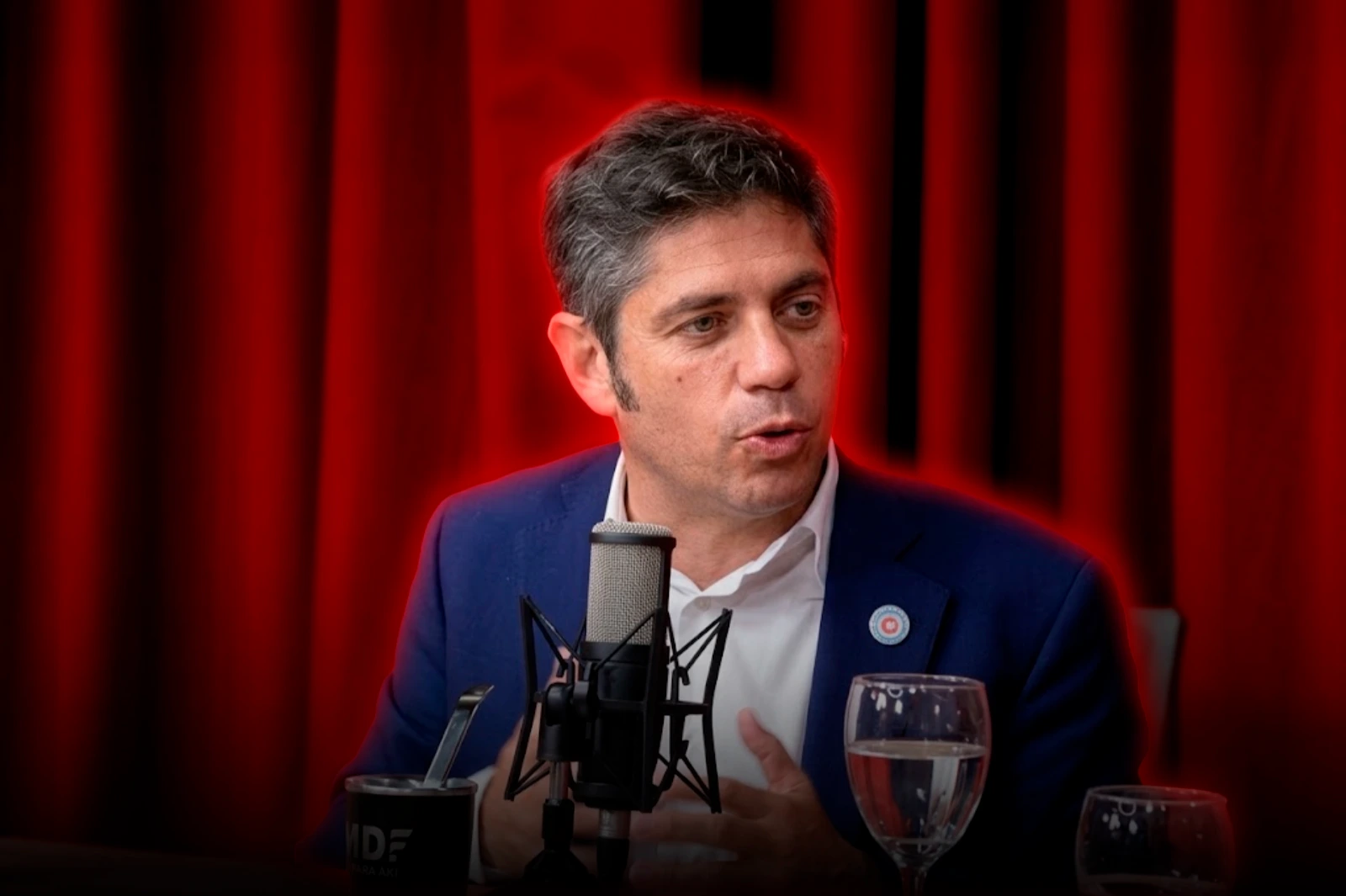
On the other side, the opposition is doing the work of showing that the alternative to Milei is a return to economic darkness. Kicillof launched his candidacy in Avellaneda and a few days later was in New York explaining to investment funds that the peso is overvalued, criticizing the RIGI, and saying that the country is wasting its moment. He did not present a single measure. Boudou called for ending the fiscal surplus and resuming subsidies for tariffs. In the Chamber of Deputies, a project for a tax on capital transfers abroad is circulating. Senator Di Tullio said in a friendly streaming that she had no record of the SIRA, of Insaurralde's yacht, or of other corruption cases that were front-page news. As the cherry on top, Gabriel Rubinstein, former Deputy Minister of Economy under Massa, proposed this week to bring the dollar to the range of $3,000 or $3,500. He himself calculated the cost: several months with inflation between 5% and 8% monthly. Devaluing, subsidizing, raising taxes, and protecting the usual sectors: it is a photocopy of the country that this Government received, and from which the majority of Argentines decided to leave when they said "never again" to the Kirchnerist experiment. That is what the market is starting to discount in the country risk: not this management, but the possibility that that agenda will return in 2027.
That contrast is the best asset of the ruling party, but no one is going to show it for the Government. The President cannot be the only one fighting the war for ideas. After Sipe Sipe, the Northern Army retreated and the front was held by Güemes with his gauchos, skirmish after skirmish, while independence was declared in Tucumán. Milei marked the north. What the Government lacks is its Güemes: colonels, captains, and lieutenants who go out to fight every battle of the narrative, every month, with the data in hand and before the opposition. Every number that the Government leaves unexplained, others will explain for it, and not in good faith.