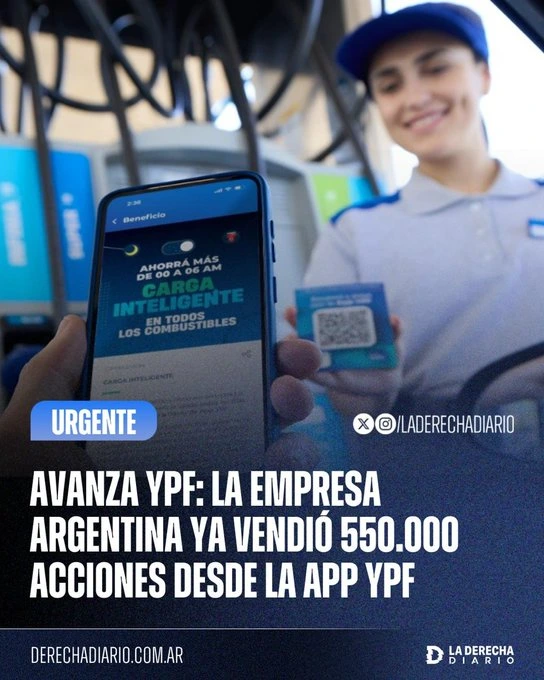
The oil company added more than 15,000 new shareholders in just 15 days through its mobile app, with 550,000 shares purchased and more than 60,000 daily transactions
According to the formal notification to the National Securities Commission (CNV), Argentine Stock Exchanges and Markets (ByMA), and A3 Mercados S.A., the company transitioned from 393,312,793 ordinary registered shares with a nominal value of $10 each to a total of 3,933,127,930 ordinary shares of $1. The share capital remained unchanged at 3,933,127,930 pesos, without requiring the liquidation of fractional shares according to the ByMA listing regulations.
To implement the technical function on the mobile platform, YPF formed a strategic alliance with Santander bank, the entity that manages user funds. To buy and sell shares, customers who download the YPF App must:
The new economic direction set by President Javier Milei's administration is consolidating a radical transformation in the Argentine financial and productive system. In this framework of openness, deregulation, and encouragement of private initiative, the majority state-owned oil company YPFhas marked an unprecedented global milestone by becoming the first company in the world to enable the buying and selling of its own shares within its mobile application.
The success of this pro-market policy is evidenced by the massive enthusiasm of the population. In just 15 days, more than 15,000 Argentines (or people) became shareholders and new owners of the energy firm through the YPF App.
During this brief initial period, 550,000 shares have already been purchased (surpassing the initial mark of over 500,000 shares), with registrations reaching peaks of over 60,000 daily transactions (or more than 60,000 shares bought per day).
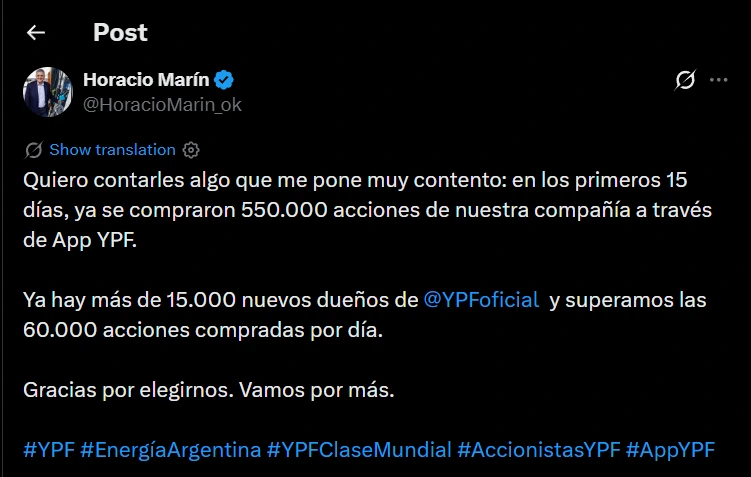
Celebrating this historic public response, the president and CEO of YPF, Horacio Marín, publicly stated on his social media: “I want to share something that makes me very happy: in the first 15 days, 550,000 shares of our company have already been purchased through the YPF App. There are now over 15,000 new owners of @YPFoficial and we have surpassed 60,000 shares bought per day”, concluding with a strong message: “Thank you for choosing us. We are going for more”.
In that same vein, Horacio Marín emphasized the company's strategic vision: “We want more and more Argentines to be part of YPF's growth. The stock split is a concrete step to bring the capital market closer and make investment in the company more accessible”.
YPF APP
This operation, officially enabled on August 18, 2026, was realized after the company executed a stock split (or share split) of 10 to 1 on its stock in the Buenos Aires Stock Exchange, identified with the ticker $YPFD.
The mechanism reduced the unit price of the stock to a tenth and multiplied by 10 the number of shares held by each investor with the aim of providing greater market liquidity to the local market. The restructuring did not alter the total equity of shareholders, the amount invested, the proportion of ownership, or the political rights (maintaining one vote per share).
Horacio Marín on X:
Access the investments tab.
Complete a risk profile test.
Have a balance in pesos.
Transactions operate exclusively during market hours (from 10:30 AM to 5 PM). The system automatically performs the fund settlement, generates the purchase receipt, and updates the holdings in real time on the user's screen.
This function integrates into the app ecosystem, which includes options to fund balances, earn interest on money, pay at service stations, make transfers, pay bills, and do top-ups.