Police data reveal a higher proportion of these groups in violent crimes compared to their population weight.
Nuevo
Agregar La Derecha Diario en
Compartir:
The most recent report from the New York City Police Department (NYPD), for 2024, provides a detailed overview of the racial makeup of victims, suspects and individuals arrested in major violent crimes.
Official data show significant differences between the city's demographic distribution and participation in criminal acts.
According to available statistics, New York City has a Latino population that represents approximately 29% of the total, while the black population accounts for around 23% of the inhabitants.
Although both groups do not constitute the majority of the population, their presence in crime is at considerably higher levels.
A detainee.
Homicides
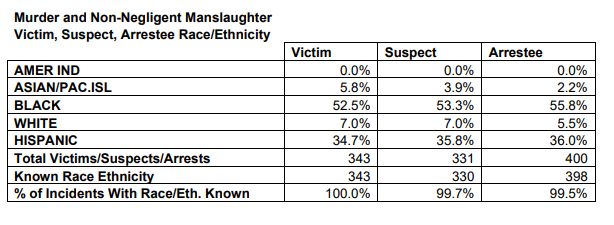
In the case of homicides, the report notes that homicide victims are more frequently black (52.5%) or Hispanic (34.7%).
Whites, on the otherhand, account for 7.0% of all homicide victims, while Asians account for 5.8%.
Along the same lines, the ethnic composition of those arrested follows a similar pattern: Blacks (55.8%) and Latinos (36.0%) represent the vast majority of those arrested for homicide, while those arrested Asians (2.2%) and whites (5.5%) represent the remaining parts of the population arrested for murder.
This means that 91.8% of those arrested for homicide are black or Latino people, despite representing a relatively small part of the population. However, whites, who are the majority group, represent only 5%
. Homicide facts.
Violations
A comparable situation is seen in rape crimes.
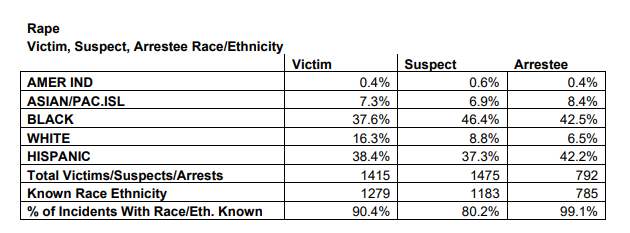
The police report indicates that the victims of rape are 38.4% Hispanic, 37.6% black, 16.3% white, and 7.3% finally Asian
.
Regarding arrests for this crime, it is indicated that those arrested for rape are most often Hispanic (42.2%) and black (42.5%). Asian arrests make up 8.4%, and white arrestees make up 6.5%, the
lowest percentage. Data on violations.
The NYPD report thus makes it possible to establish a direct relationship between the distribution of the population and the incidence of serious crimes, evidencing a strong overrepresentation of certain groups compared to their proportion in the total number of inhabitants of the city.