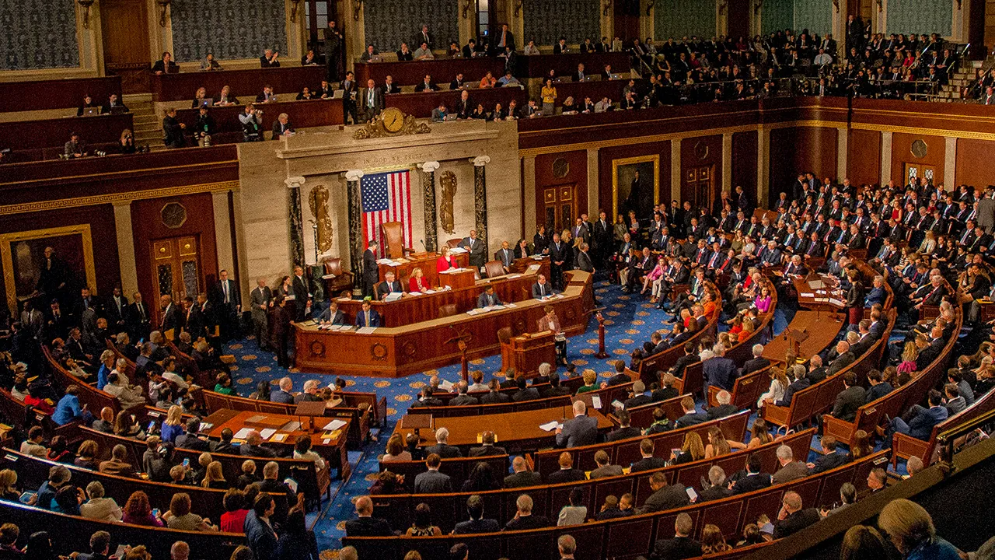
Redistricting in several states favors Republicans after court rulings and reconfigures the political map heading to 2026.
Nuevo
Agregar La Derecha Diario en
Compartir:
The redistribution of electoral districts in the United States has become one of the most intense and decisive political battles ahead of the 2026 midterm elections, with a scenario that, according to multiple current projections, favors the Republican Party after a series of legislative changes and recent judicial decisions.
The process, known as “redistricting”, which traditionally takes place every ten years after the national census, has entered an extraordinary phase of accelerated reviews, legal disputes and state reforms that are redefining the balance of power in the House of Representatives.
The most important turning point was a recent decision by the U.S. Supreme Court that found that Louisiana had engaged in an unconstitutional form of “gerrymandering” based on racial criteria. Although the ruling does not order a national redesign, it did establish a legal precedent that is being interpreted differently by
both parties. The governor of Louisiana aims to eliminate re-districting based on racial criteria
For Republicans, the ruling represents a successful validation of their historic critiques of electoral manipulation and an opportunity to correct decades of artificially designed districts to favor
Democrats.
In an immediate response, several southern states with republican governments have initiated processes to redesign electoral maps that could significantly change the composition of their congressional delegations. These include Florida, Alabama, Tennessee, Mississippi and Louisiana, where state governments have argued that the new maps seek to better reflect the demographic and political evolution
of their populations.
Republicans are sweeping the South In
Louisiana, Governor Jeff Landry pushed for a reorganization of districts following the Supreme Court decision, with the objective of eliminating distortions based on racial criteria. The state, which currently has six seats in the House of Representatives, could see a reconfiguration that significantly strengthens the Republican position in at least several
of its districts.
In Tennessee, Governor Bill Lee called for a special legislative session to redraw electoral maps, stating that districts must more accurately reflect the will of voters. The main focus is the Memphis district, currently controlled by Democrats, which Republicans consider an anomaly in a state largely dominated by conservative voting
.
In Alabama, Governor Kay Ivey promoted a redesign that could allow the Republican Party to control all of the state's seven seats in the House of Representatives, including the possibility of winning up to two districts currently in Democratic hands. In Florida, Governor Ron DeSantis signed a new congressional map that, according to estimates, could allow Republicans to win up to four additional seats in a key state with 28 representatives in
total. De Santis approved a redrawn map that could give Republicans an important advantage in the electoral arena
In Texas, another of the most influential states in national politics, the Supreme Court approved a new electoral map that reinforces the republican position. With 24 seats currently held by the Republican Party versus 13 Democrats, the new redesign could further expand that advantage, with estimates pointing to up to five additional seats
for conservatives.
In North Carolina, the state legislature approved a new map that could give Republicans control of 11 of the state's 14 congressional districts. This change would entail the loss of at least one Democratic seat and would consolidate the republican position in one of the most competitive states in the country
.
These changes are seen as a necessary correction in the face of a previously biased electoral system. For years, Democrats used redistricting to maximize their representation in states where they had legislative control, particularly in California, New York and Illinois. In this context, Republicans argue that the new maps do not represent an artificial advantage, but rather a re-balancing of the system based on recent judicial decisions and the will of the voters
. The Republican Party could get eleven of North Carolina's fourteen congressional districts
Democrats are losing ground in states controlled by them
.
Meanwhile, Democrats have also promoted their own redistricting initiatives in states under their control. In California, Governor Gavin Newsom promoted a reform that could add up to five favorable seats to his party. In Virginia, voters approved a new redistribution that could allow Democrats to control up to 10 of the state's 11 seats in the House
of Representatives.
However, these Democratic initiatives have been the subject of strong criticism from Republicans, who describe them as attempts at political compensation following conservative advances in other states. In addition, several of these reforms face legal challenges and judicial reviews that could limit their implementation before the 2026 elections.
In New York, for example, the Supreme Court previously blocked attempts to redraw districts that would have affected Republican representatives, keeping the current map. In Illinois and Maryland, similar proposals have been halted or amended due to concerns about their legality and possible violations of principles of electoral equity
.
The result of this process is a highly dynamic scenario in which both parties seek to maximize their representation in the House of Representatives before the elections. However, current projections suggest that Republicans start with a significant advantage. According to estimates based on maps already approved or in the process of being implemented, the Republican Party could add up to 14 additional seats, which would be enough to consolidate or expand its
current majority. Socialist Democrat Gavin Newsom promoted a reform that could add some additional seats to the Democratic Party