CENTCOM confirmed a new offensive after three commercial vessels were hit by Iranian attacks
Agregar La Derecha Diario en
Compartir:
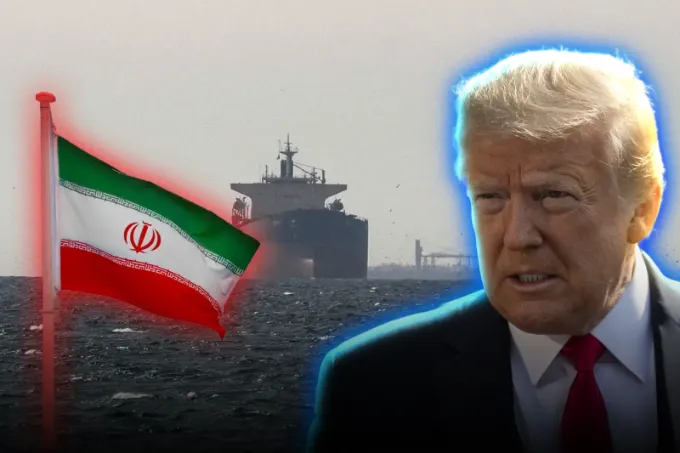
The United States launched a new series of “powerful attacks” against Iran in response to the Iranian offensive against three commercial vessels that were transiting through the strategic Strait of Hormuz, in a new escalation of tension that again puts one of the world's main energy routes under pressure.
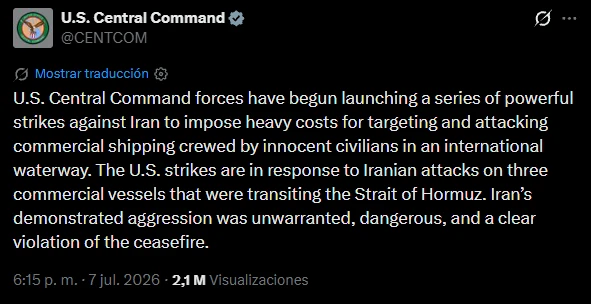
The U.S. Central Command (CENTCOM) confirmed the operation and stated that the objective is to impose “high costs” on the Iranian regime for directing attacks against civilian crews in an international maritime route.
The statement published by the Central Command in X
“The forces of the U.S. Central Command have begun to launch a series of powerful attacks against Iran,” the U.S. military agency reported. Additionally, it described the Iranian aggression as “unjustified, dangerous, and a clear violation of the ceasefire.”
Washington's response came after three commercial vessels were hit by Iranian projectiles in the Strait of Hormuz, according to the British Army. One of the ships was struck off the coast of Oman and caught fire, while the other two sustained damage but were able to continue their journey. No injuries were reported on these last two vessels.
Following the start of the U.S. offensive, Iranian state media reported multiple explosions in Sirik, Qeshm, and Bandar Abbas, in the south of the country. Images of impacts at the Shahid Haghani port, located in Bandar Abbas, were also circulated.
Trump revoked the authorization to sell oil to the Iranian regime for violating the truce in the Strait of Hormuz.
The U.S. administration also decided to revoke a 60-day license that temporarily exempted Iranian oil from sanctions. According to a source cited by the Associated Press, the measure was adopted because Tehran's actions in Hormuz were deemed unacceptable and needed to face consequences.
The conflict revolves around control of a crucial route for international trade. In times of peace, one-fifth of the oil and natural gas traded globally passes through the Strait of Hormuz, so any disruption poses significant risks to energy markets and the global economy.
Iran has insisted on controlling the routes used by vessels and even intends to charge fees for passage. The United States and various Arab countries in the Persian Gulf rejected that possibility and maintain that Tehran cannot unilaterally impose conditions on international navigation.