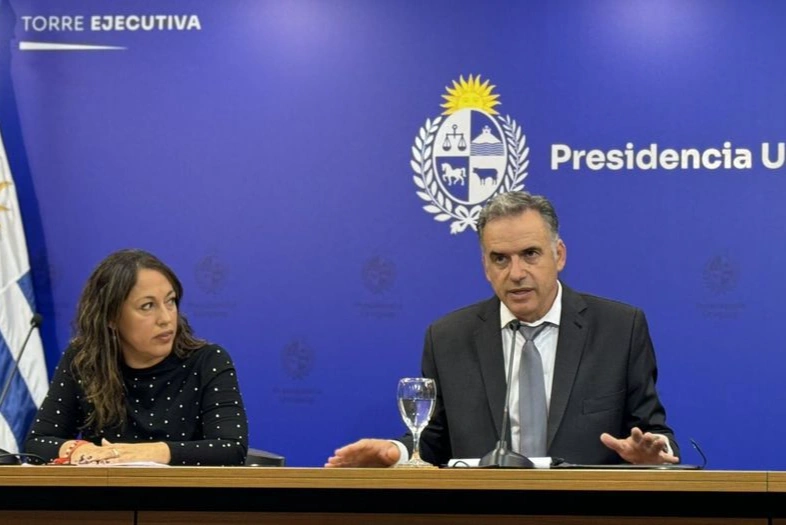
The Yamandú Orsi government implemented a change in the mode of adjusting fuel prices that generated a direct cost overrun of 89 million dollars for Uruguayans between March and December 2025, according to a report by the Center for Public Policy Studies (CEPP) published by Ámbito.
This cost overrun is not an accidental result, but rather the foreseeable consequence of state intervention in prices. Free prices are not merely arbitrary numbers: they are signs that arise from voluntary exchange between thousands of people and reflect the real scarcity of resources at all times. When the government decides to fix them or modify their form of updating, it interrupts that spontaneous coordination and
generates inevitable inefficiencies.
In the specific case, the Executive abandoned the monthly adjustment scheme aligned with the Import Parity Price (PPI) that governed under the Urgent Consideration Act (LUC) between 2021 and 2025. This mechanism allowed cumulative savings of 450 million dollars for consumers by keeping prices closer to international reference values
.
The new government opted for a bimonthly adjustment based on the two-month average, added to a “stabilization factor” of 1.5 pesos per liter and a maximum variation band of 7%. This formula created a growing gap between the PPI calculated by Ursea and the Ex Planta Price (PEP) set by the
Executive Branch.
This gap resulted in overpricing of 39 million dollars in Super 95 gasoline and 50 million dollars in 50S diesel, adding up to exactly the 89 million reported. On average, Uruguayans paid 2.40 pesos more per liter of gasoline and 2.16 pesos more per liter
of diesel during the period under review.
The CEPP report points out that this difference worked as a covert fiscal financing mechanism: by keeping prices artificially above the import parity level, the State extracted additional resources from consumers through ANCAP without the need to vote on new taxes. These funds were used to cover part of the fiscal deficit and finance other items, including supergas subsidies that generated losses of 35 million dollars in the same
period.
This intervention not only raises the cost of living, but it distorts the economic decisions of thousands of individuals and companies. By setting prices above the level that would reflect a free market, less efficient consumption is encouraged, the search for energy alternatives is discouraged and the competitiveness of key sectors such as transport, logistics and agricultural and industrial production is reduced
.
In addition, ANCAP's state monopoly continues to generate monopoly income estimated at more than 88 million dollars annually (equivalent to more than 0.1 percent of GDP). In a scheme without barriers to entry and with private competition, that income would tend to disappear: prices would fall under competitive pressure and efficiency would increase
. Advertisement
The contrast with the previous period is clear. Under the LUC scheme, prices were adjusted monthly to the PPI, making it possible to operate with margins more adjusted to the international reality and transferred real savings to the pockets of citizens. The change introduced prioritized short-term revenue over the containment of the cost of living and efficiency in the energy sector
.
Any initial intervention in prices—whether to “stabilize”, subsidize or finance public expenditure—ends up generating imbalances that require new interventions to correct them. In Uruguay, this can be seen in supergas subsidies financed indirectly by overprices in gasoline and diesel, in ANCAP's monopoly rent and in the use of fuels as a disguised fiscal tool
.
In short, the 89 million dollars in cost overruns are the specific bill that Uruguayans pay for this interventionist decision. Maintaining artificially high prices, justified by fiscal or “stabilization” objectives, transfers resources from citizens to the State and its expenses, instead of allowing adjustments to respond to real international market conditions
.
Experience shows that interventions in essential goods tend to produce the opposite effects to those declared: instead of protecting the consumer, they make their daily lives more expensive and finance other government priorities. The solution is to reduce intervention: to eliminate ANCAP's monopoly, to allow private competition and to allow prices to be formed freely according to supply and demand. Only in this way will recurring cost overruns be avoided and a more efficient and prosperous economy will be promoted