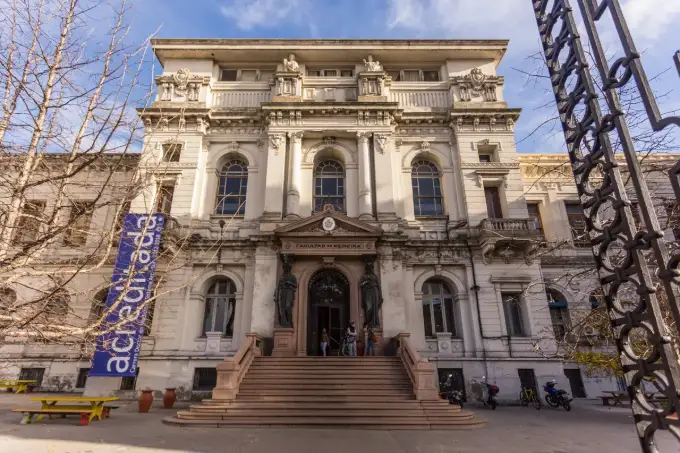
Last Tuesday, a student stabbed a 19-year-old classmate on the third floor of the Faculty of Medicine at the University of the Republic. The young woman was left with serious injuries, including eye and abdominal injuries. As happens every time an event of this magnitude occurs, public opinion is shaken, and the political class comes out to express itself. Tweets of several paragraphs filled with heartfelt words, indignation, and deep reflections from various leaders, mainly those who have championed gender policies, such as Di Candia, Constanza Moreira, or the Minister of Health, Cristina Lustemberg, who even showed up at the faculty and made profound statements in front of the cameras.
No one disputes how serious the episode was. The problem is that the same discourse is repeated after every attack, every rape, every situation of harassment, and it almost never comes with a concrete commitment: firm and effectively enforced penalties for those who commit these crimes. Getting outraged is free. Legislating against one's own electoral interests is not so easy.
The Broad Front — the party that presents itself as the most sensitive and empathetic — has systematically avoided toughening penalties against sexual crimes and crime in general since its first government. We all remember Tabaré Vázquez and his "prison decongestion plan" launched in 2009 when he aimed to transfer and release inmates rather than strengthen the punishment system. When there was insistence for more than a decade (2008, 2010, 2015, 2018) to create a National Registry of Rapists and Sexual Abusers, the Broad Front, with its own parliamentary majority, blocked the initiative time and again, calling it "redundant." The registry was only created in 2020, with the Law of Urgent Consideration, already under another government. Today, the Broad Front governs again, and the mechanism that dilutes penalties through abbreviated trials remains intact for sexual crimes. One can talk as much as one wants about gender sensitivity; what is lacking, so far, is the willingness to touch the procedural tool that, in practice, devalues the sentence.
What is the abbreviated trial? Why does this tool devalue the sentence?
In Uruguay, the judicial system suffers from significant delays in trials and a serious resource problem, and the mechanism that has grown the most to alleviate it is the abbreviated trial. Basically, the accused negotiates or settles with the prosecution and resolves the situation before reaching an oral trial, avoiding that longer and more exposed process. This favors those who have more resources or better defense to avoid the penalty, and in many cases, it directly prevents justice from being served for the victim. Moreover, the system itself promotes a lesser sentence, because simply accessing the abbreviated trial reduces the applicable penalty by up to a third. The numbers confirm this. According to a study by the Faculty of Law at the University of the Republic, only 3.6% of formalized cases in Uruguay reach or are on track to reach an oral trial: the rest are resolved through the abbreviated process. The same study estimates that nearly 95% of the country's criminal convictions arise from these agreements and not from a proper trial.
Concrete cases
In sexual crimes, the outcome is predictable: in 2018, a man who raped his partner twice negotiated a sentence of three years of supervised release and did not even step foot in prison, which forced the then Attorney General to restrict these agreements for rape and sexual abuse. This year, in Canelones, a stepfather who abused his stepdaughter for five years — since the girl was six — was ultimately sentenced to four years in prison. The case came to light because the girl wrote about it in a school assignment on Marie Curie.
As if that were not enough, it must be said clearly: the corrective ideal of the system matters less. What matters is to focus on the victim and on justice, which is precisely what the political class has not done in the last thirty years. To gauge how generous our system is, it suffices to look outside: in the United States, there is no single minimum because each state legislates its own, but as a reference, California sets life sentences with aggravating factors, and Texas allows sentences of up to 20 years; and not only in the United States, even in China, aggravated rape can lead to life imprisonment or the death penalty; in Russia, between 3 and 15 years depending on the aggravating factors. They are different systems and not strictly comparable to each other, but they all agree on something that does not happen in Uruguay: the legal minimum tends to be a real floor, not a ceiling that is negotiated downwards with the abbreviated trial.
The disastrous prison system
The other side of this failure is the prison system, in deplorable conditions and with disastrous results compared to the region; for example, in Uruguay, almost two-thirds of prisoners reoffend when they are released. Only now, in the Accountability Report, is a project being discussed for the first time to separate the management of prisons from the Ministry of the Interior and give technical and budgetary autonomy to a new institute. It arrives 40 years late and is still not approved. The world has had penitentiary management schemes with private participation for over forty years in more than ninety countries; discussing it in Uruguay should not be taboo. The Uruguayan state no longer needs to demonstrate how inefficient it is in public management. And when they try to determine that the situation is due to a lack of resources, it is difficult to understand that if there are resources to sustain state structures of dubious priority, there apparently are not for a penitentiary and judicial system that fulfills its function.
This is not just a problem of the FA; it is of the entire political class and journalism. It is predictable that in the coming days, legislators and pseudo-journalists of all colors will compete to show themselves more shocked than the rest by the attack at the Faculty of Medicine, in television panels and press releases, etc. It seems as if the focus is on them, it is the political discourse because it is time to shine.
And there is something that confirms this with total clarity: when harassment or abuse occurs behind closed doors within the political class itself, the reaction is significantly more lukewarm than in these days. A survey by El Observador counted at least eight complaints of harassment, sexual abuse, or gender violence against leaders of different parties during a single legislative term. The deputy of Cabildo Abierto, Martín Sodano, received a court order of non-approach for gender violence and continued in his position without any issues. The Colorado leader from Canelones, Heber Duque, is being criminally investigated for sexual violence and workplace harassment against a subordinate and had to wear an electronic ankle bracelet due to the "high risk" he posed to the victim. The white mayor of Cerro de las Cuentas, Humberto Allende, was charged with raping an 80-year-old woman and continued in office on leave. From the side of the Broad Front, the mayor of Municipality A, Jorge Meroni, and the communist deputy Gerardo Núñez only resigned when the case reached the press or the political deadline to sustain them expired; the mayor of Los Cerrillos, Rodrigo Roncio, was sanctioned by the FA's own Political Conduct Tribunal for sexual harassment and messages with a minor; and deputy Gustavo Olmos, reported by his own substitute, took a leave of absence without major institutional consequences. None of these cases generated the wave of statements, tweets, and public appearances that the attack on the medical student generated in just 48 hours. The outrage, for the political caste, always has a different speed depending on who it concerns.
And none of them — of whatever color — lifted a finger to remove serious sexual crimes from the abbreviated regime, or to reduce public spending that only knows how to grow and provide real resources to a penitentiary system in a calamitous state. The outrage of the caste works like this: it is unanimous, transversal, and, above all, free. It is better exercised in front of a camera than in a committee session where something uncomfortable for the internal party must be voted on. Meanwhile, we continue to be the same cuckolds listening to the speeches of outrage after the events.
---
Sources consulted: Faculty of Law (Udelar), report on the abbreviated process; Attorney General's Office (gub.uy), cases and statistics of sexual crimes; El Observador, "Abbreviated trials, a controversy that persists" (2018); Infobae and Uruguay Al Día, case of the convicted stepfather in Canelones (2026); El Observador and GPA, legislative history of the National Registry of Rapists and Sexual Abusers; LR21, Tabaré Vázquez's prison decongestion plan (2009); Montevideo Portal, "Nothing Grows in the Shadow: between 'irregularities' and the attempt at 'delegitimization'" (2021, with original report from Radio Carve); Infobae, incarceration rate and crisis of the Uruguayan penitentiary system; Radiomundo En Perspectiva, reform of the INR in the Accountability Report 2025-2029; Montevideo Portal and Portada Punta, case of unaccountability in Punta del Este (March 2026); Subrayado and La Diaria, coverage of the case at the Faculty of Medicine (September 2026); Maldita.es and Morez Abogados, penalties for sexual assault in force in Spain; general sources on penal frameworks for rape in Russia, China, and the United States.