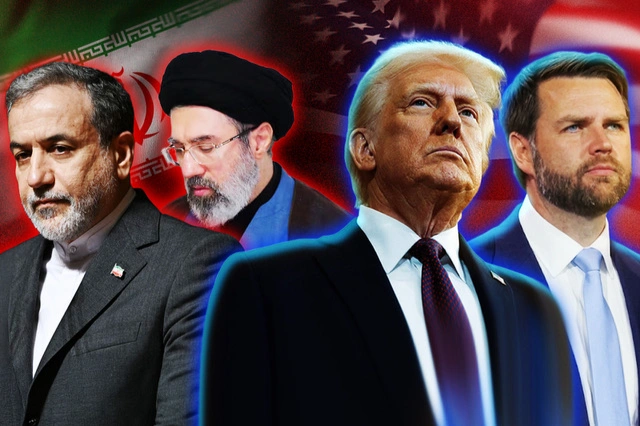
The Vice President of the United States, JD Vance, traveled urgently to Islamabad, the capital of Pakistan, to negotiate with Iranian representatives the peace of the war that is now in its seventh week. White House number two said that negotiations between the United States and Iran ended early Sunday without a peace agreement after the Iranians refused to accept American conditions not to develop nuclear weapons
.
According to Vance, the tense talks lasted 21 straight hours, where 15 points were discussed to achieve peace, but on the point of nuclear non-proliferation, the Iranians were unwavering. The vice president maintained constant communication with US President Donald Trump and other members of the administration, as reported by the media present there
.
“The reality is that we need to see a firm commitment that they will not seek a nuclear weapon or the tools that would allow them to obtain it quickly,” Vance told reporters one hour before Sunday began. “That is the main objective of the President of the United States. And that is what we have tried to achieve through these negotiations.”
“We maintained constant communication with the team because we were negotiating in good faith,” said Vance, speaking from a podium in front of two American flags, accompanied by special envoy Steve Witkoff and Jared Kushner, who recently achieved peace in Palestine. “We are leaving here with a very simple proposal, a method of understanding that constitutes our final and best offer. We'll see if the Iranians accept it.”
Trump's response Trump
had said that he would suspend attacks against Iran for two weeks to achieve peace. Vance's comments did not indicate what will happen after that deadline expires or if the ceasefire will continue after these
events.
The American president had issued an ultimatum last week, stating that if Iran did not reopen the Strait of Hormuz by Tuesday night, “an entire civilization would die” that night. However, at the last minute, the Strait began to open and Trump stopped the attacks. Vance would have been the one who advised him that it was time to open a negotiating table, and that's why the president sent him to lead the
talks.
The Trump movement is undergoing strong questioning from a sector of the grassroots that reject the decision to enter into war with Iran; a sector to which the vice-president would belong. All indications are that Trump sent Vance to lead the negotiations to clear up any doubts that he is willing to listen to the two views he has in his Cabinet on the issue of the Iranian terrorist regime. “If Vance, who is the biggest supporter of obtaining quick peace with Iran, could not achieve it, no one can. Iran seems to have chosen suicide,” reports a source from the MAGA movement
.
The war is entering its seventh week.
While the negotiations were taking place, the US Army stated that two destroyers transited the Strait of Hormuz, controlled by Iran, to carry out demining work, indicating that the Iranians have agreed to keep open the channel through which 70% of the fuel produced in the Middle East passes.
“We are moving forward by leaps and bounds. Whether we reach an agreement or not doesn't matter to me,” Trump told reporters as the talks continued and approached 2 in the morning in Islamabad. He called the negotiations “very deep”.
The negotiations involved the American delegation, led by JD Vance; the Iranian delegation, led by the President of the Persian Parliament, Mohammad Bagher Qalibaf; and the Prime Minister of Pakistan, Shehbaz Sharif, who maintains good relations with both Tehran and Washington, and focused on how move forward with the ceasefire. There were also Chinese, Egyptian, Saudi and Qatari representatives to indirectly facilitate
the talks.
In addition to not agreeing to denuclearize, Iran also wants the United States to ensure that they will stop Israel's attacks against Hezbollah, the proxy group with which Iran controls Lebanon. The Israeli government assures that Hezbollah did not adhere to the ceasefire between the United States and Iran, and that it will not allow it to gain military positions in the interim
.
Qalibaf belongs to the powerful Iranian Revolutionary Guard, which has issued some of Iran's most incendiary statements since the fighting began, and which is fervently opposed to the pacifist stance apparently adopted by the new Ayatollah, the son of the late Ali Khamenei, Mojtaba Khamenei.
Iran establishes “red lines”, including compensation for attacks.
The Iranian delegation, for its part, told state television that it had presented “red lines” in meetings with the Pakistani prime minister, including compensation for the damage caused by the American and Israeli attacks that started the war on February 28 and the release of frozen Iranian assets.
The war has left at least 3,000 dead in Iran, 2,020 in Lebanon, 23 in Israel and more than a dozen in the Arab states of the Gulf, in addition to causing permanent damage to infrastructure in half a dozen countries in the Middle East. Iranian control of the Strait of Hormuz has largely isolated the Persian Gulf and its oil and gas exports from the world economy, driving up energy prices
.
Iran's closure of the Strait of Hormuz has proven to be its greatest strategic advantage in the war. Normally, around a fifth of the world's traded oil transited this strait through more than 100 ships a day. Since the ceasefire, there have been only 12 transits, a number much lower than what is needed to resume international trade and stabilize markets.