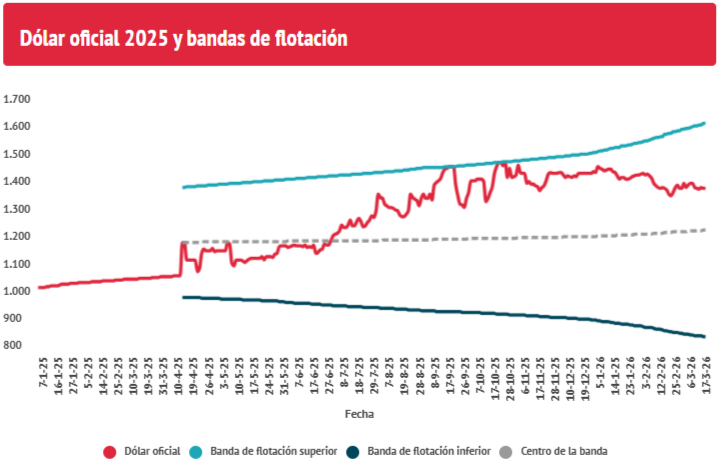

In a context of stability in the exchange rate and strengthening of the external front, the Central Bank of the Argentine Republic (BCRA) consolidated a historic streak of chain together 50 consecutive days with foreign exchange purchases in the official market. This Tuesday, the monetary authority acquired USD 73 million, bringing the cumulative total in 2026 to more than USD 3.4 billion. Since the beginning of the fourth phase of the monetary scheme in January, the entity that leads Santiago Bausili has incorporated USD 3,421 million, a figure that represents just over a third of the annual objective set for this year. In percentage terms, the accumulation has already reached 34% of the expected target
.To complete these acquisitions, the BCRA issued pesos without applying sterilization mechanisms, while the Treasury absorbed part of that surplus through domestic debt placements. In recent tenders, the Ministry of Economy chose not to expand the monetary base, a decision aimed at avoiding inflationary and exchange rate pressures, in line with the
official equilibrium strategy.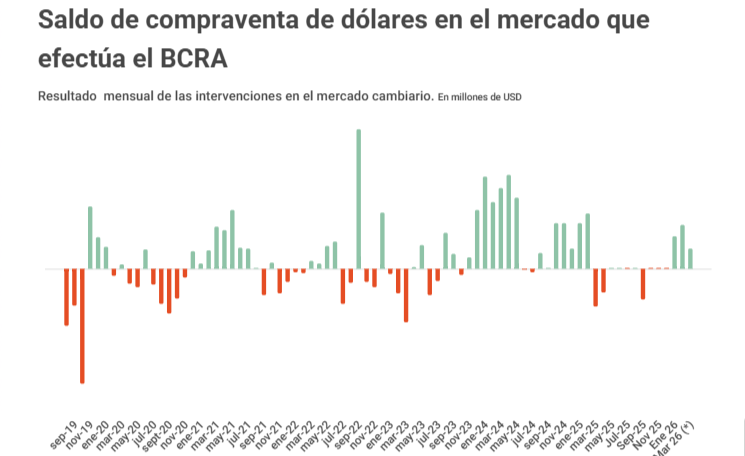
Official projections estimate that the net accumulation of reserves in 2026 could be between USD 10 billion and USD 17 billion, depending on the demand for pesos and the availability of foreign exchange. In this regard, Santiago Bausili argued that the pace of purchases will be determined by the demand for local currency and the flow of dollar income. As part of the current scheme, the BCRA set a daily limit for foreign exchange purchases equivalent to 5% of the volume traded on the Free Exchange Market. It also formalized agreements with companies and entities to channel operations outside the wholesale segment, with the objective of moderating pressure on the exchange rate
.Despite the strong pace of purchases, international reserves stood at USD 44,788 million, implying a daily drop of USD 67 million. At the close of the previous month, the stock had reached USD 46,905 million, the highest level since the beginning of the current administration and the highest in six years, when USD 47,448 million were registered. These movements respond both to debt payments and to changes in asset valuation. The accumulation process was conditioned by the financial obligations of the Treasury, which used the BCRA to purchase currencies intended to cancel debt maturies, which impacted the final result and limited stock growth