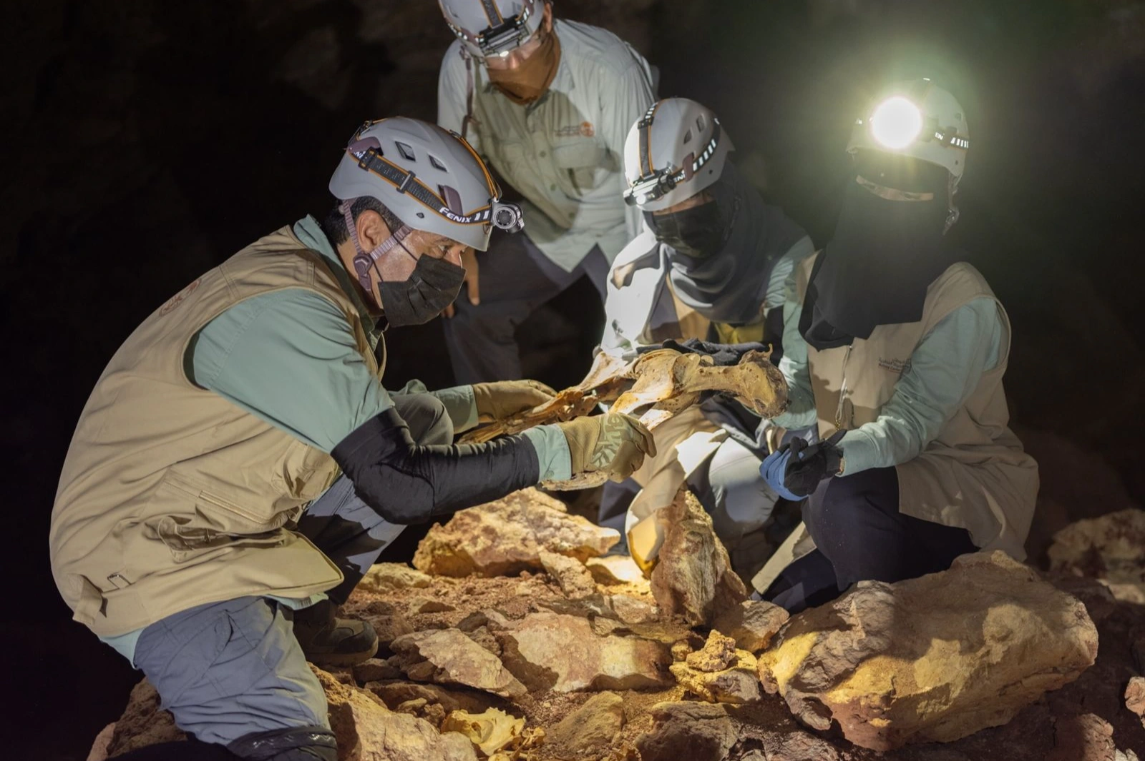
Researchers at the Saudi Arabian National Wildlife Center found seven mummified cheetahs in a network of remote caves while exploring for bats and insects. The discovery, made in 2022, surprised scientists because it had never been recorded that these felines lived in caves.
Carlos Duarte, an ecologist at the King Abdullah University of Science and Technology, stressed that at first it was not clear why there were cheetahs there. The animals were kept in perfect condition thanks to the dry, cool air and the darkness of the caves, with specimens around 130 years old and others almost 2000 years old
.
Along with the mummies, researchers recovered bone remains of more than 50 cheetahs, some dating back some 4000 years ago. This indicates that many generations of these felines used caves as a refuge and den
for millennia.
Genetic analysis The
team succeeded in sequencing the entire genomes from mummified tissue. The results, published in January 2026 in the journal Communications Earth & Environment, show that these cheetahs are closely related to the Asian and Northwest African subspecies, which still
survive.

Cheetahs became locally extinct in the Arabian Peninsula in the 1970s, victims of sport hunting and the loss of prey. They used to be icons of the region, given to kings and trained to hunt alongside humans
.
Today they occupy only 9% of their historical distribution and number about 7000 copies worldwide. The caves offered them shelter from the desert heat, where they also left the excrement and bones of
their prey.
Potential for conservation
Molly Cassatt-Johnstone, from the Paleogenomics Laboratory at the University of California at Santa Cruz, celebrated the finding as an enormous contribution to understanding a critically endangered subspecies. Paleogenomic data helps fill gaps in ecological and evolutionary history
.
For a long time it was thought that only the Asian subspecies inhabited Saudi Arabia. With less than 30 specimens alive in the wild, mainly in Iran, it is not feasible to use it to reintroduce them. On the other hand, the cheetah from northwestern Africa, with about 400 specimens and captive breeding programs, has greater potential
given their genetic similarity.
Duarte and his colleagues argue that these animals can be used to recover the population in Saudi Arabia. The government is already making progress in measures such as the breeding of prey such as the oryx and the creation of conservation areas
.
Future Challenges
Laurie Marker, from the Cheetah Conservation Fund, noted that there is great potential for the return of cheetahs, but warned that success will require long-term commitment
and sustained economic resources.
Although all five cheetah subspecies are adapted to open, dry environments, how they would thrive in the region's specific deserts remains to be seen. The same caves that protected their ancestors could once again serve as a refuge if the project progresses.
This finding not only illustrates the collapse of big cats in the area, but it also offers concrete tools for their possible recovery in the Arabian Peninsula.